Witwatersrand Gold Rush
George Harrison probably sold his claim for less than ten pounds. In July 1886, on a farm called Langlaagte near what would become Johannesburg, Harrison found gold in the Witwatersrand ridge -- either by accident or through deliberate prospecting, depending on which account you trust. He filed his claim with the government of the South African Republic, and then he left. Within a decade, the mining camp that sprang up around his discovery had become the largest city in South Africa, surpassing Cape Town, which had a two-hundred-year head start. Harrison vanished from the historical record with almost nothing to show for the fortune he had uncovered.
Secrets Under the Veld
Harrison was not the first to find gold on the Witwatersrand. In 1852, a Welsh mineralogist named John Henry Davis presented a gold find from the Pardekraal farm near Krugersdorp to President Andries Pretorius of the South African Republic. Pretorius understood immediately what the discovery could mean for his young republic and wanted no part of it. Davis was ordered to sell the gold -- worth 600 pounds -- to the Transvaal Treasury and was escorted to the border. A year later, Pieter Jacob Marais, who had dug gold in California, found deposits on the Jukskei River. He was warned that revealing the find to any foreign power would be punishable by death. The republic was trying to keep a secret that the geology of the Witwatersrand made impossible to contain.
The Rush That Built a City
Once Harrison's discovery was declared open in 1886, news traveled fast. Cecil Rhodes heard about it in Kimberley, over 400 kilometers away, and rode to the camp at Vogelstruisfontein with a team of companions. He purchased the first batch of Witwatersrand gold from prospector Jan Gerrit Bantjes for 3,000 pounds -- the founding transaction of Consolidated Gold Fields of South Africa. Prospectors poured in from Australia, California, and across Europe. The mining village of Ferreira's Camp became a formal settlement, though the government, skeptical that the gold would last, mapped out a cramped triangular plot for the new town. This is why Johannesburg's central business district has such narrow streets -- the city was designed to be temporary. It became the opposite. Within ten years, it was South Africa's largest city.
Randlords and Railways
The gold created a new aristocracy. The Randlords, as they became known, were the miners and industrialists who amassed fortunes from the Witwatersrand reefs. They built grand estates and mansions along the Parktown Ridge, establishing a corridor of wealth that still marks the Johannesburg landscape. The rush also demanded infrastructure. In 1888, the South African Republic granted a concession to the Netherlands-South African Railway Company to build a 25-kilometer line from Johannesburg to Boksburg. It opened on 17 March 1890 -- the first working railway in the Transvaal -- and became known as the Randtram, though it was a proper railway. Coal mines sprang up to feed the gold industry's hunger for fuel, and what had been empty veld transformed into an industrial corridor in barely a decade.
Gold, Dynamite, and War
President Paul Kruger of the South African Republic watched the influx of foreigners with growing alarm. The uitlanders, as they were called, threatened to outnumber the Boers. Kruger imposed heavy taxes on dynamite sales to foreign miners, a measure he discussed with Jan Gerrit Bantjes, whose father had educated Kruger during the Great Trek. The taxes infuriated the mining community and gave the British a convenient grievance. In 1895, the Jameson Raid -- funded by Cecil Rhodes and led by Leander Starr Jameson -- attempted to overthrow the Transvaal government and claim the gold fields for Britain. It failed spectacularly: of the 500 men who took part, 21 were killed and most of the rest arrested. But the underlying tensions did not resolve. The dispute between British mining interests and Boer sovereignty escalated into the Second Boer War in 1899, a conflict that reshaped the political map of Southern Africa.
The Golden Arc's Long Shadow
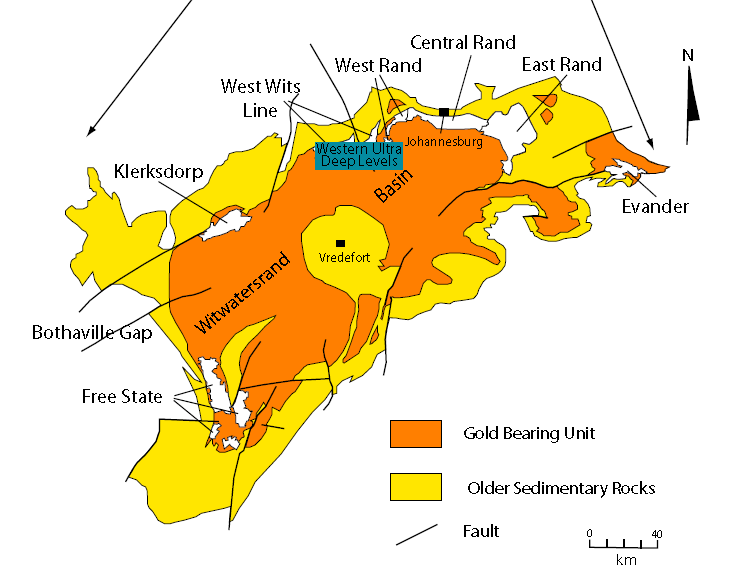
Scientists have since determined that the Witwatersrand deposits formed in what was once a massive inland lake, where silt and alluvial gold settled along a geological band stretching from Johannesburg to Welkom -- the so-called Golden Arc. The gold was ancient, the lake long gone, but the human consequences of the discovery continue to radiate outward. The mining industry's demand for cheap labor shaped the migrant worker system that would underpin apartheid. The wealth generated by the reefs concentrated in white hands while black miners lived in hostels far from their families. Johannesburg itself -- sprawling, unequal, energetic, and ungovernable -- is the gold rush's most enduring artifact, a city that exists because of a geological accident and a man who walked away from it for less than ten pounds.
From the Air
Located at 26.210S, 27.988E along the Witwatersrand ridge west of central Johannesburg. The ridge itself is visible from the air as a gentle east-west escarpment. Historic mine dumps -- distinctive flat-topped tailings mounds -- are scattered across the landscape south and west of the CBD, marking the locations of early gold mining operations. OR Tambo International Airport (FAOR) is approximately 30 km to the east. Lanseria International Airport (FALA) is about 25 km to the north. Viewing altitude: 5,000-10,000 feet AGL to see the full extent of the Witwatersrand mining belt.