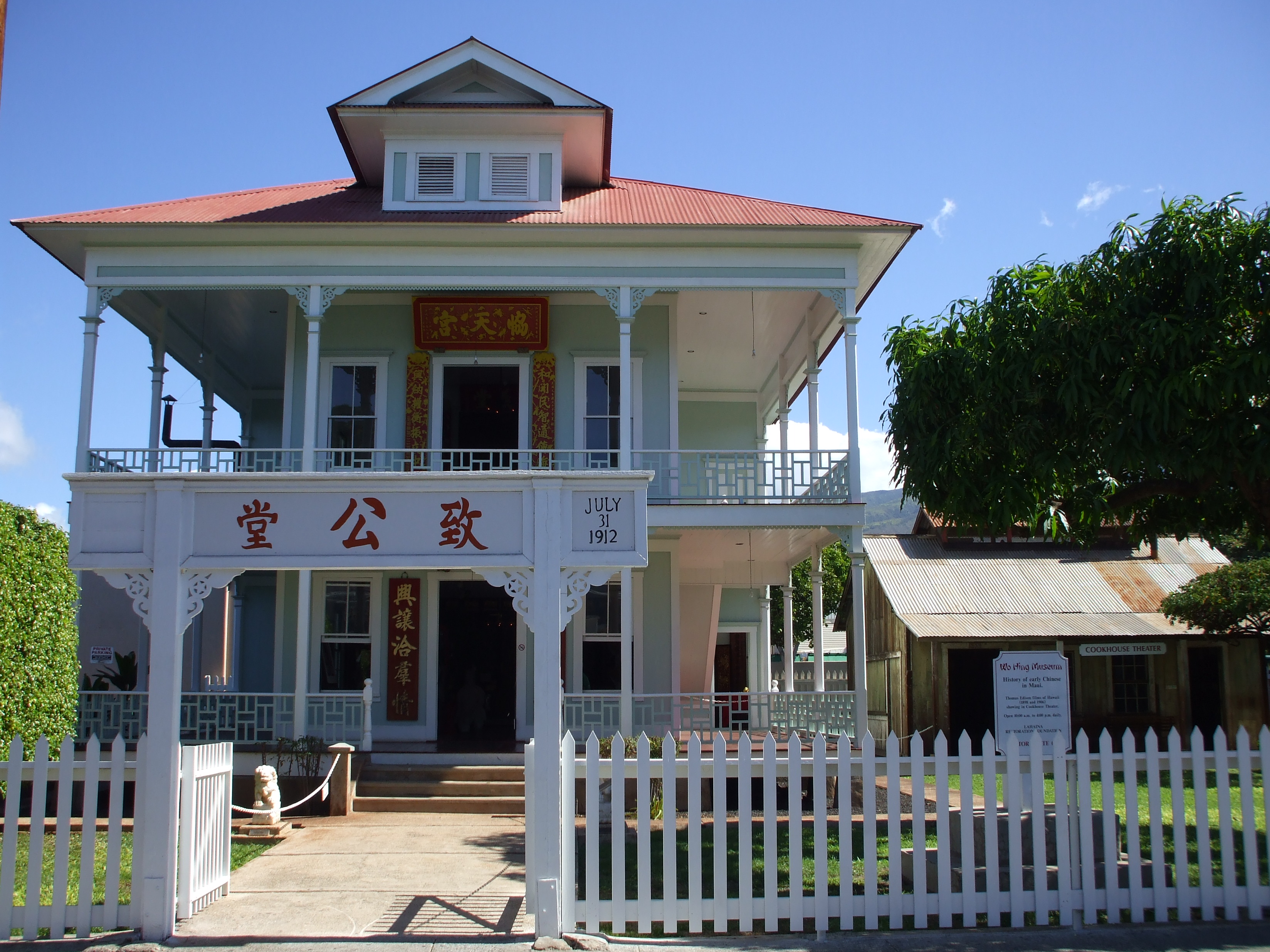
Wo Hing Society Hall
On the second floor of 858 Front Street in Lahaina, an altar to Lord Guan once presided over a room thick with incense and memory. Flanked by guardian deities and an ancestral shrine, it was the spiritual heart of the Wo Hing Society Hall, a fraternal building erected in 1912 by Chinese laborers who had come to Maui's sugarcane fields and decided to stay. For over a century, the hall stood as one of only two surviving Chinese Society Halls on all of Maui. In August 2023, the wildfire that devastated Lahaina took it, along with so much else.
Strangers in the Cane Fields
The story begins in 1852, when Chinese men arrived in Hawaii to work the sugarcane plantations. They came mostly as single men, bound by labor contracts to an industry that would define the islands for generations. When those contracts expired, some returned to China. Others stayed, taking up new trades in a place that was impossibly far from home. Distance from the mainland created an acute need for community, and Chinese Tong societies emerged to fill it. These were not the criminal organizations the word sometimes conjures on the mainland. They were mutual aid organizations, providing religious services, political support, friendship, and the crucial promise that when a member died, his burial would be handled with dignity.
A Hall of Their Own
Around 1909, the Chinese community in Lahaina formed the Wo Hing Society as an offshoot of the Chee Kung Tong. Using private donations, they erected their hall in 1912 on Front Street, right in the center of Lahaina's historic district. The building was modest in scale but rich in purpose. The ground floor served as a gathering place; the second floor housed the altar room, where Lord Guan, the deity of righteousness and loyalty, watched over the community. A separate cookhouse stood nearby, the kind of practical, communal space where rice steamed and conversation flowed in Cantonese. The hall became a place where men far from home could find something resembling it.
Decline and Resurrection
By the 1940s, the Chinese population in Lahaina was thinning. Younger generations pursued opportunities in Honolulu, and the hall fell into disrepair. Termites and rot did what time always does to neglected wood in a tropical climate. For decades, the building deteriorated, though it was considered one of the finest surviving Chinese Tong Society Halls in all of Hawaii. Then, in 1982, the building was placed on both the Hawaii State Register and the National Register of Historic Places. The Lahaina Restoration Foundation partnered with the Wo Hing Society itself, and by 1984 the restored building reopened as the Wo Hing Museum, its altars and cookhouse once again visible to the public. Visitors could walk through and glimpse a side of Hawaiian history that tourist brochures rarely mention.
What the Fire Took
On August 8, 2023, wind-driven wildfires swept through Lahaina with a speed and ferocity that overwhelmed every defense. The Wo Hing Society Hall, along with much of the Lahaina Historic District, was destroyed. The altars, the cookhouse, the founders' portraits of Chung Koon You and Chan Wa, the plaque marking it as Site 41 of the Lahaina Restoration Foundation -- all of it burned. What remains is the story itself: of men who crossed an ocean to cut sugarcane, who built a place to honor their gods and bury their dead, and who left behind a building that outlasted them by generations. The hall's loss is part of a larger grief that Lahaina is still processing, but the community it served -- and the resilience it represented -- endures in the people who carry that history forward.
From the Air
Located at 20.881N, 156.683W on Front Street in the Lahaina Historic District, west coast of Maui. Best viewed from low altitude approaching from the ocean side. The former site sits along the waterfront strip that bore the brunt of the 2023 wildfire. Nearest airport is Kapalua Airport (PHOG/OGG - Kahului Airport is the main commercial field, approximately 25 nm east). The West Maui Mountains rise dramatically behind the town.