The Dream That Burned Before Dawn
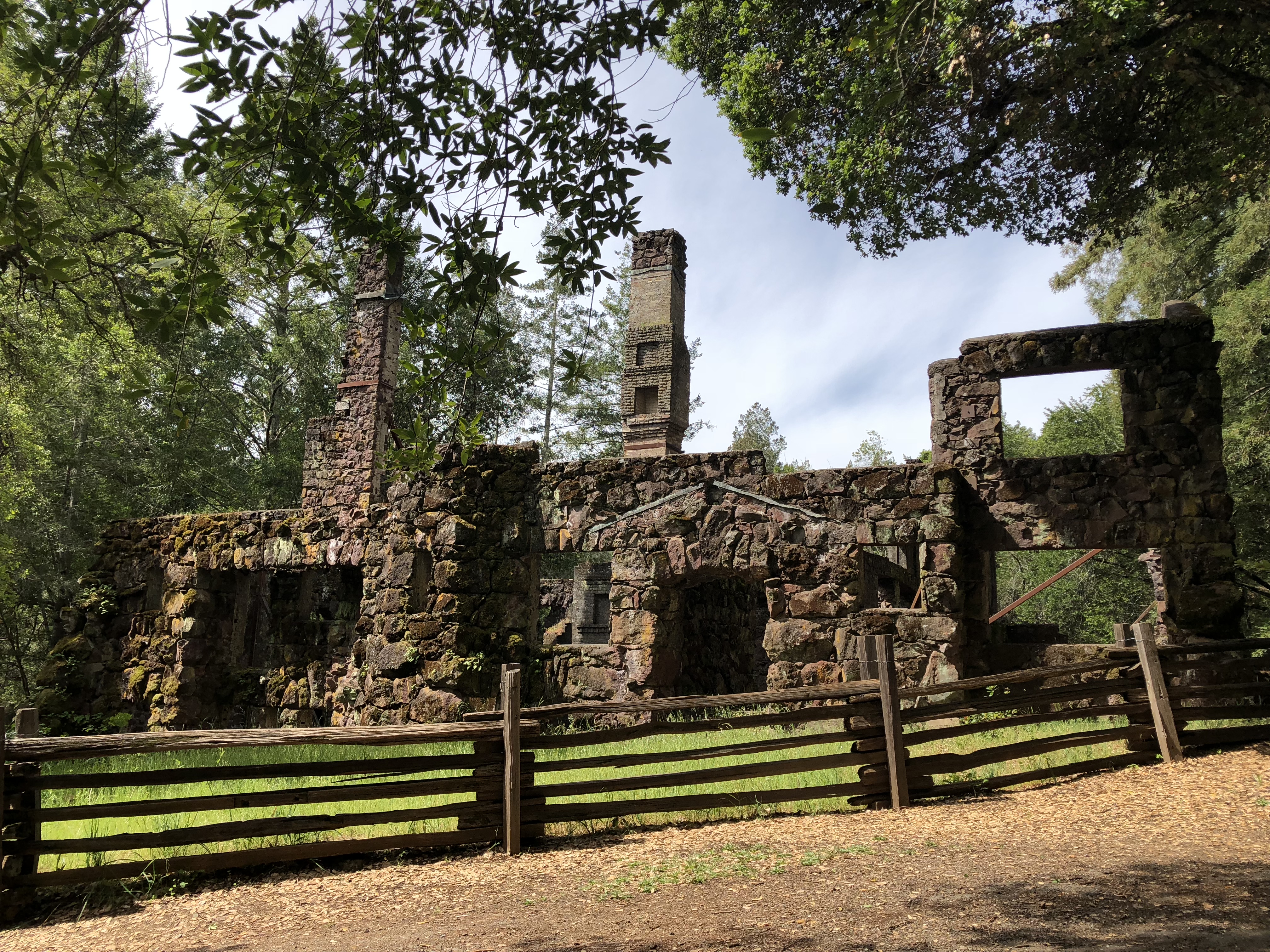
Jack London never spent a single night in Wolf House. He had spent years planning it, poured a fortune into building it, and imagined growing old inside its walls -- but on August 22, 1913, just weeks before the Londons were to move in, the 26-room mansion caught fire and burned. What remained the next morning were the stone walls and chimneys of a house that had been fully built and never occupied, a monument to ambition interrupted at the threshold. The ruins still stand in the Sonoma Valley hills near Glen Ellen, surrounded by the oaks and madrones of what is now Jack London State Historic Park, designated a National Historic Landmark in 1963. They are among the most eloquent ruins in California -- not because of what they were, but because of what they almost became.
The House Beautiful
London began articulating his vision in 1906, in an essay called "The House Beautiful" published in his 1909 collection Revolution and Other Essays. "Utility and beauty must be indissolubly wedded," he wrote, insisting that a home should be "honest in construction, material and appearance." He described modern bathrooms, generous servants' quarters, easy maintenance, good ventilation, and ample fireplaces. He predicted he would build the house within seven to ten years. By then, London had already purchased a 130-acre farm in the Sonoma Valley -- around 1905 -- and was steadily acquiring adjoining parcels until the property stretched to approximately 1,200 acres of cultivated land and wooded hillsides. He called it Wonder Ranch, a name that captured his sense that the land itself was extraordinary, even before anything was built upon it.
Farr's Masterwork in Stone and Redwood
To design Wolf House, London hired Albert L. Farr, a San Francisco architect and leading exponent of the Arts and Crafts movement in California. Farr's design was described as "rustic and individualistic" -- a phrase that could equally describe its patron. The house featured a library, a two-story living room, and amenities that were remarkably forward-looking for 1910: a water heater, electric lighting, refrigeration, a built-in vacuum cleaning system, laundry facilities with a steam dryer rotary wringer, and a wine cellar. The materials were volcanic boulders gathered from the ranch and unpeeled redwood logs, giving the structure a quality of having grown from the hillside rather than being placed upon it. At 26 rooms, Wolf House was massive, but its scale was meant to serve London's vision of a working estate -- a home for a writer who was also a rancher, a host, and a man who believed architecture should express how its owner actually lived.
Ashes on the Threshold
The fire's cause has never been definitively established. Some investigations pointed to spontaneous combustion of linseed-oil-soaked rags left by workers. Others speculated about arson, though no evidence was ever produced to support the claim. What is certain is that the blaze consumed the wooden elements -- the redwood logs, the interior finishes, the roof -- while leaving the massive stone walls and chimneys standing like a skeleton stripped of everything soft. Financial losses were estimated between $35,000 and $40,000, enormous for the era. London held several insurance policies on the home and collected $10,000 in claims. The National Union Fire Insurance Company later featured a thank-you letter from London in its advertising -- a peculiar testimonial, the famous author grateful for being partially compensated for the destruction of his dream.
The House of Happy Walls
London died just three years after the fire, in 1916, at age forty. He never rebuilt Wolf House, though he spoke of doing so. His wife Charmian continued living on the ranch -- which they had called Beauty Ranch -- until her death in 1955. She eventually settled into a home she named the House of Happy Walls, built about half a mile from the Wolf House ruins. There, she devoted herself to protecting her husband's literary legacy and writing a biography of him. Her home is now a museum within Jack London State Historic Park. The contrast between the two structures tells its own story: the grand ruin that was never inhabited, and the modest house where a life was actually lived. Visitors today walk a trail through the forest to reach the Wolf House ruins, where stone walls still frame doorways that open onto nothing but sky and oak branches. It is a place where the distance between intention and fate is measured in walls that stand and roofs that do not.
From the Air
Located at 38.351N, 122.543W in the hills above Glen Ellen, in the Sonoma Valley. The Wolf House ruins and Jack London State Historic Park sit on a wooded hillside visible as dense forest cover east of Glen Ellen along Arnold Drive. Nearest airports: Charles M. Schulz-Sonoma County Airport (KSTS) approximately 10 nm northwest, and Napa County Airport (KAPC) roughly 15 nm east. Sonoma Mountain rises to the southwest. The park's cleared areas and vineyard-adjacent meadows may be visible from moderate altitude, though the ruins themselves are concealed beneath heavy tree canopy.