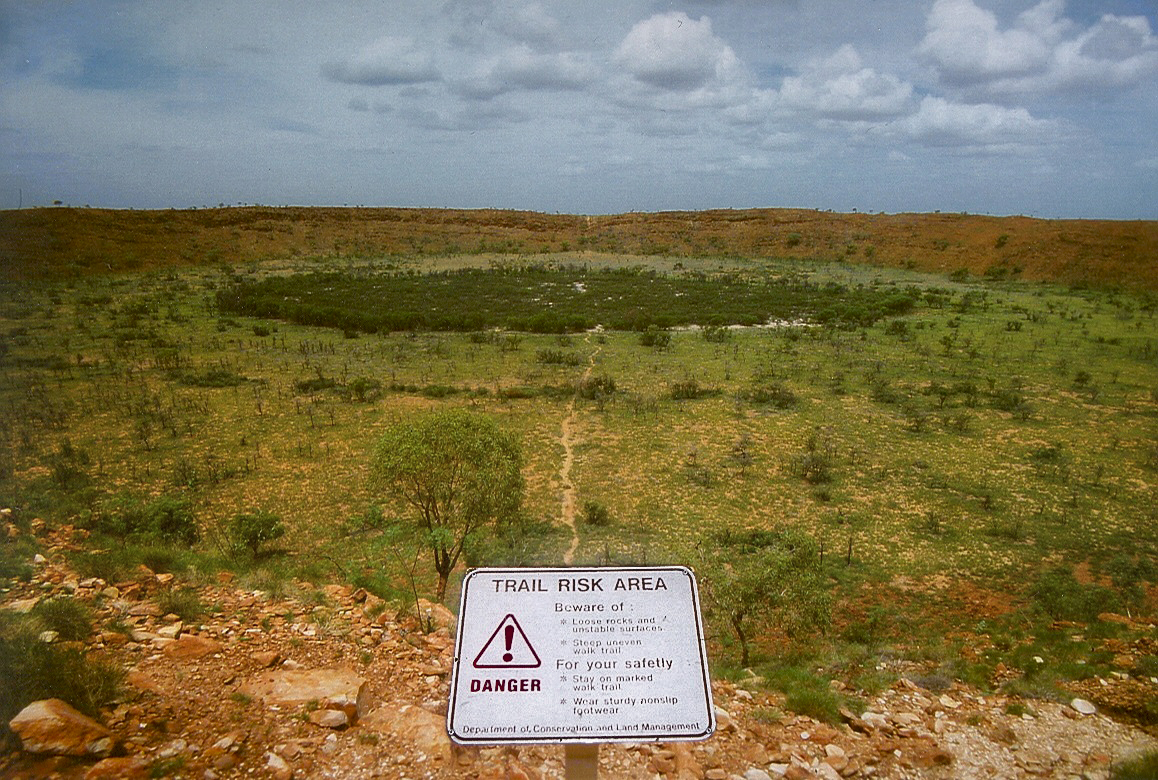
Wolfe Creek Crater
The Djaru people tell a story about the night the crescent moon and the evening star passed too close to each other. The evening star grew so hot that it fell from the sky, striking the earth with an explosion and a flash that sent a dust cloud billowing across the desert. A long time passed before anyone dared approach the site. When they finally did, they named the place Kandimalal, and it has been prominent in Djaru art ever since. Western science arrived at the same spot by a different route: an aerial survey in 1947 spotted an almost perfectly circular depression in the Great Sandy Desert of Western Australia, and within two months a ground team confirmed what the Djaru had known for generations. Something had fallen here.
A Scar That Barely Ages
Wolfe Creek Crater averages about 875 metres in diameter and drops 60 metres from rim to floor. It is, by most assessments, the second most obviously preserved meteorite impact crater on Earth, after Arizona's Barringer Crater. Where Barringer sits in arid desert that slowed erosion, Wolfe Creek benefits from the same advantage -- the Great Sandy Desert's dry climate has kept the crater's walls sharp and its bowl intact for what researchers now estimate to be less than 120,000 years. That figure, established in 2019 by a team from the University of Portsmouth working with Australian and US researchers, revised earlier estimates of 300,000 years significantly downward, placing the impact squarely in the Late Pleistocene. For a hole nearly a kilometre across, it is remarkably young.
Iron From the Sky
Small fragments of iron meteorite have been recovered from the area around the crater, physical evidence of the object that carved it. More unusual are the so-called shale-balls found nearby -- rounded objects made of iron oxide, some weighing as much as 250 kilograms, formed from the meteorite's material as it weathered over millennia. The crater sits within the Wolfe Creek Meteorite Crater National Park, accessed via the Tanami Road, 150 kilometres south of the town of Halls Creek. Its European name comes from a nearby creek named after Robert Wolfe, a prospector and storekeeper during the gold rush that established Halls Creek. Early reports consistently misspelled it as Wolf Creek -- a mistake that would later become famous for entirely different reasons.
Where Science Met Story
The crater was first brought to scientific attention when it appeared in a 1947 aerial survey. A ground investigation followed two months later, and the first publication describing the site appeared in 1949. Since then, Wolfe Creek has been studied extensively. Researchers have found shocked quartz in the crater walls -- a mineral signature created only by the extreme pressures of an impact event. Gravity surveys have mapped the deep structure beneath the crater floor. Stable isotope studies have examined the vegetation patterns that have colonised the crater's interior, where a narrow savanna-woodland ecotone has formed in the bowl's sheltered microclimate. For geologists, the crater is a natural laboratory, its preservation allowing them to study impact mechanics in detail that more eroded craters cannot offer.
Kandimalal in Culture
For the Djaru, Kandimalal is more than a geological feature. The story of the evening star's fall is a Dreaming narrative embedded in the cultural landscape of the Great Sandy Desert, and the crater features prominently in regional Aboriginal art. In Western popular culture, the crater took on a different kind of notoriety when the 2005 Australian horror film Wolf Creek used it as a setting, followed by a 2013 sequel and a television series on the Stan streaming platform. Arthur Upfield set his 1962 novel The Will of the Tribe at the crater. These fictional associations, built on the crater's genuine remoteness and the unsettling perfection of its shape, have made Wolfe Creek one of the more recognisable place names in outback Australia -- even among people who could not find it on a map.
The Desert's Signature
Approaching Wolfe Creek from the air resolves a question that ground-level visitors cannot easily answer: how perfect is this circle, really? The answer, from altitude, is startling. The crater's rim traces a near-perfect ring against the red-brown desert, its interior slightly greener where moisture collects and vegetation takes hold. There is no ambiguity about what made this shape. No geological process -- no volcanic caldera, no sinkhole, no wind erosion -- produces this geometry. Only an object falling at thousands of metres per second and releasing energy equivalent to a nuclear detonation leaves a signature this clean. The Djaru understood it as a cosmic event. Geologists confirm it. From a flight path above the Tanami Road, Kandimalal makes its case without argument.
From the Air
Located at 19.17S, 127.80E in the Great Sandy Desert, 150 km south of Halls Creek, Western Australia. The crater is spectacularly visible from altitude -- an 875-metre-diameter near-perfect circle in flat desert terrain. Best viewed from 5,000-15,000 ft where the full circular rim is clearly defined. Nearest airport is Halls Creek (YHLC). The Tanami Road is visible as a track running nearby. The crater's interior shows slightly greener vegetation than the surrounding desert.