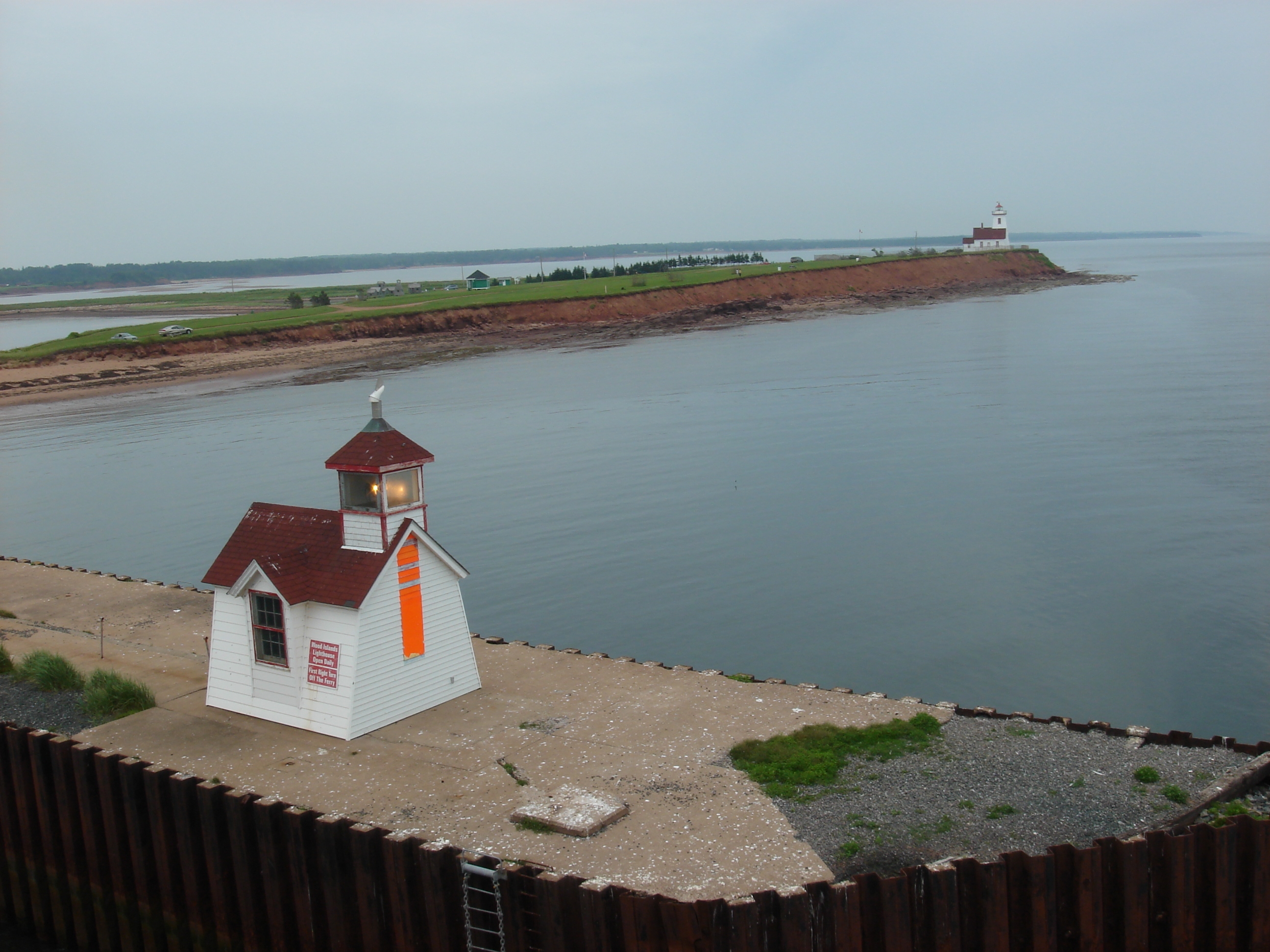
Wood Islands Lighthouse
The first contractor quit. Archibald MacKay of New Brunswick signed on to build a lighthouse at Wood Islands in 1875, made little progress, and abandoned the job entirely. It fell to Donald MacMillan, a local master carpenter who understood both the red sandstone coastline and the urgency of the work, to finish what MacKay could not. By the autumn of 1876, a white-shingled tower topped with a red iron lantern stood on the southeastern shore of Prince Edward Island, its beam sweeping across the Northumberland Strait for the first time on November 1 of that year.
A Light Through Dense Woods
Reaching the lighthouse in its early decades was nearly as challenging as building it. The tower stood on a small island off the southeast shore, accessible only through dense forest and along the beach from well to the west. Keepers and their families followed a track running south down what is now Pioneer Cemetery Road, crossing a sand bar to reach the light's isolated corner. When that path was eventually lost to shifting terrain, a new approach was carved from McLeod Road. Over the years, harbour improvements and the construction of the Wood Islands ferry terminal slowly connected the once-separate island to the mainland shore, transforming a place of solitude into a point of connection.
Sentinel of the Strait
For its first six decades, the lighthouse served as a navigation aid for marine traffic crossing the Northumberland Strait and for fishing boats working the waters around Wood Islands Harbour. That role expanded in 1941, when Northumberland Ferries Limited began seasonal service between Wood Islands and Caribou, Nova Scotia. The light became the first thing ferry passengers saw of Prince Edward Island -- a white tower with its red roof catching the afternoon sun. Canadian Parliament had appropriated six thousand dollars for the original construction in 1874, purchasing the site from Thomas McMahon the following year. Modest investments continued: in 1950, the keeper's dwelling received a new kitchen, and in 1958, electricity finally reached the station. The fixed light gave way to a revolving flash powered by a 1000-watt airway beacon lamp, a pattern still in use.
The Last Keeper's Family
Wood Islands holds a quiet distinction among Prince Edward Island's lighthouses. It was one of the last three on the island to be fully automated, and the very last where a keeper and his family actually lived in the attached dwelling. The three-storey tower and its adjoining residence formed a single household -- a workplace and a home inseparable from each other, shaped by the rhythms of tides and fog and the responsibility of keeping the light burning. When automation finally came, a generator and fog alarm equipment were installed in 1984, ventilators replaced windows, and a halon fire alarm system was added. A balcony was built to house the fog alarm equipment. The keeper's era was over.
From Keeper's Quarters to Living Museum
Today the lighthouse and residence operate as a museum. Visitors walk through exhibits on the history of Prince Edward Island's lighthouses, the ferry service that has connected the island to Nova Scotia for over eight decades, and the fishing communities that once relied on lights like this one for safe passage home. A 1950s-era kitchen has been preserved in the keeper's quarters, offering a glimpse of domestic life shaped entirely by the demands of the light. The red roof still contrasts sharply against the white-shingled exterior, and the observation deck with its white railing still frames the view across the strait. From the water, or from the air, it looks much as it did when MacMillan's Island craftsmen finished their work a century and a half ago.
From the Air
Located at 45.950N, 62.746W on the southeastern tip of Prince Edward Island. The white lighthouse with red roof is visible against the coastline when approaching from over the Northumberland Strait. The Wood Islands ferry terminal is adjacent, with ferries crossing to Caribou, Nova Scotia. Nearest airport is Charlottetown Airport (CYYG), approximately 55 km northwest. Best viewed at 1,500-2,000 ft AGL following the island's south shore.