Wooden churches of Maramureș
The prohibition was simple: no stone churches for Orthodox believers. The Austro-Hungarian Catholic authorities who controlled Maramures from the 17th century onward enforced this rule as a matter of religious dominance. The response was magnificent defiance. Across the valleys of northern Transylvania, Romanian craftsmen raised churches entirely from timber -- thick oak logs, fitted with flush joints and sealed walls so precise they kept weather out for centuries. Then, as if to compensate for the humble material, they crowned each building with a bell tower so tall and slim it seemed to pierce the sky. Nearly a hundred of these wooden churches still stand today, roughly a third of the number that existed two centuries ago. Eight were inscribed as UNESCO World Heritage Sites in 1999.
Carpenters Who Were Not Peasants
The craftsmen who built Maramures's churches were specialists, not simple villagers who happened to own tools. From the Middle Ages through the 18th century, at least two main family schools of church carpenters operated in the region, their techniques passed down through generations. Researchers have traced three principal itineraries these builders followed as they moved from village to village, and numerous smaller routes, each indicating the work of a particular master or lineage. The skills they carried -- building ample log structures with perfectly planed, well-sealed walls and flush joints -- represented knowledge out of the ordinary, closer to the guild traditions of European cathedral builders than to the vernacular carpentry of farmhouses. These men built exclusively for worship, and their work shows it in every precisely fitted beam.
Towers That Dwarf Their Own Churches
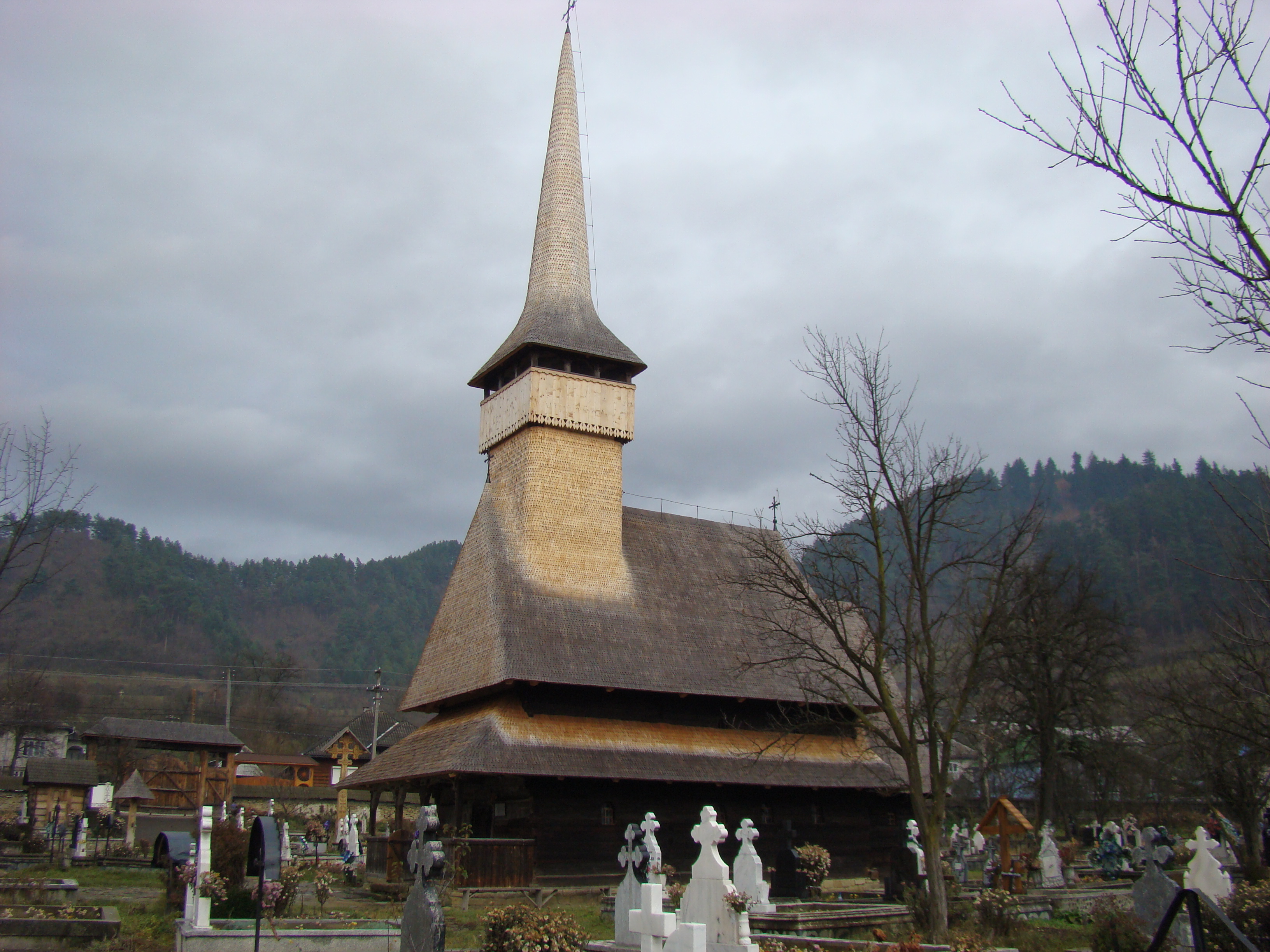
Stand inside one of these churches and you notice the darkness first. Some are quite small, their interiors painted with Biblical scenes in a naive folk style by local artists -- vivid, sincere, and sometimes startling in their interpretive freedom. But step outside and look up, and the proportions become almost surreal. The most characteristic feature of a Maramures church is the massive roof and the extraordinarily tall, slim tower above the western entrance. The tower dwarfs the main body of the building, an effect that reads from a distance as a wooden needle rising from the valley floor. The church at Surdesti holds the distinction of having one of the tallest wooden structures in Europe. These towers were bell towers, but they were also declarations -- visible proof that a community's faith could not be diminished by a decree banning stone.
Eight Valleys, Eight UNESCO Sites
The surviving churches are scattered across river valleys that cut through the Carpathian foothills: the Iza, the Mara, the Cosau, the Viseu, the Lapus. In 1999, UNESCO selected eight as World Heritage Sites for their outstanding religious architecture and timber construction traditions. These are the churches at Barsana, Budesti, Desesti, Ieud, Plopis, Poienile Izei, Rogoz, and Surdesti. The Ieud Hill Church, known as Ieud Deal, is among the oldest surviving wooden churches in Romania. The church at Desesti is dedicated to Saint Parascheva. Each represents a different solution to the same challenge: how to create sacred space from logs alone. The tradition of building in wood was not unique to Maramures -- wooden churches appear throughout the Carpathians, from Poland to Ukraine -- but nowhere else in Europe did the tradition produce structures of this ambition or refinement.
A Living Museum That Keeps Building
Maramures is often described as the closest thing to a living museum that exists in Europe. Traditional dress -- colorful embroidered garments -- is still worn for church services, not performances. Hay is still cut and stacked by hand in some villages. The wooden gates that mark property entrances are carved with motifs that date back centuries. After the Romanian Revolution of 1989, which ended decades of Communist rule, new churches began rising in the old timber style. This was not nostalgia but continuity. Senior carpenters still possess the knowledge and skills of traditional construction, and they still train apprentices. The region was partitioned between Romania and what is now Ukraine's Zakarpattia Oblast after World War I, and wooden churches survive on both sides of the border -- a shared heritage divided by a political line that the builders never anticipated.
From the Air
Located at approximately 47.82N, 24.06E in the Maramures region of northern Romania, near the Ukrainian border. The churches are distributed across multiple river valleys in the Carpathian foothills. Their tall, slim wooden spires are visible from low altitude against the green valleys. Best viewed at 3,000-5,000 feet AGL to appreciate the distribution pattern across valleys. Nearest airport: Baia Mare Airport (LRBM), approximately 30 km west. The churches at Surdesti, Barsana, and Ieud are among the most visually prominent from the air.