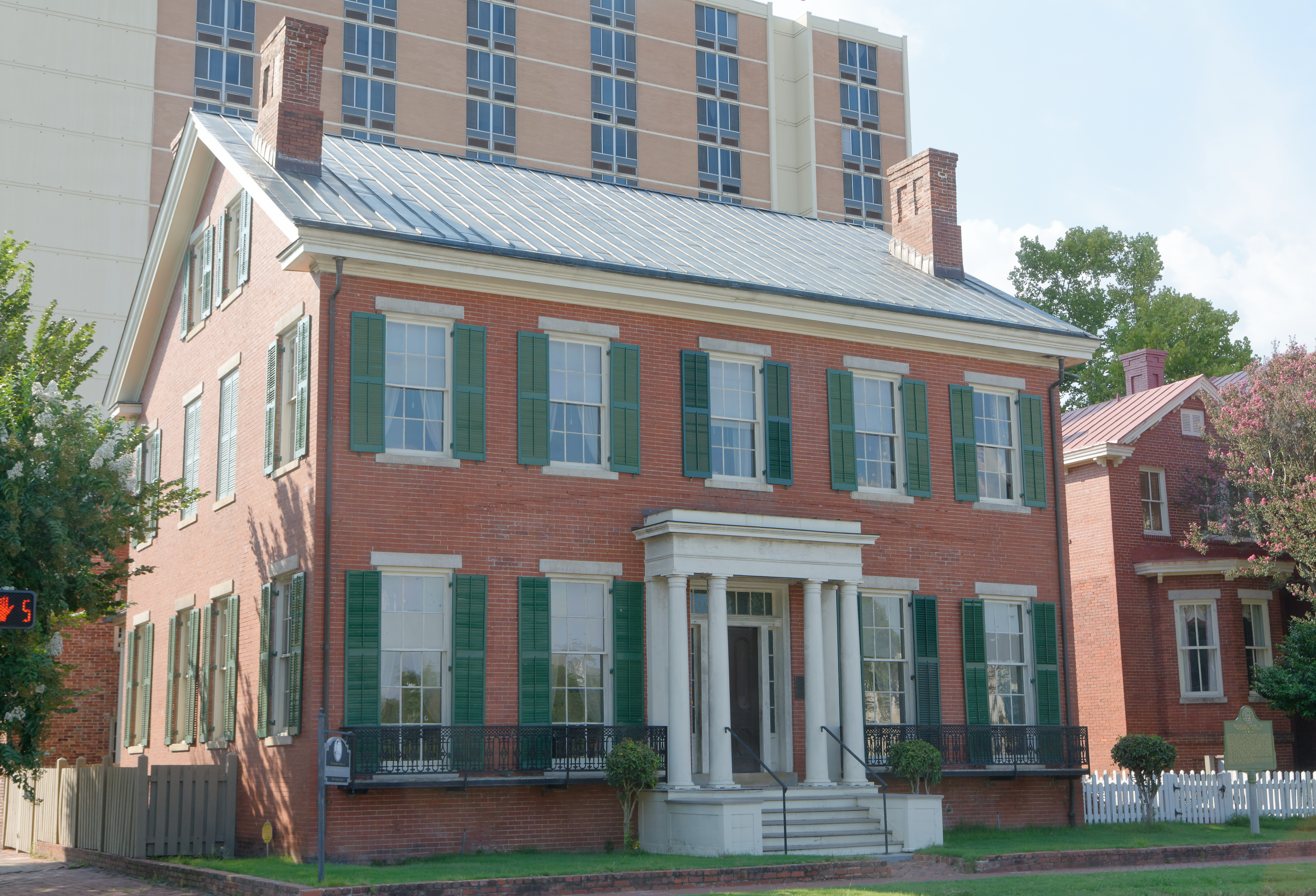
Woodrow Wilson Boyhood Home
Woodrow Wilson's earliest memory was standing at his father's gateway in Augusta, Georgia, four years old, and hearing someone pass by and say that Mr. Lincoln had been elected and there was to be war. That gateway still stands at 419 7th Street, attached to a two-story brick house built in 1859 as the manse for First Presbyterian Church. The boy who overheard that fragment of news -- and who would spend the next decade watching the Civil War and its aftermath unfold from these rooms -- grew up to lead the nation through a world war of his own and propose the League of Nations.
The Preacher's Son
Joseph Ruggles Wilson arrived in Augusta in January 1858 to take the pulpit at First Presbyterian Church, bringing his wife, Janet, and their young son, Thomas Woodrow Wilson -- called Tommy by the family. The Wilsons first lived in the church manse on Greene Street before the congregation purchased a new house at 53 McIntosh Street (now 419 7th Street) directly across from the church. The two-story brick structure, with its paired Tuscan columns framing the entrance, its side gable roof, and its end chimneys, became the backdrop for nearly thirteen years of Wilson's childhood. One bedroom window still bears the name "Tom" etched into the glass, believed to have been scratched there by the boy himself.
A Childhood Shaped by War
The Civil War turned the Wilson household upside down. First Presbyterian Church, just across the street, was commandeered by the Confederacy as a hospital after the Battle of Chickamauga sent waves of wounded soldiers to Augusta by train. The young Wilson saw dying men in his father's sanctuary and Union prisoners held in the churchyard. In 1865, after the Confederacy's collapse, the nine-year-old watched Jefferson Davis marched through Augusta's streets under Union guard on the way to prison. These were not abstract history lessons. They were sights and sounds absorbed through the windows of the manse, shaping a boy who would later write extensively about the nature of government, democracy, and the terrible cost of conflict.
The Lightfoot President
Not every memory was grim. By 1870, the thirteen-year-old Wilson founded the Lightfoot Baseball Club and installed himself as president, drafting bylaws and requiring members to practice parliamentary procedure. It was an early flash of the organizational instinct and insistence on rules that would define his political career. The house at 7th Street was where Wilson learned to read -- reportedly not until age nine, a late start that some biographers attribute to the disruptions of war. Augusta gave Wilson his formative years: the preacher's study where his father drilled him in rhetoric, the church across the street where he absorbed the cadences of Presbyterian sermons, and the streets of a Southern city rebuilding itself after defeat.
Saved and Restored
After the Wilson family left Augusta in 1870, the house passed through various hands and uses. By the late twentieth century, the building was deteriorating. Historic Augusta, Inc. purchased the manse at public auction on March 23, 1991, and launched a restoration that cost over two million dollars. Specialists analyzed original paint layers to determine the 1860s wall colors. Artisans regrained doors and remarbleized mantles. Thirteen original furnishings from the Wilson family's residence, loaned by First Presbyterian Church, were returned to their rooms. The adjacent Joseph R. Lamar Boyhood Home -- once the childhood residence of a future Supreme Court Justice -- now serves as the visitors center. On October 6, 2008, the house was designated a National Historic Landmark, recognized as the oldest presidential residence in the state of Georgia.
Two Houses, One Corner
The intersection of Telfair and 7th Streets in downtown Augusta holds an improbable concentration of American history. On one corner stands the manse where a future president spent his boyhood. Next door is the house where Joseph Rucker Lamar, who would serve on the U.S. Supreme Court, grew up. Diagonally across the street rises First Presbyterian Church, where the elder Wilson preached and where Confederate wounded once filled the pews. Behind the manse, a service building and carriage house built of the same load-bearing brick still stand, anchoring the property to its antebellum origins. The interior, restored to its circa-1860 appearance, is decorated with period furnishings and Wilson memorabilia, offering visitors a window into the daily life of a Southern household during the most turbulent era in American history.
From the Air
The Woodrow Wilson Boyhood Home is located at approximately 33.472N, 81.965W, in downtown Augusta, Georgia. The house sits at the corner of Telfair and 7th Streets, near the distinctive steeple of First Presbyterian Church, which is a useful visual landmark. Best viewed at 1,500-2,500 feet. Nearest airports: Daniel Field (KDNL) 3nm west, Augusta Regional Airport at Bush Field (KAGS) 7nm south. The Savannah River and Augusta's grid street pattern are clearly visible from altitude.