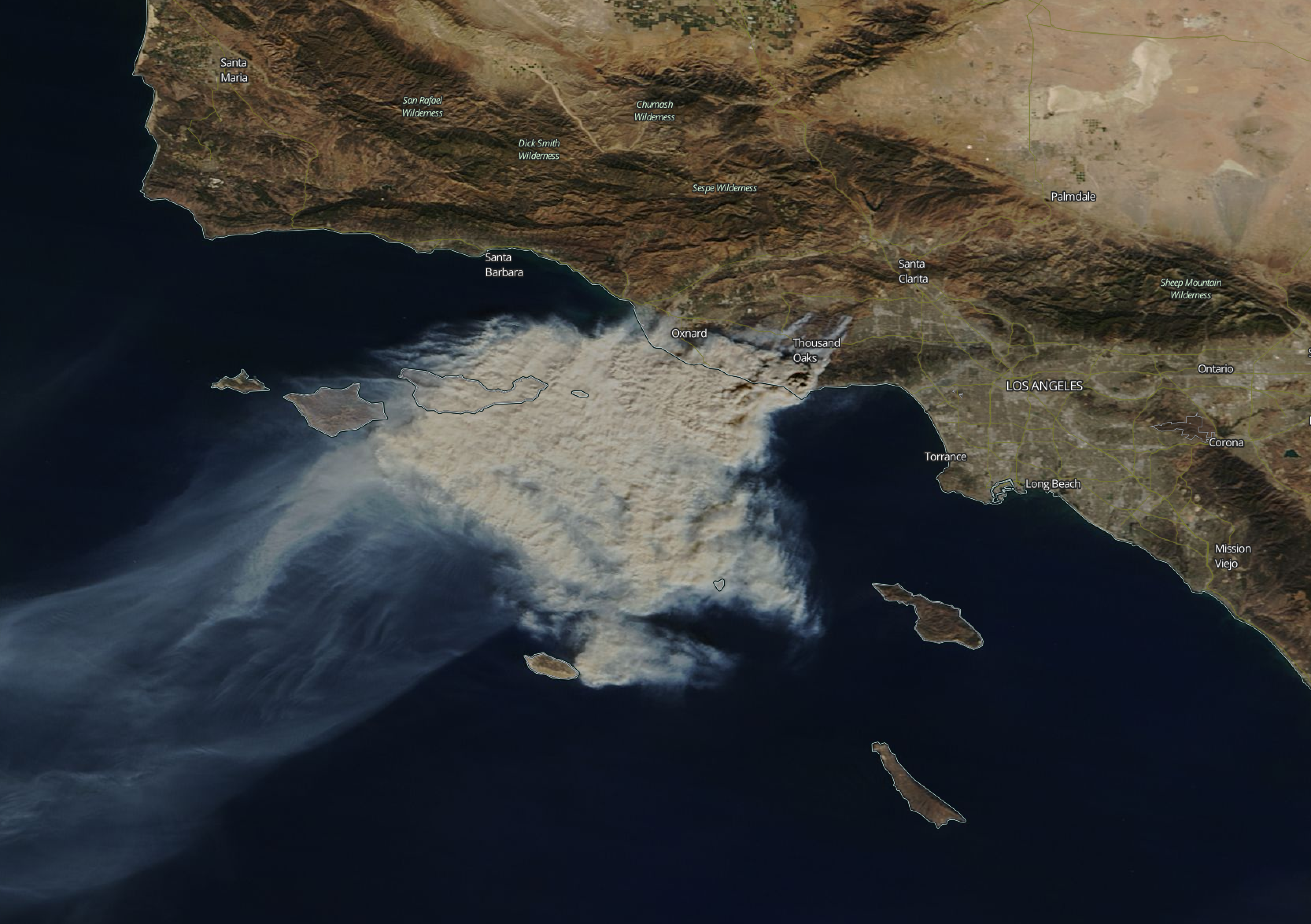
Woolsey Fire
Two minutes. That was the gap between the power outage and the first flames. At 2:22 p.m. on November 8, 2018, Southern California Edison reported an electrical problem on the Big Rock 16kV circuit at the Santa Susana Field Laboratory. At 2:24 p.m., brush fire. By nightfall, the Woolsey Fire had become an unstoppable monster driven by Santa Ana winds, racing toward the Pacific through some of the most expensive real estate in America.
When the Wind Became the Enemy
The Santa Ana winds arrived like an invading army. Gusting at speeds that grounded firefighting aircraft until 5 a.m. the next morning, they pushed the fire south through steep chaparral-covered canyons at a pace no human effort could match. The Ventura County Fire Department, already stretched thin fighting the Hill Fire near Newbury Park, sent just three firefighters in the first engine. A private fire crew contracted to protect Boeing's nearby facility never arrived because their engine broke down. By the time aerial support could safely deploy, the fire had already crossed the Ventura Freeway and was tearing through Liberty Canyon toward the sea.
Hollywood Burns
The flames found targets that seemed almost too symbolic to be real. Paramount Ranch, where Western movies had been filmed since 1927 and HBO's Westworld had recently wrapped shooting, burned to the ground. The Peter Strauss Ranch went next. Then the former Reagan Ranch, now part of Malibu Creek State Park. Even the Bachelor Mansion, Villa De La Vina, lost its lower house. The fire didn't discriminate between celebrities and working families, between billion-dollar estates and the drug rehabilitation centers that had earned Malibu the nickname 'Rehab Riviera.' At least two of those facilities were destroyed. Three beloved Jewish summer camps were almost completely devastated.
The Beach as Ark
At Zuma Beach, one of the strangest scenes in California wildfire history unfolded. Local fire officials had designated it an evacuation point for large animals, and soon llamas stood tied to lifeguard stations, alpacas huddled near poles, and horses waited beside beach chairs while smoke darkened the sky behind them. The Los Angeles Times captured images that seemed pulled from magical realism: apocalypse on the sand, hoofprints in the surf. Meanwhile, Pepperdine University's fire mitigation measures proved their worth, with students sheltering in place on campus while flames burned all around them.
The Cost of Thirteen Days
When containment finally reached 100 percent on November 21 at 6:11 p.m., the numbers told the story of devastation: 1,643 structures destroyed, 364 damaged, three people dead, over 295,000 evacuated, and at least six billion dollars in property damage. The fire had burned 88 percent of the federal parkland in the Santa Monica Mountains National Recreation Area. Thirteen radio-collared mountain lions had been in the fire's path. One, known as P-74, died in the flames. Another, P-64, was found dead shortly after with burnt paws. The scars would take years to heal, for the land and for the families who lost everything.
A Ghost from 1959
The fire began on the grounds of the Santa Susana Field Laboratory, a site haunted by its own history. In 1959, a partial nuclear meltdown occurred there, and decades of rocket engine testing had left contamination that was still being cleaned up. When the Woolsey Fire swept through, some worried that radioactive and toxic materials might have become airborne. State investigators ultimately found no evidence of widespread contamination, but a 2021 study discovered that two locations did contain elevated levels of radioactive isotopes associated with the field laboratory. The fire had disturbed more than earth and chaparral; it had stirred up the buried secrets of Cold War-era nuclear experimentation.
From the Air
Located at 34.235N, 118.701W in the Santa Monica Mountains between the San Fernando Valley and Malibu. From the air, the burn scar remains visible years later as lighter-colored vegetation. Best viewed approaching from the Pacific at 3,000-5,000 feet. Van Nuys Airport (KVNY) lies 15nm northeast. Camarillo Airport (KCMA) is 25nm northwest. The fire's path traced a dramatic corridor from the Simi Valley foothills to the Pacific Coast Highway.