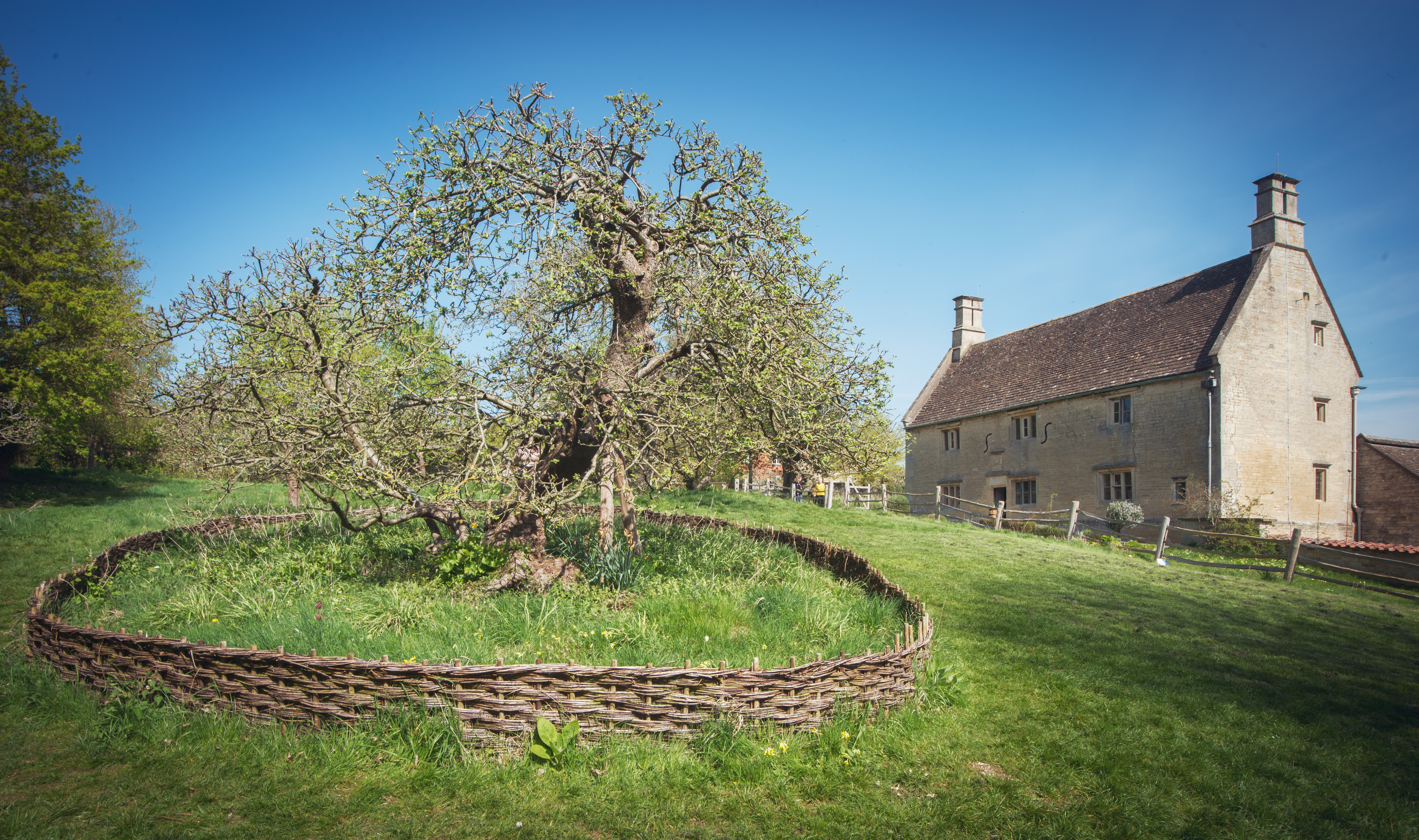
Woolsthorpe Manor
The apple tree is still there. Dendrochronology confirms it to be over 400 years old -- not the original trunk, which blew down in a storm in 1820, but a regrowth from the same roots, tended by National Trust gardeners and protected by a fence. It stands in the orchard of a modest limestone farmhouse in the Lincolnshire village of Woolsthorpe-by-Colsterworth, and it is, by a considerable margin, the most consequential fruit tree in the history of science. Isaac Newton told his friend William Stukeley that watching an apple fall from this tree set him thinking about the force that pulled it downward -- the same force, he would eventually prove, that held the moon in orbit around the Earth and the planets around the Sun. The house where this happened is not a grand estate or a university laboratory. It is a yeoman's farmstead, built for rearing sheep.
A Premature Birth on Christmas Day
The manor had passed through several families -- the Sleafords, the Pigotts, the Thimelbys, the Burys, and the Underwoods -- before being sold to Robert Newton in 1623. Robert settled the property on his eldest son Isaac as a wedding gift in 1639. The younger Isaac married Hannah Ayscough in April 1642 and died in October the same year, three months before the birth of his son. Isaac Newton was born on Christmas Day 1642, so small and premature that he was not expected to survive the week. He did. When Newton was three, his mother remarried and moved a mile and a half away to North Witham, leaving the boy to be raised by his grandparents at Woolsthorpe. She returned after being widowed a second time. At twelve, Newton was sent to the King's School in Grantham. He came back briefly at seventeen to try his hand at farming, proved spectacularly unsuited to it, and in 1661 left Lincolnshire for Trinity College, Cambridge.
The Plague Year of Wonders
In 1665, the Great Plague swept through England. Cambridge University closed its doors. Newton, then twenty-two, returned to the farmhouse where he had been born. What followed was one of the most productive periods of intellectual discovery in recorded history. Working alone in this small house, with no laboratory equipment beyond what he could improvise, Newton conducted his groundbreaking experiments on light and optics. He proved that white light was composed of a spectrum of colors by passing sunlight through a prism, then recombining it. He developed the mathematical framework that would become calculus. And here, in the orchard, watching an apple fall, he began the chain of reasoning that would culminate in his law of universal gravitation -- the insight that the force pulling fruit from a branch was the same force governing the motion of celestial bodies. Newton later called 1666 his annus mirabilis. The work he did at Woolsthorpe in those plague months laid the foundations for the Principia Mathematica, published two decades later, which would transform physics, astronomy, and mathematics.
A Farmhouse Preserved
Newton never returned to live at Woolsthorpe permanently. When he died in 1727, the manor passed to his nearest male heir, John Newton, his uncle Robert's great-grandson. In 1732 the estate was sold to the Turnor family of nearby Stoke Rochford, who leased it to a farming family named Woolerton. The Woolertons remained tenants for two hundred years, keeping the house as what it had always been: a working farm. In 1942, the Pilgrim Trust and the Royal Society purchased the manor and gave it to the National Trust for preservation. Today it is presented as a typical 17th-century yeoman's farmhouse, its rooms furnished to suggest the world Newton knew as a child. One of the former farmyard buildings has been equipped as an interactive science centre exploring the physical principles Newton investigated in these rooms. Visitors can stand in the orchard beside the descendant of the apple tree that Newton described to Stukeley. The tree still bears fruit. The house remains surrounded by fields, on the edge of a village that has grown from a hamlet of several houses to several hundred, but has not lost the quiet that once allowed a young man, sent home by plague, to think his way toward the laws of the universe.
From the Air
Woolsthorpe Manor sits at 52.81°N, 0.63°W in the village of Woolsthorpe-by-Colsterworth, near Grantham, Lincolnshire. The modest limestone farmhouse and its orchard are set amid flat agricultural countryside. The nearest significant airport is RAF Cranwell, approximately 15nm to the north. The A1 road passes nearby to the east.