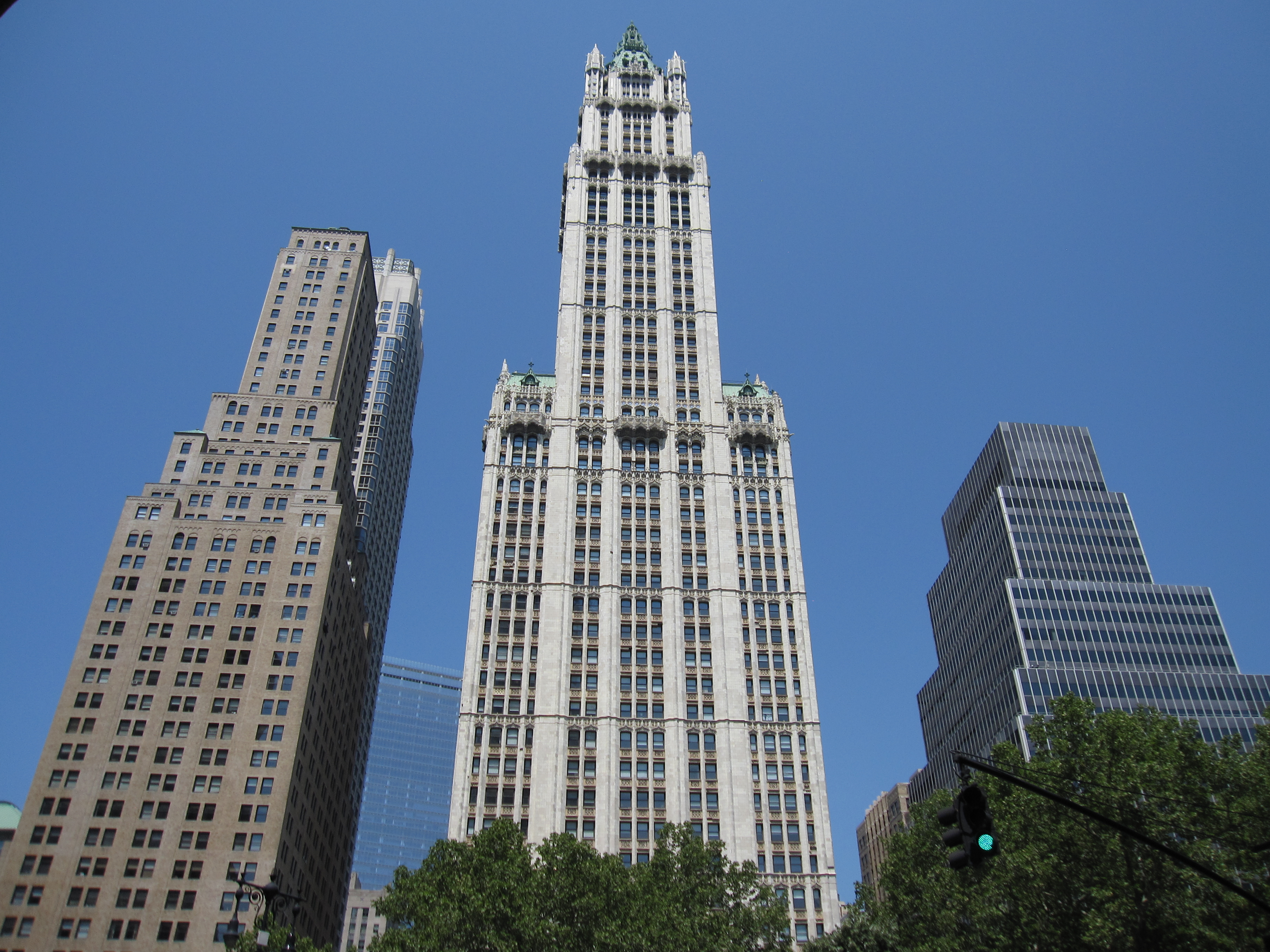
Woolworth Building
Frank Woolworth paid for the whole thing in cash. Thirteen and a half million dollars, no mortgage, no loan -- just the accumulated profits of selling buttons, soap, and kitchen gadgets for a nickel apiece. When the 60-story tower at 233 Broadway opened on April 24, 1913, President Woodrow Wilson pressed a button in Washington, D.C., and eighty thousand electric lights blazed to life, visible from miles across the harbor. The Woolworth Building was not just the tallest structure on Earth; it was proof that the five-and-dime could produce a cathedral.
Nickels and Dimes to Gothic Spires
The story begins with a lunch between two ambitious men. Frank Woolworth needed a headquarters for his booming retail empire. His friend Lewis Pierson needed help forcing a bank merger. Over a meal, they struck a deal: Woolworth would buy shares and vote to merge Pierson's Irving National Bank with the rival New York Exchange Bank, and in return, the combined institution would anchor his new building. What started as plans for a modest 12-to-16-story office block kept growing. Woolworth kept demanding more height, more grandeur. "I do not want a mere building," he told architect Cass Gilbert. "I want something that will be an ornament to the city." Gilbert obliged with a soaring neo-Gothic design inspired by the Palace of Westminster, clad in thousands of terracotta panels that shimmer with a polychrome effect -- the upper floors slightly darker and denser than the lower ones, an optical trick that makes the tower appear to dissolve into the sky.
A Lobby That Tells Its Own Jokes
Step inside and the Woolworth Building reveals its wit. The lobby walls are sheathed in veined marble from the Greek island of Skyros, and the ceilings glow with glass mosaics in blue, green, and gold, punctuated by red accents. But look closer at the twelve plaster brackets where the arcade meets the mezzanine: they carry sculpted grotesques that caricature the building's own creators. There is Cass Gilbert cradling a model of his tower. There is structural engineer Gunvald Aus measuring a girder. And there is Woolworth himself, counting his nickels and dimes with undisguised glee. Above the mezzanine, a stained-glass skylight bears the dates 1879 and 1913 -- the founding of the Woolworth Company and the building's opening -- surrounded by grotesques depicting the five-and-dime trade. Two ceiling murals by C. Paul Jennewein, titled Labor and Commerce, watch over the crossing of the north and south wings.
Steel, Speed, and Bedrock
Building the tallest structure in the world meant solving problems no one had faced before. Beneath the site, Manhattan's bedrock plunges unusually deep, requiring 69 massive caissons drilled down to anchor the steel skeleton. Where columns did not align with caissons, engineers cantilevered them on plate girders so large that a single one could span the width of a street. The steel framework itself was a feat of logistics: beams from foundries in Philadelphia and Pittsburgh were so heavy that surveyors had to inspect the transport routes to ensure city streets would not collapse under their weight. Construction moved at a blistering pace. Steelworkers set a speed record, assembling 1,153 tons of steel in six consecutive eight-hour days. The topping-out ceremony came two weeks ahead of schedule on July 1, 1912, when the last rivet was driven into the summit. The finished tower carried its own ZIP code -- 10279 -- one of just 41 buildings in Manhattan granted that distinction.
A Century of Reinvention
The Woolworth Building has reinvented itself across every era. In its early years, Columbia Records operated a studio in the tower where, in 1917, the Original Dixieland Jass Band cut what are considered the first jazz recordings. Nikola Tesla kept an office on one floor until he was evicted for not paying rent. Fordham University ran an entire downtown campus inside the building from 1916 to 1943, enrolling more than 3,000 students at its peak. During World War II, the Kellex Corporation, a key arm of the Manhattan Project, worked from offices within its walls. The September 11 attacks, occurring just blocks away, left the building without electricity for weeks and shattered its windows. The ornate lobby, once freely open to tourists, was locked behind security checkpoints. It took until 2014 for public tours to return, led in part by Cass Gilbert's own great-granddaughter. In 2012, the top 30 floors were sold and converted into 33 luxury residences, each with access to a restored basement swimming pool that had been proposed as early as 1910.
The Cathedral Endures
Architecture critic Montgomery Schuyler called it "the noblest offspring" of steel-skeleton construction. Others dubbed it the Cathedral of Commerce. More than a century after its opening, the Woolworth Building remains one of the hundred tallest structures in the United States, a National Historic Landmark since 1966 and a New York City designated landmark since 1983. Its copper roof is electrically grounded through the building's steel superstructure. Its Gothic crown, deliberately over-scaled so it could be recognized from miles away, still punctuates the Lower Manhattan skyline. Gilbert himself wrote that the style was meant to be "light, graceful, delicate and flame-like." On a clear day, approaching from the harbor, you can still pick out the polychrome shimmer of those terracotta panels -- blue, green, sienna, and rose -- a building paid for in pocket change, reaching for the sky.
From the Air
Located at 40.7122N, 74.0081W in Lower Manhattan's Tribeca/Civic Center area. The neo-Gothic tower rises 60 stories at 233 Broadway, directly east of City Hall Park. Best viewed from 2,000-3,000 ft AGL approaching from the south over New York Harbor or from the west over the Hudson River. The distinctive Gothic crown and copper pyramidal roof are identifiable landmarks. Nearby airports: KJFK (John F. Kennedy International, 13 nm SE), KLGA (LaGuardia, 7 nm NE), KEWR (Newark Liberty International, 9 nm W), KTEB (Teterboro, 11 nm NNW). Note: Lower Manhattan airspace is heavily restricted (Class B, TFR zones). The building sits among the dense Lower Manhattan skyline near One World Trade Center, the Brooklyn Bridge, and City Hall.