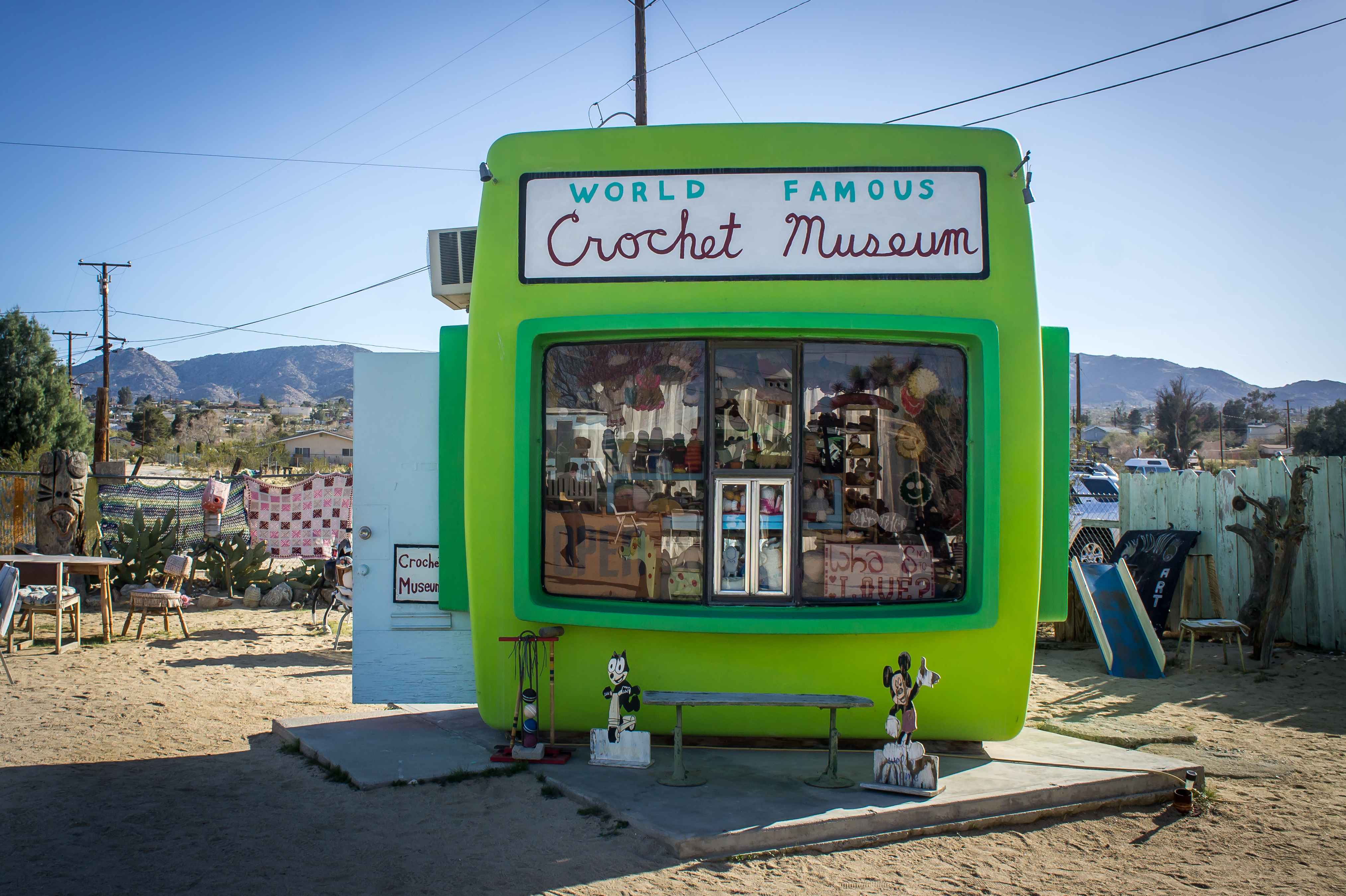
World Famous Crochet Museum
The building was already there, waiting to become something. It had been a one-hour photo hut — those freestanding drive-through structures that briefly colonized parking lots in the 1980s and 1990s before digital cameras made them extinct. Shari Elf painted it acid green, filled it with crochet, and opened the doors. She does not know how to crochet.
The Logic of the Thing
Shari Elf founded the World Famous Crochet Museum in Joshua Tree in 2006. Admission is free. The museum occupies the repurposed photo hut, repainted in a green that is visible from some distance, which is appropriate for a building whose entire purpose is to be found and entered by strangers. The collection inside consists of crocheted objects contributed over the years — a form of accumulation that depends entirely on other people's skill, since Elf herself has never learned the craft she chose to celebrate.
This is not an oversight. It is something closer to a curatorial position. The museum does not position its founder as an expert practitioner but as someone who recognized that crochet — domestic, tactile, often dismissed as mere handicraft — deserved a dedicated space in the desert. The name announces itself without apology: World Famous.
What the Wind Did
In 2011, a windstorm knocked the building over. The Mojave Desert produces wind events of genuine violence — sustained gusts that move vehicles and uproot Joshua trees — and a freestanding structure that had been designed to dispense photo envelopes was not engineered for the forces the desert occasionally delivers.
The building went down. Less than five percent of the collection was lost. The museum was righted and reopened. This survival rate, for a collection housed in a structure that physically fell over, is either a testament to how securely the objects were arranged or simply to how much crocheted material can compress and cushion itself. Either way, the museum continued.
Joshua Tree's Particular Gravity
The World Famous Crochet Museum exists in the same square mile as several other institutions that follow a similar logic: free, open, unexpected, maintained by individual will rather than institutional funding. Noah Purifoy's sculpture field sits a few miles away, also free, also unfenced, also the product of one person deciding that the desert should hold something it had not held before.
Joshua Tree has accumulated these places over decades. The Integratron stands nearby, built from instructions its founder received from Venusians. Giant Rock, eight miles north, hosted UFO conventions for seventeen years. The desert does not seem to discourage this kind of project. The distances between things, the quality of light, the relative absence of competing noise — something about the High Desert has consistently attracted people with specific, uncompromising visions, and the acid-green former photo hut is one of them.
From the Air
Located at approximately 34.13°N, 116.31°W in the town of Joshua Tree, California, west of Twentynine Palms and north of the national park's main entrance. The building is small and low-profile from altitude but the acid-green paint makes it identifiable at low altitude on approach. Nearest airports: Twentynine Palms (TNP) ~15 miles east, Desert Resorts Regional (PSP) ~30 miles south.