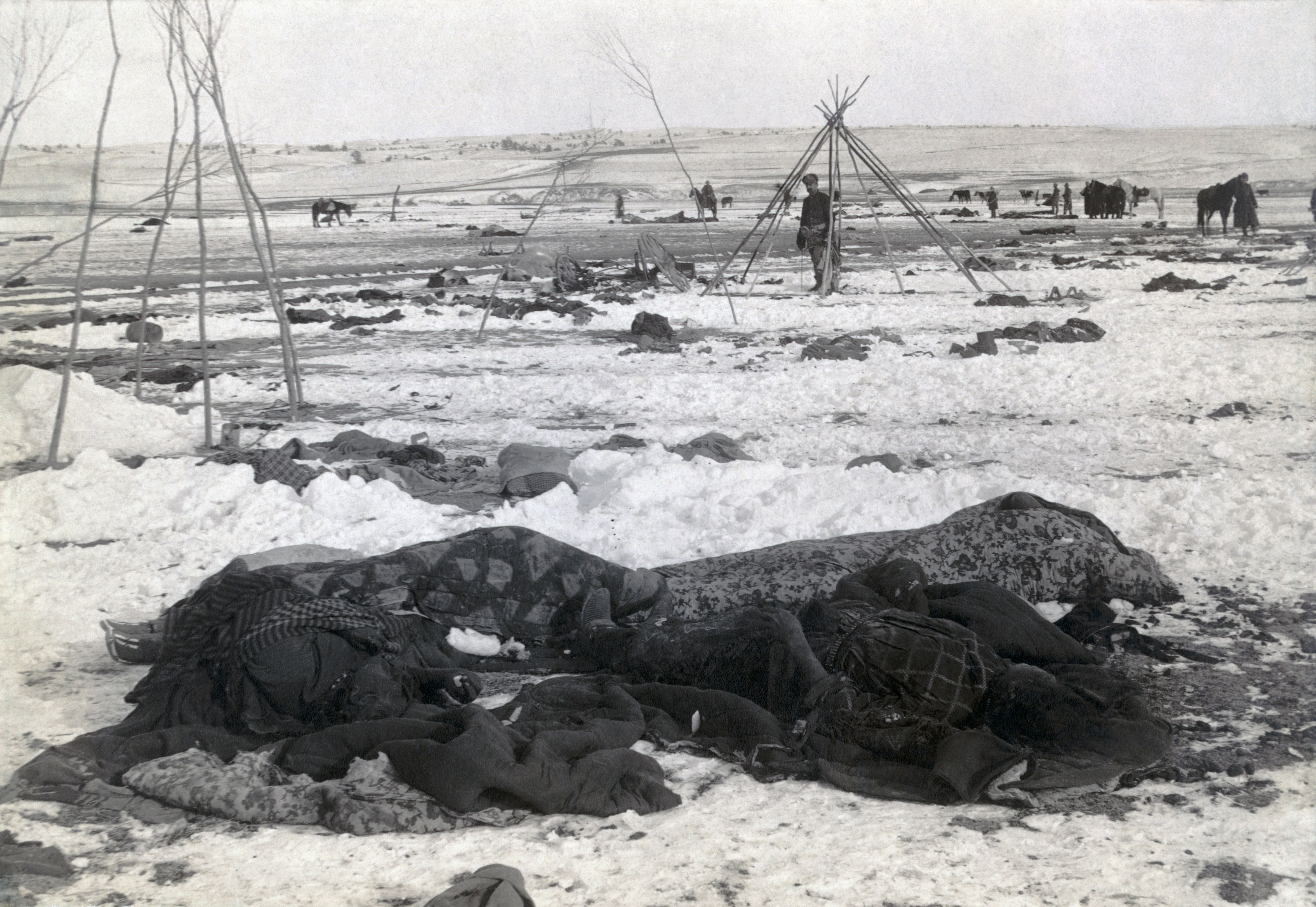
Wounded Knee
On the morning of December 29, 1890, the 7th Cavalry surrounded a band of Miniconjou Lakota at Wounded Knee Creek on the Pine Ridge Reservation in South Dakota. The soldiers had orders to disarm the group and escort them to the railroad for removal from the area. As weapons were being collected, a shot rang out - accounts differ on who fired first - and within minutes the soldiers' rifles and four Hotchkiss mountain guns were pouring fire into the Lakota camp. When the shooting stopped, approximately 250 Lakota lay dead, including Chief Big Foot and scores of women and children. Twenty-five soldiers also died, many from friendly fire. The Army awarded twenty Medals of Honor to participants - a grotesque recognition that generations of Native Americans have sought to have revoked. Wounded Knee marked the effective end of armed Native American resistance to U.S. expansion. It also became the symbol of everything that conquest had meant: broken treaties, stolen land, systematic destruction of a people and their way of life. In 1973, Wounded Knee would make headlines again when members of the American Indian Movement occupied the site, demanding treaty rights and government accountability.
The Ghost Dance
The tragedy at Wounded Knee grew from desperation and misunderstanding. By 1890, the Lakota had lost their buffalo, their land, and their freedom. Confined to reservations, dependent on government rations that were frequently late or inadequate, they faced cultural extinction. Into this despair came the Ghost Dance movement, a spiritual revival promising that the buffalo would return, the dead would rise, and the white invaders would vanish if believers performed the sacred dance. The movement, which had originated with the Paiute prophet Wovoka, spread rapidly across the Plains. White officials, seeing large gatherings of dancing Indians, panicked. They saw insurrection where there was only prayer. The Army moved to suppress the movement and arrest its leaders. Sitting Bull was killed during an arrest attempt on December 15, 1890. Big Foot's band, already traveling to Pine Ridge, was intercepted by the 7th Cavalry on December 28.
The Massacre
Big Foot was already dying of pneumonia when his band camped at Wounded Knee Creek. The next morning, soldiers began confiscating weapons. Tensions escalated when a deaf man named Black Coyote refused to surrender his rifle - accounts suggest he didn't understand the order or believed he had paid much for the weapon. A struggle ensued, the rifle discharged, and soldiers opened fire. The Hotchkiss guns, positioned on a hill overlooking the camp, swept the ravine where women and children fled. Bodies were found as far as two miles from the camp. The shooting lasted less than an hour. Survivors described soldiers hunting down fleeing women and children. A blizzard that night prevented burial details from reaching the site for three days. When they arrived, they found frozen bodies scattered across the snow-covered landscape. The dead were buried in a mass grave on the hill where the Hotchkiss guns had been positioned.
Aftermath
The Army's official report characterized Wounded Knee as a battle, not a massacre - a fiction that the twenty Medals of Honor reinforced. Native Americans knew better. Black Elk, then a young man who witnessed the aftermath, later told his story to poet John Neihardt: 'I did not know then how much was ended. When I look back now from this high hill of my old age, I can still see the butchered women and children lying heaped and scattered all along the crooked gulch as plain as when I saw them with eyes still young. And I can see that something else died there in the bloody mud, and was buried in the blizzard. A people's dream died there.' The campaign to revoke the Medals of Honor has continued for over a century. In 2021, the Remove the Stain Act was introduced in Congress, though it has not yet passed. The descendants of the massacre victims continue to seek formal acknowledgment and justice.
1973 Occupation
On February 27, 1973, approximately 200 members of the American Indian Movement and local Oglala Lakota occupied the town of Wounded Knee, demanding a review of all treaties between the U.S. government and Indian nations, and calling for investigations into the treatment of Native Americans at Pine Ridge and other reservations. The occupation lasted 71 days, with federal marshals and FBI agents surrounding the village. Two Native Americans were killed during the standoff, and a federal marshal was paralyzed. The occupation drew international attention to Native American grievances and galvanized a new generation of activists. Although the immediate demands were not met, the occupation helped shift public perception and contributed to policy changes including the Indian Self-Determination Act of 1975. The 1973 occupation made Wounded Knee a symbol not only of historical tragedy but of ongoing resistance.
The Site Today
Wounded Knee lies within the Pine Ridge Indian Reservation in Shannon County, South Dakota - one of the poorest counties in the United States. A simple monument marks the mass grave on the hill, surrounded by a chain-link fence and scattered with offerings left by visitors: tobacco ties, coins, photographs, letters. The Sacred Heart Catholic Church stands nearby, rebuilt after being damaged in the 1973 occupation. The site is not a national monument or park - it remains on tribal land, and facilities for visitors are minimal. A small museum operated by the Oglala Lakota offers interpretation when open. The landscape itself is unchanged: the ravine where people died, the creek where they camped, the hills where the guns were positioned. There are no crowds, no gift shops, no sanitized narrative. Wounded Knee asks visitors to bear witness to what happened here and to reckon with what it means. It is a place for mourning, reflection, and the hope that acknowledging truth might lead toward healing.
From the Air
Located at 43.15°N, 102.36°W on the Pine Ridge Indian Reservation in southwestern South Dakota. From altitude, the area appears as rolling prairie with the winding course of Wounded Knee Creek visible. The small community of Wounded Knee is barely visible. Pine Ridge, the reservation's main town, lies 16 miles southwest. Rapid City Regional Airport (RAP) is 90 miles northwest.