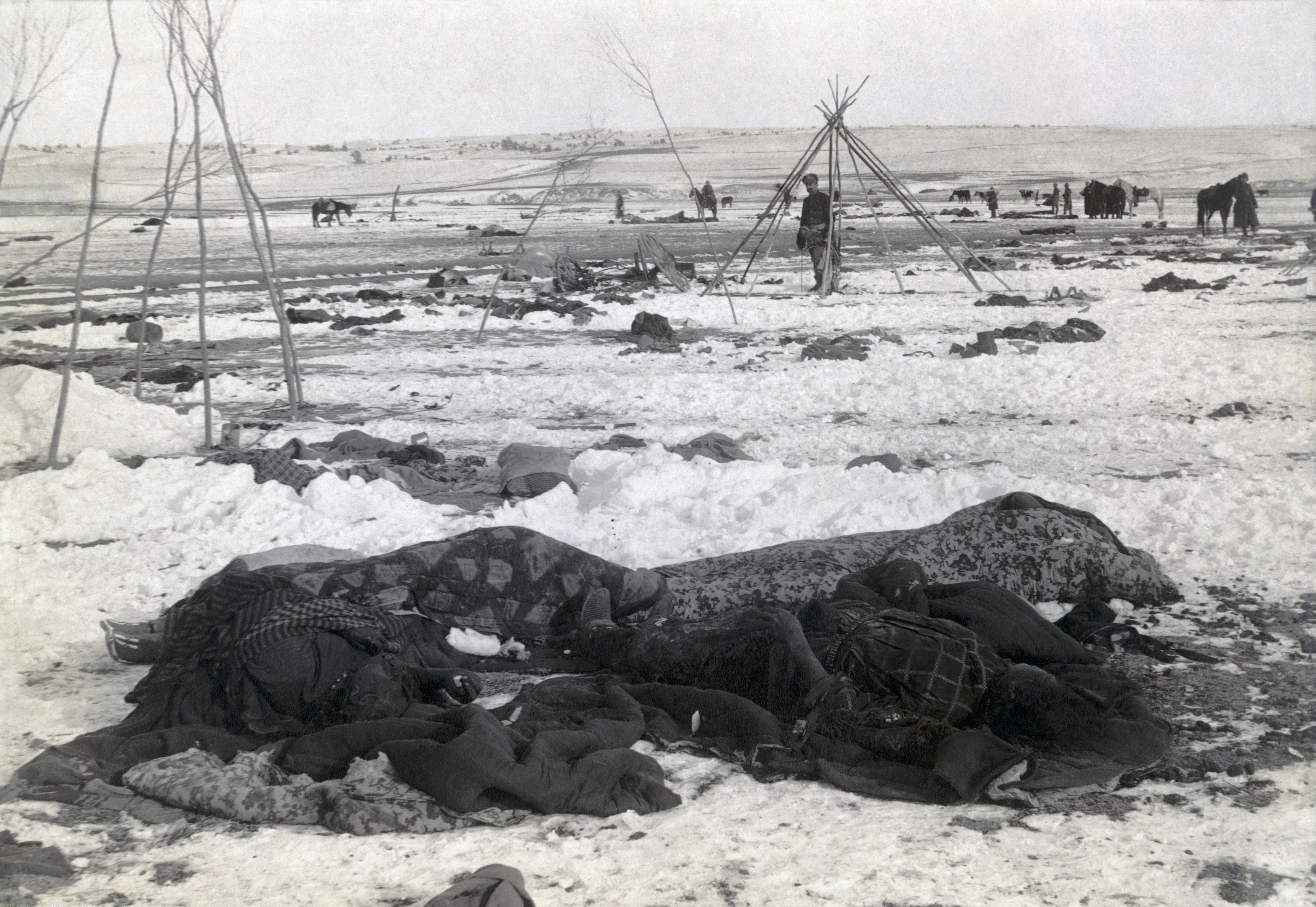
Wounded Knee Massacre
Black Coyote could not hear the soldiers demanding his rifle. He had paid good money for that Winchester and did not understand why they wanted it. When two soldiers grabbed him from behind, the gun went off. In the chaos that followed, soldiers opened fire with Hotchkiss guns on a camp of 350 Lakota men, women, and children. By the time the shooting stopped, at least 250 Lakota lay dead or dying on the frozen ground near Wounded Knee Creek. The date was December 29, 1890. It would be remembered as the last major confrontation of the Indian Wars, though calling it a battle obscures what actually happened that morning on the Pine Ridge Reservation.
The Ghost Dance and the Fear It Inspired
The tragedy had roots in desperation. By 1890, the Lakota had watched their world collapse. The great bison herds were gone, hunted nearly to extinction. Treaty promises to protect reservation lands had proven worthless against miners and settlers. Onto this landscape of loss came word of Wovoka, a Paiute prophet with a vision: the white man would disappear, the buffalo would return, and the ancestors would rise again. His Ghost Dance spread across reservations like hope itself. To the Lakota, it was a religious movement born of cultural destruction. To settlers and Indian agents, the sight of hundreds dancing in ceremonial Ghost Shirts signaled potential uprising. Officials decided to arrest the chiefs they considered most dangerous. On December 15, 1890, Indian police came for Sitting Bull at Standing Rock. When he resisted, they shot him. Two hundred of his followers fled south to join Chief Spotted Elk.
The Morning Everything Changed
Spotted Elk's band, along with Hunkpapa refugees, was intercepted by the 7th Cavalry on December 28. The soldiers escorted 350 Lakota to Wounded Knee Creek and surrounded them with 500 troops and four Hotchkiss mountain guns positioned on the overlooking hill. Colonel James Forsyth ordered the Lakota disarmed at dawn. The search of the camp confiscated 38 rifles. None of the elderly men were armed. Tensions rose as soldiers grew rougher in their searches. A medicine man named Yellow Bird began the Ghost Dance, telling young men their shirts could stop bullets. Then came Black Coyote. Another Lakota shouted that he was deaf, that he could not understand the orders. The soldiers grabbed him anyway. The rifle discharged. Five young Lakota threw aside blankets and fired concealed weapons. What followed was not battle but slaughter.
Less Than an Hour
Half the Lakota men fell before they could reach the pile of confiscated weapons. Those who grabbed rifles found themselves fighting at close range with no cover. While warriors and soldiers exchanged fire, the Hotchkiss guns on the hill opened up on the tipi camp full of women and children. Survivors fled toward a ravine, seeking any shelter from the crossfire. Some soldiers pursued them for miles across the prairie, shooting the wounded and the fleeing alike. The officers had lost control of their men. In less than an hour, at least 150 Lakota were killed and 50 wounded. Some estimates place the dead closer to 300. Army casualties numbered 25, many likely from their own Hotchkiss guns firing into the chaos. A blizzard struck that night, freezing the dead where they fell.
The Graves on the Hill
Three days later, a civilian burial party gathered the frozen bodies. They found four infants still alive, wrapped in their dead mothers' shawls. The dead were placed in a mass grave dug on the same hill where the Hotchkiss guns had stood. In all, 84 men, 44 women, and 18 children were buried there. General Nelson Miles relieved Colonel Forsyth of command and called for court-martial, believing Forsyth had deliberately disobeyed orders to massacre the Lakota. An Army inquiry criticized Forsyth's tactics but exonerated him of responsibility. He was reinstated and later promoted to major general. Nineteen soldiers received the Medal of Honor for Wounded Knee. The medals remain controversial to this day; efforts to revoke them have repeatedly failed in Congress.
A Wound That Will Not Close
Wounded Knee became a National Historic Landmark in 1965, though a memorial to the Lakota dead was not added until the 1990s. In 1973, members of the American Indian Movement occupied the site for 71 days in a standoff with federal authorities, choosing Wounded Knee for its symbolic weight. The massacre site itself remained in private hands until 2022, when the Oglala Sioux and Cheyenne River Sioux tribes purchased the 40-acre property. Each December, the Big Foot Memorial Riders retrace the path Spotted Elk's band took to Wounded Knee, carrying white flags as symbols of peace. The inscription on the 1903 monument reads simply: Many innocent women and children who knew no wrong died here.
From the Air
Located at 43.1425N, -102.365W on the Pine Ridge Indian Reservation in southwestern South Dakota. The site lies approximately 18 miles east of the town of Pine Ridge. The nearest commercial airport is Rapid City Regional (KRAP), about 80 miles north. From 2,000-3,000 feet AGL, the landscape appears as rolling grassland cut by the meandering course of Wounded Knee Creek. The mass grave site occupies a small hilltop overlooking the creek valley. The memorial and cemetery are visible as a cleared area with a distinctive monument. This is sacred ground to the Lakota people; visitors should approach with appropriate respect.