Wreck Alley
The Yukon was supposed to go down on a specific day, at a specific time, after a ceremony in which the winner of a large game of Sink My Battleship would push the button and send the 366-foot Canadian Navy destroyer to the bottom. The night before the ceremony, the wind picked up, the ship moved, and the Yukon sank on its own. It landed on its port side instead of upright, which made the planned 'Grand Promenade' corridor an advanced dive at 105 feet rather than an intermediate dive at 68 feet, as planned. Nothing about Wreck Alley has been entirely predictable.
A Deliberate Underwater Cemetery
Wreck Alley occupies a stretch of ocean a few miles off Mission Beach, in the cold nutrient-rich currents of the San Diego coast. Most of the wrecks here were placed intentionally — sunk as artificial reefs to create diving destinations and marine habitat. Six ships were deliberately scuttled: the Ruby E (a Coast Guard cutter), the El Rey (a kelp harvester), the Yukon (the Canadian destroyer), and three smaller vessels. The Naval Ocean Systems Center tower, built in 1959 about a half mile offshore, is the only true wreck — it was knocked down in a storm, unexpectedly, and now sits in sixty feet of water looking, as one account describes it, like a sunken oil rig.
The Ruby E: From Prohibition to the Deep
Built in 1934 in Seattle, the Ruby E began life as Coast Guard Cutter Cyane, designed specifically for enforcing Prohibition along the Pacific coast. During World War II she conducted anti-submarine patrols and convoy escort duties. After the war, she was sold, converted to a fish-processing vessel, sold again, renamed the Ruby E, and outfitted as a salvage vessel. Her owners ran into financial difficulties; the bank repossessed her. She sat in San Diego Harbor until the San Diego Tug and Barge Company purchased her and arranged her deliberate sinking in 1989. She now rests upright on the bottom in 85 feet of water, her wheelhouse accessible through round portholes, her engine room still containing two large diesel engines. She is in good condition.
The El Rey: 800,000 Miles, Then the Bottom
The El Rey spent 35 years as a Kelco kelp harvester, cutting the top three feet of the kelp canopy from Point Conception to Mexico. She was capable of carrying 300 tons of kelp and made some 3,600 voyages, traveling more than 800,000 miles before her retirement in 1981. Destined for the scrap yard, she was instead claimed by the San Diego Council of Diving Instructors and the California Department of Fish and Game for an artificial reef program. Kelco donated her. A U.S. Navy demolition team used explosives to sink her on April 2, 1987. She came to rest upright on the bottom. Over the decades she has deteriorated, but the fish living in her wreck have multiplied.
Life in the Wreckage
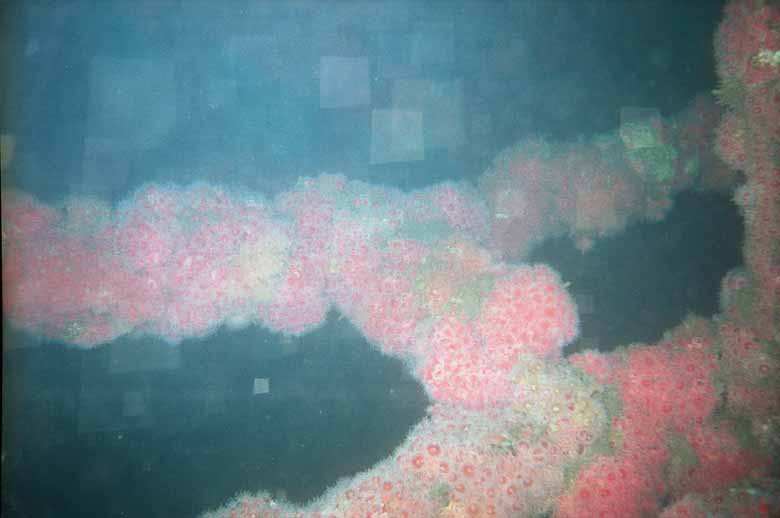
The cold currents running through Wreck Alley are rich in nutrients, and the artificial reefs created by the sunken ships concentrate marine life in ways that natural flat-bottomed ocean floor cannot. Strawberry anemones — the Corynactis californica — carpet the hulls in brilliant pink and red. Large snow-white Metridium anemones occupy prominent positions. Scallops, barnacles, tunicates, nudibranchs, brittle stars, lobsters, and garibaldi find shelter in corridors that were once crew quarters and engine rooms. From inside the Yukon, the holes cut into the hull for diver access look, according to those who have swum through them, like green video screens — windows into illuminated water rather than windows into a ship.
From the Air
Located at approximately 32.767°N, 117.287°W, several miles offshore from Mission Beach in San Diego. The site is underwater and not visible from the air, but Mission Beach itself — the long narrow sandspit separating Mission Bay from the Pacific — provides the orientation. San Diego International Airport (KSAN) lies approximately 8 miles to the southeast. Best understood from altitude by noting the dark patches of kelp forests along the coast.