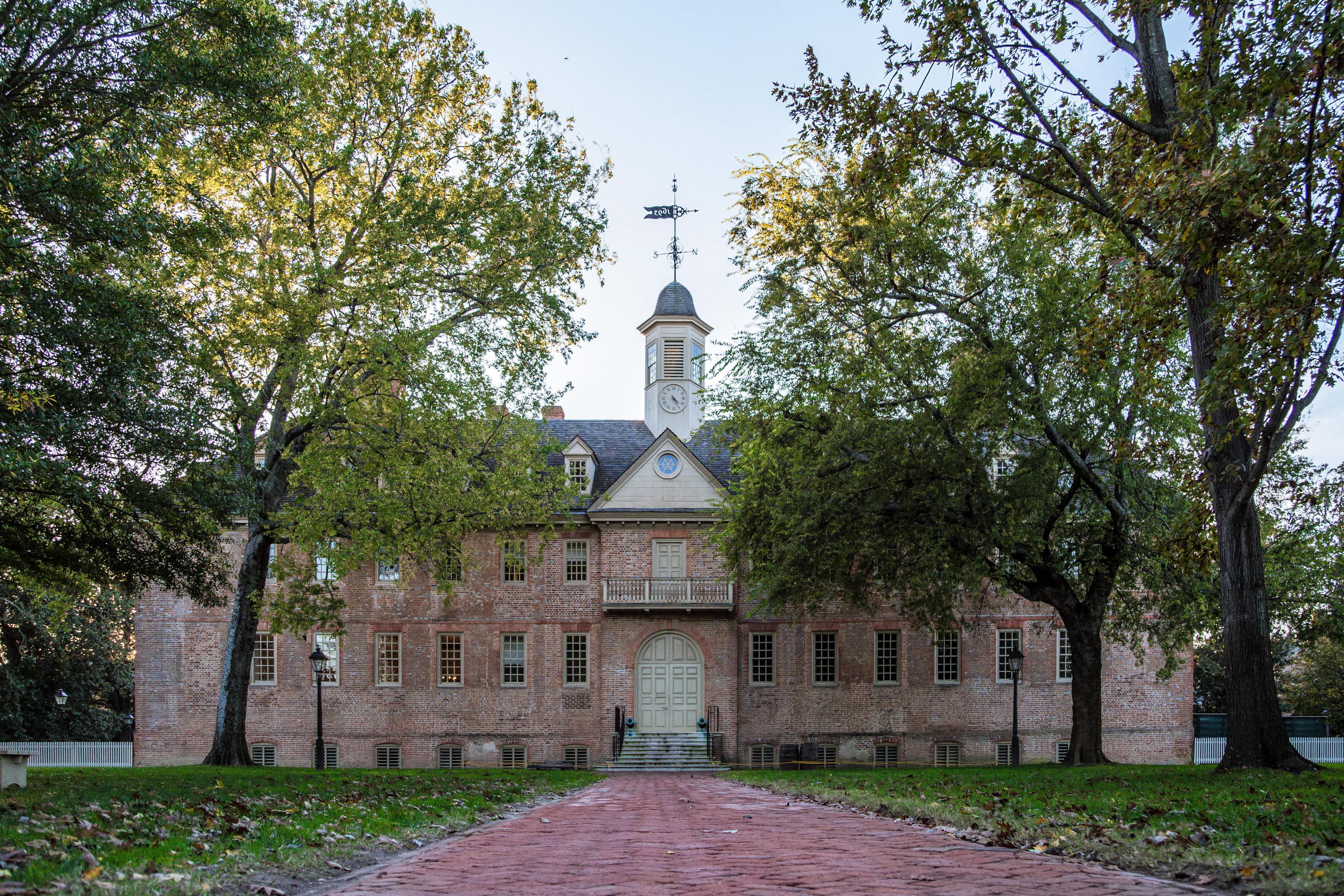
Wren Building
Five buildings have stood on this spot, and the walls of the first one hold up the latest. The Wren Building at the College of William & Mary was begun in 1695, gutted by fire in 1705, rebuilt, burned again in 1859, reconstructed in Italianate style, torched by Union soldiers in 1862, rebuilt a fourth time, and finally restored to its 18th-century appearance in 1931 using Rockefeller money and a single copper engraving found at Oxford's Bodleian Library. Through it all, the original masonry - bricks laid in English bond over three centuries ago - has formed the majority of every version's walls. It is the oldest college building in the United States, and five grammar school students once gave speeches on its steps that convinced an entire colony to move its capital.
A Building That Moved a Capital
King William III and Queen Mary II chartered the College of William & Mary on February 8, 1693, to train ministers and convert Native Americans. The foundation was laid on August 8, 1695, at a settlement called Middle Plantation on the Virginia Peninsula's central ridge. Governor Edmund Andros, who opposed the college, grudgingly attended the ceremony because the institution bore the monarchs' names. Construction was slow - Andros may have deliberately diverted English workmen to other projects and reneged on a promise to supply bricks for the chapel wing. The eastern and northern wings were finished by 1699, creating the largest building in the Chesapeake Colonies. Then opportunity arrived: Jamestown's statehouse burned. College president James Blair and Governor Francis Nicholson arranged a May Day celebration at the College Building where five grammar school students delivered orations arguing that Middle Plantation should become Virginia's new capital. It worked. The legislature approved the move, the settlement was renamed Williamsburg, and the College Building hosted both the government and students until the Capitol was completed in 1704.
Three Fires and a Tornado
Fire was always the building's nemesis. Governor Nicholson himself noted before October 1705 that hearths and chimneys had already set portions of the structure ablaze. On the night of October 29, 1705, the first building was destroyed, nearly killing several occupants. The second building, completed by 1716 under the influence of Governor Alexander Spotswood, reoriented the structure toward the growing city with a new eastern pavilion and a shortened cupola topped by a weathervane. An 'Ingine for Quenching Fire' was requested from England. The chapel wing, laid in Flemish bond rather than the English bond of the main structure, was completed in 1732. Thomas Jefferson drafted plans for a fourth wing in the 1770s, but it was never built. An 1834 tornado caused significant damage. Then, in the early morning of February 8, 1859, fire gutted the entire building again, destroying the library, chapel memorials, and important college documents. The walls survived. An Italianate redesign with twin towers was completed that same year - only to be deliberately burned by Union soldiers occupying Williamsburg during the Civil War in 1862.
The Mystery of Christopher Wren
Did Sir Christopher Wren, the architect of St. Paul's Cathedral, design the original building? The debate has persisted since 1724, when mathematics professor Hugh Jones wrote that the college was 'first modelled by Sir Christopher Wren.' Historians have argued over what 'modelled' meant - a wooden scale model, an actual architectural plan, or merely a building in Wren's style. The royal interest in the college and the social connections of its sponsors make Wren's involvement plausible, but the building as constructed in Virginia likely bore little resemblance to anything Wren would have drawn. British art historian Margaret Whinney pointed to the 'clumsy' proportions shown in a 1702 sketch by Swiss traveler Franz Ludwig Michel, noting that 'the adaptions of the Gentlemen in America were such that it bore little resemblance to his architecture.' Others have suggested that Blair's Scottish background points to architects William Bruce or Robert Mylne as more likely candidates. No conclusive evidence has settled the question. The building was formally named the Sir Christopher Wren Building in 1931 anyway.
The Bodleian Plate and the Fifth Building
The building standing today is the fifth on the site, and its existence owes everything to a single artifact: the Bodleian Plate, an early 18th-century copper engraving found at Oxford's Bodleian Library that depicted the second College Building in detail. When John D. Rockefeller Jr. funded the Colonial Williamsburg restoration, the architectural firm Perry, Shaw & Hepburn used the Bodleian Plate as their primary reference to recreate the building's 18th-century appearance. The restoration was completed between 1928 and 1931. Beneath the Great Hall, the kitchen dates to the 1716 second building, with arched windows and a hearth spanning several feet. A well in the center of the room provided unusually easy access to water. The Wren Chapel, in the south wing, features an interior described by architectural historian Richard Guy Wilson as 'Wren-ish.' Memorial tablets line the walls commemorating George Wythe, James Blair, John Randolph, and others. The building continues to host classes, faculty offices, and chapel services - a working academic building on the same foundations where students first attended class under schoolmaster Mungo Inglis in 1700.
From the Air
Located at 37.271°N, 76.709°W at the western end of Duke of Gloucester Street in Williamsburg, Virginia, at the heart of the College of William & Mary campus. The Wren Building anchors the College Yard, flanked by the Brafferton (1723) and the President's House (1732). The Sunken Garden extends westward. Colonial Williamsburg's restored 18th-century district runs east along Duke of Gloucester Street. Best viewed at 1,500-2,500 feet AGL. Nearby airports: Williamsburg-Jamestown Airport (KJGG) approximately 5nm southwest; Newport News/Williamsburg International Airport (KPHF) approximately 12nm southeast. The York River is visible to the north and the James River to the south of the narrow Virginia Peninsula.