Wright Brothers National Memorial
On a cold, windy morning in December 1903, on a narrow strip of sand in Kitty Hawk, North Carolina, the world changed forever. At 10:35 AM on December 17, Orville Wright lifted off from a wooden launching rail and flew 120 feet in 12 seconds - the first powered, controlled, sustained heavier-than-air flight. Three more flights followed that day, with Wilbur covering 852 feet in 59 seconds on the final attempt. A century later, the Wright Brothers National Memorial preserves the exact launch site, marks each landing point with granite boulders, and tops Kill Devil Hill with a 60-foot monument to the brothers who figured out what humans had dreamed of for millennia. Every powered aircraft that has ever flown traces its lineage to this windswept dune.
The Site
The Wright brothers chose Kitty Hawk for specific reasons: consistent winds (averaging 13 mph), soft sand for crash landings, and isolation from prying eyes and competitors. They camped in a wooden shed and assembled their aircraft in a hangar they built themselves. Kill Devil Hill, a large sand dune about 100 feet tall, provided elevation for glider tests in earlier years. The powered flights of December 17, 1903, occurred on flat ground nearby. The site was remote - mail came irregularly, supplies had to be carried in, and witnesses were few. The famous photograph of the first flight was taken by local John T. Daniels, who had never operated a camera before.
The Flights
The Wright Flyer's four flights on December 17, 1903, grew progressively longer as the brothers alternated at the controls. Orville flew first (120 feet, 12 seconds), then Wilbur (175 feet, 12 seconds), then Orville again (200 feet, 15 seconds). Wilbur made the final flight - 852 feet in 59 seconds, proving the aircraft could sustain controlled flight. A gust of wind damaged the Flyer after the fourth flight; it never flew again. The brothers packed it up and went home to Dayton. They didn't announce their success widely; they continued developing their technology in secret for years, seeking patents and contracts before publicizing their achievement.
The Monument
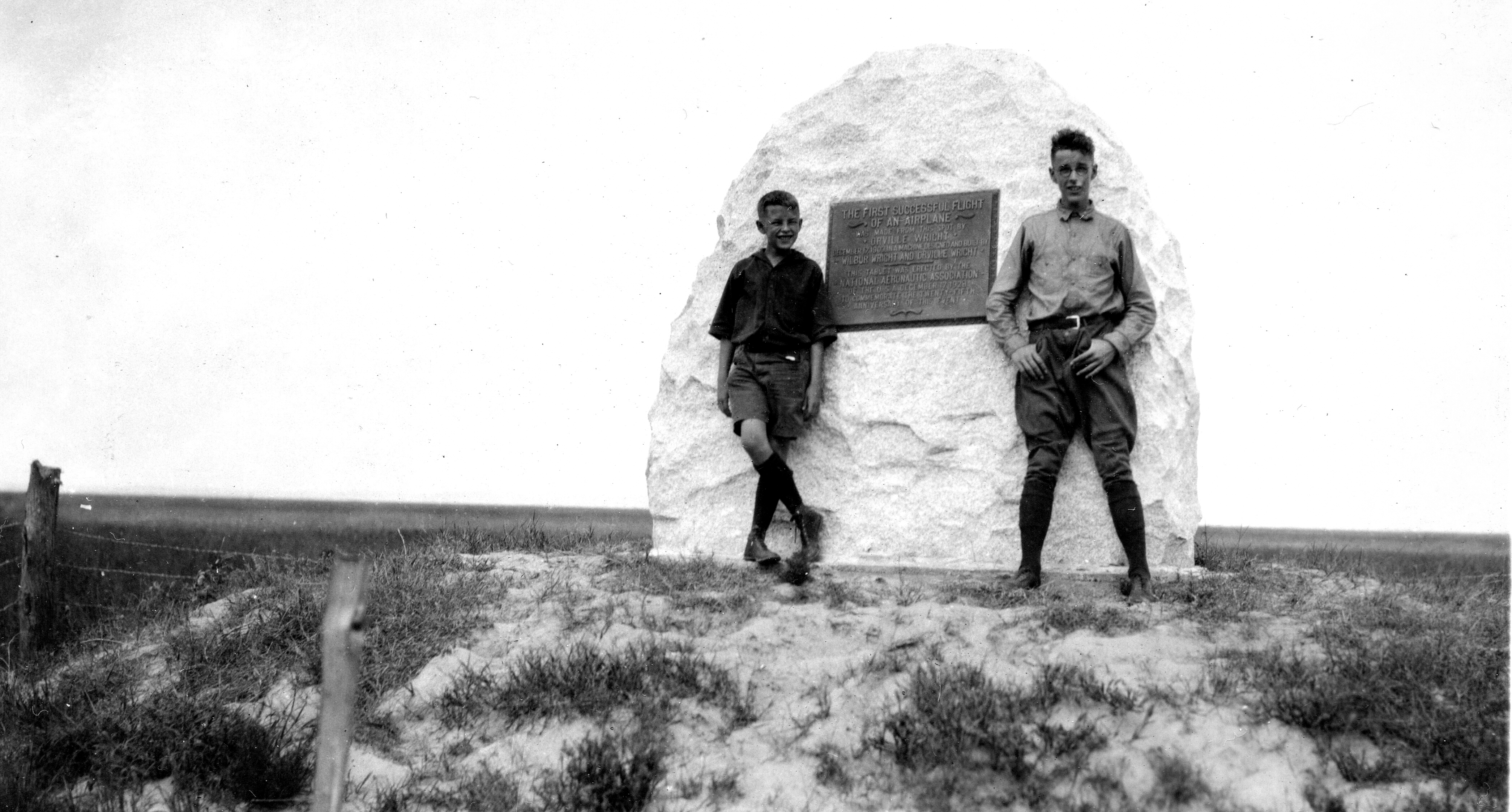
The Wright Brothers National Memorial was established in 1927 and the monument dedicated in 1932. The 60-foot granite pylon tops Kill Devil Hill (which has been stabilized with grass to prevent erosion). The monument's aeronautical design features wings and represents flight's upward aspiration. Below the hill, granite markers show the exact spots where each of the four flights ended. A metal sculpture of the Wright Flyer sits on the launch rail location. The visitor center contains a replica of the 1903 Wright Flyer and exhibits on the brothers' methodical approach to solving the problem of flight. Reconstructed camp buildings show where Orville and Wilbur lived during their experiments.
The Legacy
The Wright brothers' achievement wasn't just flying - it was systematic engineering. They built a wind tunnel to test wing shapes. They invented the three-axis control system (pitch, roll, yaw) that still controls aircraft today. They developed the propeller from theoretical first principles. Their approach - methodical experimentation, careful measurement, iterative improvement - became the model for aerospace engineering. Within Orville Wright's lifetime, humans broke the sound barrier and designed spacecraft. Every aircraft from crop dusters to space shuttles uses principles the Wrights pioneered on this windswept North Carolina dune.
Visiting Wright Brothers National Memorial
Wright Brothers National Memorial is located at 1000 North Croatan Highway in Kill Devil Hills, North Carolina, on the Outer Banks. The memorial is open daily except Christmas; admission is charged (National Parks pass accepted). The visitor center features exhibits, replica aircraft, and ranger programs. The monument atop Kill Devil Hill is accessible by walking path. Flight markers, reconstructed camp buildings, and the launch rail site are on the grounds. The memorial hosts annual First Flight celebrations on December 17. The Outer Banks are accessible via US-158 or NC-12. Norfolk International Airport is 80 miles north. The Outer Banks have extensive vacation accommodations. December visits honor the anniversary but bring cold, windy weather - exactly what the Wrights wanted.
From the Air
Located at 36.01°N, 75.67°W on the Outer Banks of North Carolina. From altitude, the Wright Brothers National Memorial is visible on Kill Devil Hill - the monument stands out as a vertical element on the barrier island. The launch site and flight markers are on the flat ground below. The Outer Banks stretch north and south - a ribbon of barrier islands between Albemarle Sound and the Atlantic Ocean. Kitty Hawk village is nearby. Norfolk, Virginia, is 80 miles north. The terrain is coastal - dunes, marsh, and ocean. The consistent winds that brought the Wrights here still blow across the exposed landscape.