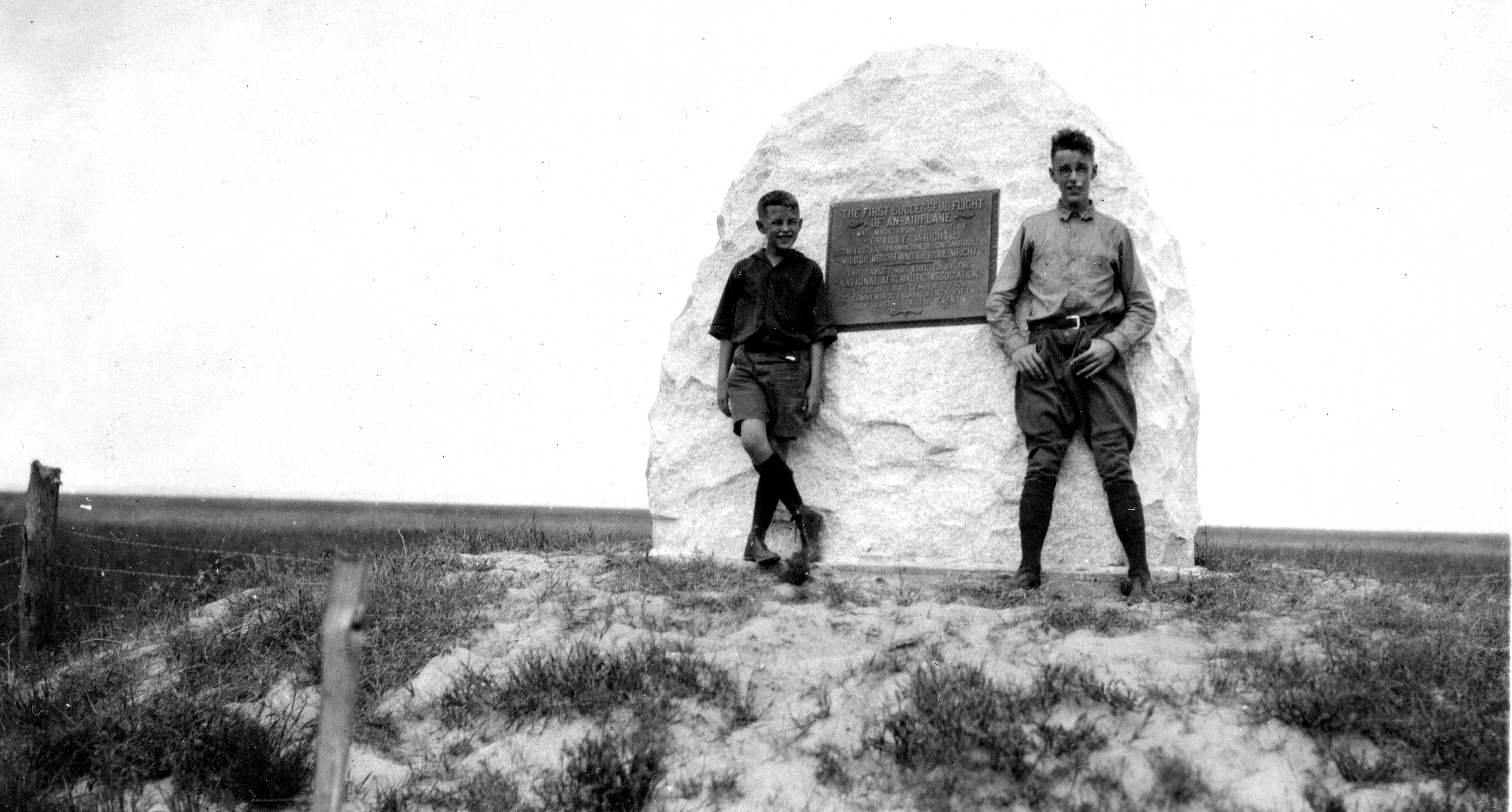
Wright Brothers National Memorial
At 10:35 on the morning of December 17, 1903, Orville Wright lay prone on the lower wing of a contraption of wood, fabric, and wire while his brother Wilbur steadied the wing tip. The engine coughed to life, the propellers spun, and the fragile craft lurched forward along a wooden rail. After forty feet, it rose into the air. Twelve seconds later, it settled back to earth 120 feet from where it started. Humanity had achieved powered, controlled, heavier-than-air flight. Three more flights that day proved the first was no fluke; the longest covered 852 feet in 59 seconds. Two bicycle mechanics from Dayton, Ohio, working without government funding or university support, had solved the problem that had defeated the world's best engineers. They had chosen the remote sand dunes of Kitty Hawk, North Carolina, for their experiments because of the steady winds, soft landing surfaces, and privacy from curious observers. The Wright Brothers National Memorial now preserves the site where the air age began.
The Problem of Flight
By 1900, engineers had been attempting powered flight for decades. Otto Lilienthal in Germany had made over 2,000 glider flights before dying in a crash. Samuel Langley of the Smithsonian Institution had built successful unmanned flying machines and was preparing a piloted attempt with government funding. The problem seemed close to solution, but crucial pieces were missing. Most researchers focused on building more powerful engines. The Wright brothers recognized that the real challenge was control - how to maintain stability and guide an aircraft through three-dimensional space. They studied bird flight, built a wind tunnel to test wing shapes, and developed a system of 'wing warping' that allowed the pilot to bank and turn. Their systematic approach - methodically testing each variable - distinguished them from competitors who relied on intuition and luck. By the time they arrived at Kitty Hawk in 1903, they had flown hundreds of glider flights and understood their machine better than anyone.
Why Kitty Hawk
The Wright brothers selected North Carolina's Outer Banks after studying Weather Bureau data on wind speeds across the country. They needed consistent strong winds for their initial glider experiments and soft sand for the inevitable crashes. Kitty Hawk and the nearby Kill Devil Hills offered both, plus isolation - the Wrights wanted to work without attracting crowds or competitors. Beginning in 1900, they made annual trips to the remote fishing village, camping in tents and later a wooden shed while testing their designs. The locals thought them eccentric but helpful - the brothers repaired equipment and shared meals. Kill Devil Hills, a cluster of sand dunes south of Kitty Hawk proper, became their primary testing ground. Big Kill Devil Hill, a 100-foot dune, served for glider launches. The flat area at the dune's base would witness the powered flights. The isolation that had attracted them also meant the achievement went nearly unwitnessed - only five locals saw the historic flights.
December 17, 1903
The brothers had arrived that September with their new powered Flyer, a biplane with a 12-horsepower engine they had built themselves when no commercial engine met their specifications. Weather and mechanical problems delayed their attempt into December. On December 14, Wilbur won a coin toss and made the first attempt, but stalled the aircraft immediately after takeoff and damaged it slightly. After repairs, they tried again on December 17 in freezing, gusty conditions. Orville took the first turn. The Flyer lifted off, wobbled forward for twelve seconds, and landed. They made three more flights that morning, taking turns. The fourth flight, with Wilbur at the controls, covered 852 feet in 59 seconds before a gust destabilized the craft on landing. While the brothers were discussing the achievement with the witnesses, a gust of wind caught the unattended Flyer and tumbled it across the sand, damaging it beyond repair. It never flew again, but it had flown.
Aftermath
The brothers sent their father a telegram: 'Success four flights thursday morning... longest 57 seconds inform Press home Christmas.' The press, accustomed to false claims about flying machines, largely ignored the story. Only a few newspapers carried garbled accounts. The Wrights continued their experiments in Dayton, achieving longer and more controlled flights. By 1905, they could stay aloft for over thirty minutes and perform figure eights. They spent years pursuing patents and negotiating with governments before finally demonstrating their aircraft publicly in 1908, convincing the skeptics. Wilbur died of typhoid fever in 1912 at forty-five. Orville sold their company in 1915 and spent his remaining decades as an elder statesman of aviation, living to see jet engines and breaking the sound barrier. The original 1903 Flyer went to the Smithsonian - after a long dispute over credit - in 1948, a year before Orville's death.
Visiting the Memorial
Wright Brothers National Memorial encompasses the Kill Devil Hills site where the 1903 flights occurred. A sixty-foot granite monument tops Big Kill Devil Hill, visible for miles across the flat Outer Banks landscape. The visitor center displays a reproduction of the 1903 Flyer and the brothers' wind tunnel, with exhibits explaining their systematic approach to solving flight. Outside, markers indicate the takeoff point, the landing spots of all four flights, and the reconstructed wooden hangar. Rangers conduct talks about the brothers' achievement. The memorial lies along U.S. Route 158 in Kill Devil Hills, part of the Outer Banks barrier island chain. The area has become a popular vacation destination; beach cottages and hotels surround the historic site. Norfolk International Airport (ORF) is 80 miles north; Raleigh-Durham International (RDU) is 200 miles west. December 17 brings annual commemorations, including a reenactment when weather permits. Even in the bustle of beach tourism, the memorial preserves the quiet where two brothers changed history.
From the Air
Located at 36.01°N, 75.67°W on the Outer Banks of North Carolina. From altitude, Kill Devil Hills appears on the barrier islands with the distinctive Wright Brothers Memorial monument visible atop the preserved sand dune. The Atlantic Ocean lies to the east, Albemarle Sound to the west. The Outer Banks chain of barrier islands stretches north and south.