Writing-on-Stone: Where Ancestors Left Messages in Rock
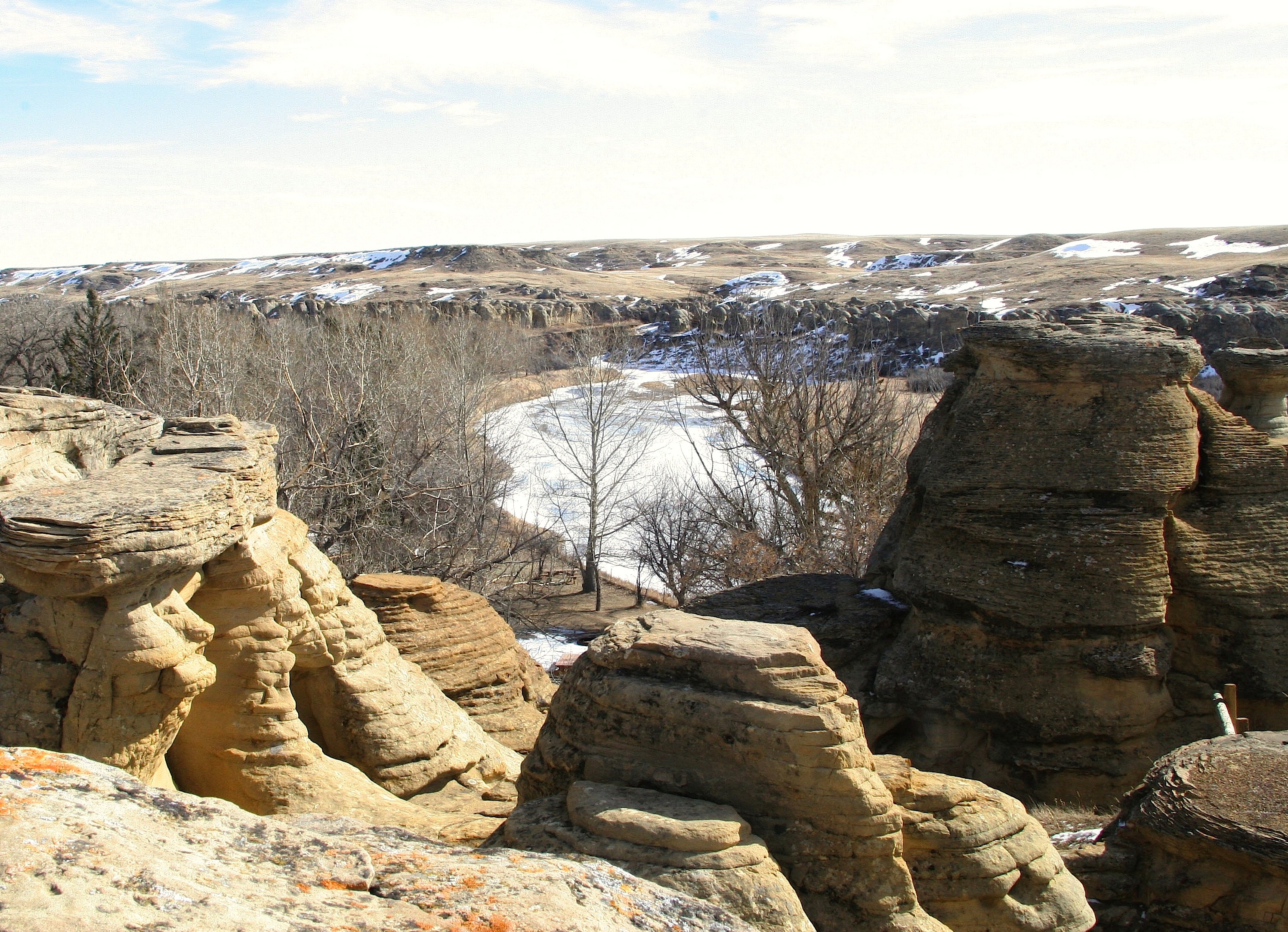
The Milk River has carved a wonderland of stone. In southern Alberta, sandstone pillars called hoodoos rise from the valley floor like sentinels from a fever dream - columns, mushrooms, pedestals balanced on stems. The Blackfoot call this place Áísínai'pi, 'where the writings are,' because their ancestors carved messages into these rocks for 3,000 years. Thousands of petroglyphs and pictographs cover the canyon walls: battle scenes, spirit beings, animals, symbols whose meanings are lost. The Blackfoot kept the site secret from European colonizers for generations. It was declared a UNESCO World Heritage Site in 2019 - one of the largest concentrations of Indigenous rock art on the North American Great Plains, hiding in plain sight for centuries.
The Carvings
Writing-on-Stone contains thousands of petroglyphs (carved images) and pictographs (painted images), the largest concentration on the northwestern Great Plains. The oldest date to roughly 1050 BCE; the most recent show horses, placing them after European contact in the 1700s. The images depict battles, hunts, ceremonies, and spirit beings - some clearly narrative, some apparently sacred. Many were carved by vision seekers who came to this powerful place seeking guidance. Some images show warriors in combat, counting specific coups with named enemies. Others defy interpretation, their meanings kept within oral traditions that colonization disrupted.
The Hoodoos
The rock formations that hold the carvings are themselves remarkable. Millions of years ago, this was seabed; the sediments hardened into sandstone that eroded into fantastical shapes as the Milk River cut through. Hard capstones protected softer rock below, creating pillars that seem to balance impossibly. The shapes look designed - faces, animals, impossible architecture - though they're purely geological. The Blackfoot saw spirit presence in the formations; European visitors saw curiosities. Both were right. The hoodoos created a landscape strange enough to mark as sacred, protected enough to preserve the carvings for millennia.
The Secrecy
The Blackfoot had good reason to hide Áísínai'pi. After European contact, sacred sites across the Plains were looted by collectors, vandalized by settlers, flooded by dams. The Blackfoot elders simply didn't tell outsiders about the writing on the stone. Early white visitors to the area mentioned the hoodoos but not the petroglyphs - the guides must have kept them hidden. The site wasn't officially 'discovered' by non-Indigenous Canadians until the 1920s. By then, attitudes had begun shifting toward preservation rather than destruction. The secrecy saved what couldn't be replaced.
The Reclamation
Today, Áísínai'pi is managed jointly by Alberta Parks and Blackfoot nations, who reclaimed interpretive authority over their own heritage. Tours are led by Indigenous guides who share what can be shared and protect what must remain private. The UNESCO designation in 2019 recognized the site's global significance while acknowledging Indigenous rights to control access and interpretation. Some areas remain restricted, visited only by Blackfoot for ceremonies. Others are open for guided tours. The balance between access and protection is imperfect but intentional - better to share carefully than to lose completely.
Visiting Writing-on-Stone
Writing-on-Stone Provincial Park is located in southern Alberta, 44 kilometers east of the town of Milk River, near the Montana border. The park has a campground, visitor center, and hiking trails among the hoodoos. Rock art sites are accessible only through guided tours booked in advance; independent wandering among the petroglyphs is prohibited to prevent damage. Tours fill quickly in summer; book ahead. The park is open year-round, but facilities are limited in winter. Lethbridge is the nearest city with full services, 100 kilometers north. The landscape is best photographed in early morning or late afternoon when shadows define the hoodoo shapes. Bring binoculars - some carvings are high on cliff faces.
From the Air
Located at 49.08°N, 111.62°W in southern Alberta, near the Montana border. From altitude, the Milk River valley is visible cutting through the prairie, with hoodoo formations appearing as irregular light-colored pillars along the canyon walls. The surrounding landscape is flat agricultural land; the valley creates a sudden dramatic interruption. The park campground and visitor facilities are visible near the river. The U.S.-Canada border runs just south of the park. This is big-sky country - few trees, long views, prairie stretching to the horizon in every direction except down into the carved valley.