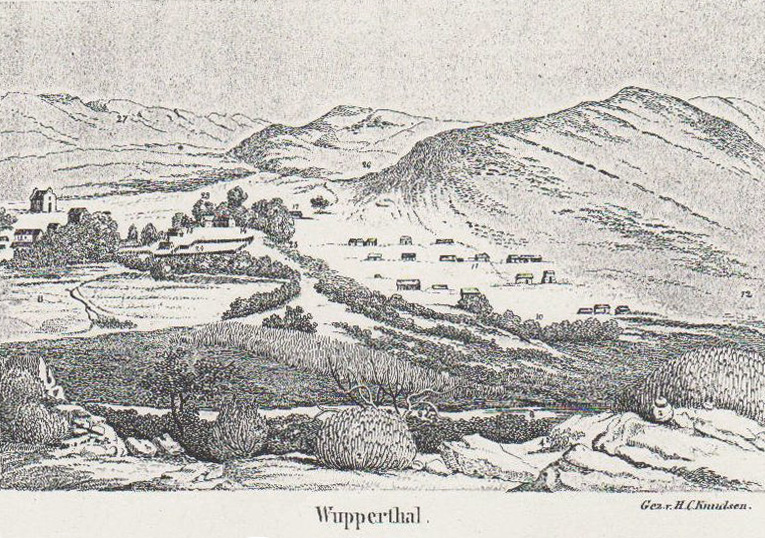
Wupperthal
It takes ten minutes to walk from one side of Wupperthal to the other. That fact tells you nearly everything about this village in the Cederberg mountains of the Western Cape -- its scale, its isolation, and the kind of life that unfolds here. Founded as a Moravian mission station, Wupperthal sits in a narrow valley roughly 250 kilometers from Cape Town, reachable only by a single mountain road that winds through some of South Africa's most dramatic terrain. In December 2018, fire swept through and destroyed most of the town, including the colonial-era buildings that had defined its character for nearly two centuries. The village is rebuilding, slowly and on its own terms.
A Mission in the Mountains
The Rhenish Missionary Society established Wupperthal in 1830 as a mission station in the Cederberg, founded by missionaries Baron Theobald von Wurmb and Johann Gottlieb Leipoldt -- grandfather of the poet C. Louis Leipoldt. The station was founded for Khoikhoi and freed-slave communities, and like all colonial-era mission stations, its history involves complex dynamics -- the imposition of European religious and social structures on indigenous communities, alongside the creation of stable settlements that offered some measure of protection in a landscape increasingly dominated by colonial land claims. In 1965, the Rhenish Mission handed the station over to the Moravian Church, which continues to oversee the village today. The mission station's legacy is not simple, but the village that grew from it developed its own identity, rooted in subsistence farming, artisanal craft, and the rhythms of a community that has lived in these mountains through generations of change.
Leather and Leaves
Wupperthal is known across South Africa for two things: veldskoene and rooibos. The veldskoene -- literally "field shoes" -- are traditional soft leather shoes handmade in a workshop that has operated in the village for decades. The craft is meticulous: each pair is cut, stitched, and shaped by hand from locally sourced leather, producing a shoe prized for its comfort and durability. Rooibos tea, the other local claim to fame, grows in the acidic soils of the surrounding mountain slopes. The Cederberg is one of the only places on Earth where rooibos grows naturally, and the area around Wupperthal is considered among the best growing regions. Locals who have lived here for decades know the land intimately -- the microclimates, the soil changes with altitude, the seasonal patterns that determine when to harvest.
Stone, Sand, and Ancient Art
The landscape surrounding Wupperthal belongs to the Cederberg Wilderness Nature Reserve, part of the Cape Fynbos UNESCO World Heritage Sites. Within hiking distance of the village, the terrain opens into a gallery of natural sandstone sculptures: the Maltese Cross, a towering pillar that mimics the shape of a Maltese cross; formations locally called Lot's Wife, which resemble a standing human figure; and arches carved by wind erosion over millions of years. The Stadsaal caves nearby shelter well-preserved San rock art, including depictions of elephants, shamans, and hunters that date back centuries or more. These paintings are sacred cultural heritage, recording the spiritual and daily life of the San communities who inhabited the Cederberg long before mission stations or farms.
After the Fire
In December 2018, fire tore through Wupperthal and consumed much of what had stood for generations. The colonial-era buildings -- the structures that gave the village its distinctive appearance and connected it visually to its mission-station origins -- were largely destroyed. The only restaurant in town burned. The recovery has been gradual, shaped by the same isolation that defines daily life here: the single road in is also the single road out, and the nearest substantial town, Clanwilliam, is on the other side of the mountain range. But Wupperthal persists. The workshop still makes veldskoene. The rooibos still grows. Hikers still arrive to walk the trails through the surrounding wilderness, and locals still tell the stories of a community that fire damaged but did not displace.
From the Air
Wupperthal is at approximately 32.27S, 19.21E, nestled in a narrow valley in the northern Cederberg mountains. From altitude, the village appears as a small cluster of structures in a valley surrounded by sandstone peaks. Access is via a single winding mountain road. Nearest town is Clanwilliam to the northeast. The Cederberg Wilderness Area is the dominant terrain feature. Cape Town International (FACT) is approximately 250 km to the south. Caution: mountainous terrain with limited emergency access.