Wycliffe Well
The concrete aliens standing guard out front are your first clue that this is not an ordinary fuel stop. Wycliffe Well sits on the Stuart Highway between Tennant Creek and Alice Springs, a speck of civilization in the vast Barkly region of Australia's Northern Territory. With only a handful of permanent residents, it barely qualifies as a settlement. But what it lacks in population, it compensates for with one of the most cheerfully absurd identities in the Australian Outback: self-proclaimed UFO Capital of Australia, ranked fifth in the world for reported sightings by The Sun Herald.
Logs from the Lonely Highway
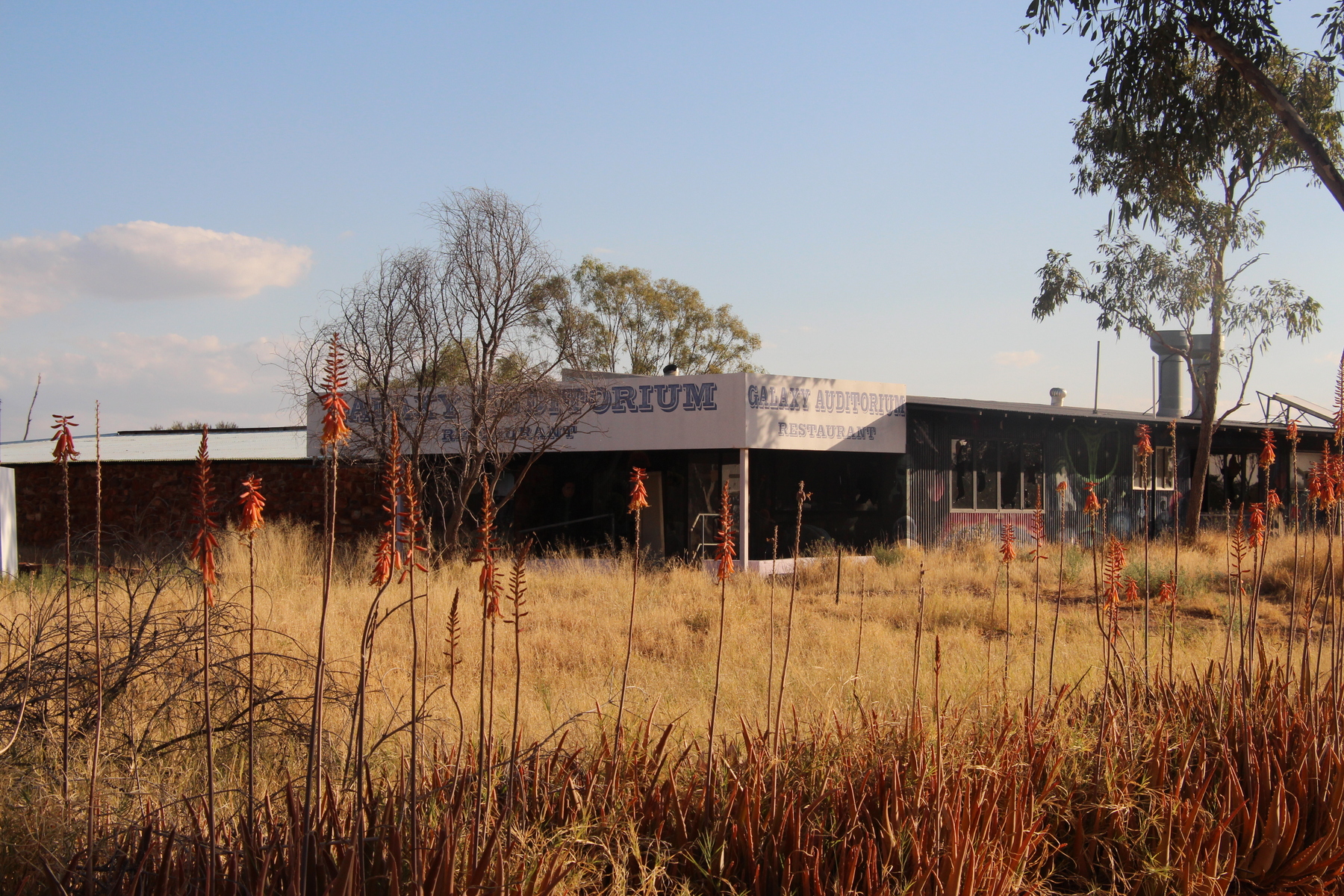
The UFO lore at Wycliffe Well traces back to World War II, when servicemen stationed in this remote stretch of the Northern Territory began recording strange lights in the night sky. They kept a handwritten log in an old binder, cataloguing sightings with the matter-of-fact precision of soldiers on watch. That original book sat on the front counter of the roadhouse restaurant for decades, available for any traveler to thumb through. It was eventually stolen, but a replacement log has been kept since the early 1990s, and browsing its entries remains one of the settlement's chief amusements. The descriptions range from the plausible to the gloriously improbable, each one recorded with deadpan sincerity. The restaurant itself doubles as an informal museum, its walls plastered with newspaper clippings, photographs, and testimonials designed to persuade even the most skeptical visitors. As the settlement's own brochure puts it: you would be considered unlucky not to see something if you stayed up all night looking.
Three Hundred Ways to Forget the Drive
For a place with essentially one building, Wycliffe Well punches well above its weight in one category: beer. The roadhouse bar stocks roughly 300 different labels when fully supplied, one of the largest selections in the Northern Territory. The logic is sound. Travelers who have been driving for hours through empty scrubland tend to arrive thirsty and curious, and the sheer variety invites experimentation. Pair that with the nightly country and western sing-along, which is free and decidedly informal, and you have the makings of a memorable evening. The atmosphere is unpretentious in the extreme. Conversations with locals and fellow travelers flow easily, lubricated by the kind of camaraderie that remote places cultivate. There are UFO-themed souvenirs on every wall, of course, but the real souvenir is the story you will tell afterward about the night you spent singing country music at a roadhouse in the middle of nowhere.
A Sky Without Interference
Strip away the alien kitsch and Wycliffe Well still has something genuinely remarkable: its sky. The Northern Territory is famous for its sunrises and sunsets, and Wycliffe Well, sitting in open country with virtually no artificial light pollution, offers some of the most vivid examples in Australia. At dusk, the western horizon flares through a spectrum of red and gold that seems designed to make photographers weep with gratitude. After dark, the absence of competing light sources reveals a canopy of stars so dense it feels three-dimensional. The Milky Way arcs overhead with a clarity that city-dwellers rarely experience, and the only intrusion comes from the occasional road train, its headlights sweeping briefly across the landscape before the darkness closes in again. Whether or not those wartime servicemen actually saw unidentified objects, the conditions for sky-watching here are indisputably excellent.
The Roadhouse at the Edge of Nowhere
In Australian parlance, a roadhouse is a service stop for petrol, food, and accommodation on long drives through the Outback, and Wycliffe Well fulfills that role with straightforward efficiency. The settlement sits roughly 130 kilometers south of Tennant Creek and 380 kilometers north of Alice Springs, so most visitors arrive with half-empty fuel tanks and appetites sharpened by hours on the road. Summers bring temperatures around 35 degrees Celsius during the day, dropping to a humid 21 at night. Winters are more forgiving, with daytime temperatures hovering near 20 degrees, though evenings stay surprisingly mild at around 15. A relocated sugar cane train from the state of Victoria, brought here in 1998, added one more curiosity to the collection. In late December 2022, a catastrophic flash flood swept through the site, destroying the roadhouse and forcing the operators to evacuate. The facility has been abandoned since, the alien statues and beer collection displaced. The cleared ground and highway sign remain, and the legacy of the place -- two exits, north or south on the Stuart Highway, toward Tennant Creek or Alice Springs -- endures even as the roadhouse itself awaits an uncertain future.
From the Air
Located at 20.80S, 134.24E in the Barkly region of Australia's Northern Territory, along the Stuart Highway. The settlement is visible as a tiny cluster of buildings amid flat, arid scrubland. Nearest airfield is Tennant Creek (YTNK), approximately 130 km to the north. Alice Springs Airport (YBAS) lies approximately 380 km to the south. Fly over at 3,000-5,000 ft AGL for best perspective on the vast, empty landscape surrounding this isolated roadhouse. Clear skies predominate, especially in the dry season (April-October).