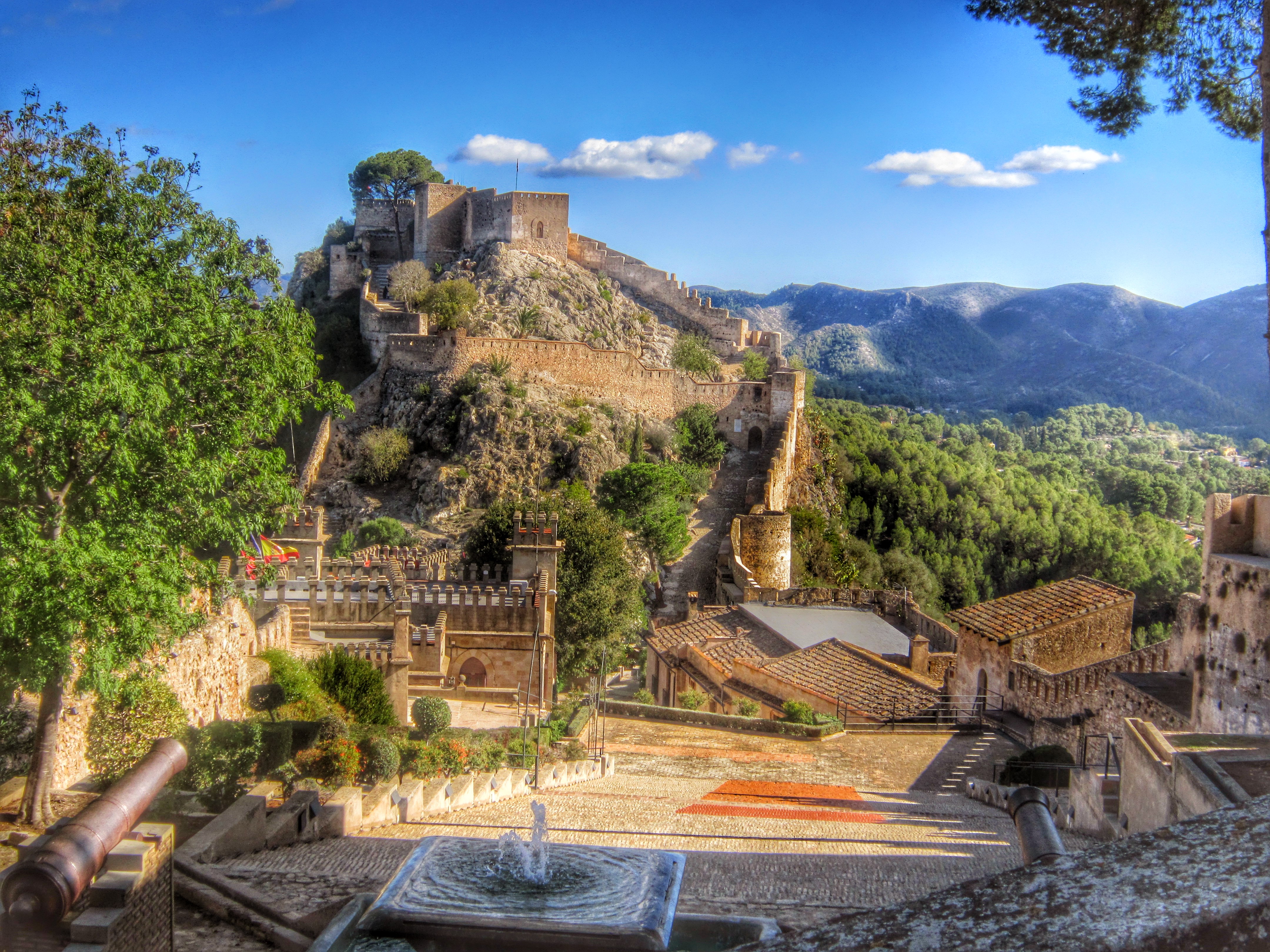
Xativa Castle
Hannibal stood here. Or so the story goes. In the third century BC, the Carthaginian general reportedly chose this ridge above what is now Xativa to plan his assault on Roman Saguntum, and tradition holds that his son was born within these walls in 218 BC. Whether or not those particular details survive scrutiny, the castle's location explains why someone of Hannibal's ambition would have wanted it. Perched 310 meters above the modern city, the fortress commands views across the entire Valencian coastal plain, and it sits directly on the Via Augusta, the ancient highway that connected Rome to Cadiz through the Pyrenees and down the Mediterranean shore. Every army marching along this coast had to reckon with whoever held this rock.
Two Castles, Two Thousand Years
What makes Xativa unusual among Spanish castles is its twin structure. The Castillo Menor, the older and smaller fortification, was built on Celtiberian foundations later expanded by Carthaginians and Romans. The Castillo Mayor, the larger castle, rose during the medieval period. Together they stretch along the ridgeline like a stone spine, each section reflecting the architectural priorities of its builders. Walking between them is a condensed lesson in Mediterranean military engineering, from Iberian dry-stone walls to medieval battlements. The layers are literal: dig into any section, and you pass through centuries.
The Treaty and Its Betrayal
When King James I of Aragon arrived during the Reconquista, the castle's Moorish governor negotiated rather than fought. Under the Treaty of Xativa, he handed over the smaller castle while the Muslim population retained the larger one for two more years. It was a pragmatic arrangement, designed to prevent bloodshed. But pragmatism had limits. After the two-year grace period expired, James I forcibly repopulated the town with Catalan and Aragonese settlers, slaughtering and expelling portions of the Muslim and Jewish populations. In the decades that followed, many Mudejar -- Muslims living under Christian rule -- left for Granada or North Africa. The castle had changed hands peacefully, but the city below it had not.
Fire, Earthquake, and Film Sets
The fortress saw combat again during the War of the Spanish Succession in 1707, when Castilian and French forces besieged Aragonese and English troops who had taken refuge within its walls. Xativa paid dearly for backing the losing side. Then, in 1748, an earthquake rocked the region and dealt the castle damage from which it never strategically recovered. The military significance faded, but the dramatic silhouette endured. Centuries later, the production team behind the Star Wars series Andor arrived and found exactly what they needed: a fortress that looked like it had witnessed the rise and fall of empires. Because it had.
The View from the Walls
Today the castle is one of the most visited monuments in the Valencia region. The climb from the city is steep but rewarded by panoramic views that stretch from the orange groves of the Costera valley to the distant Mediterranean. The fortification walls trace the contour of the ridge for several hundred meters, and the scale becomes apparent only from inside, where the twin castles reveal their distinct characters: the Castillo Menor compact and ancient, the Castillo Mayor sprawling and medieval. Stone cisterns, guard towers, and chapel ruins dot the grounds. The castle that once controlled a Roman highway now draws tourists who walk the same paths as Celtiberian warriors, Carthaginian generals, Moorish governors, and Aragonese kings.
From the Air
Located at 38.98N, 0.52W near the city of Xativa in Valencia, Spain. The twin castle complex is visible along a prominent ridgeline at 310 meters elevation. Best viewed from 3,000-5,000 feet AGL approaching from the coastal plain to the east. Nearest airport: LEVC (Valencia Airport), approximately 60 km northeast. The Via Augusta route is traceable as a corridor through the landscape.