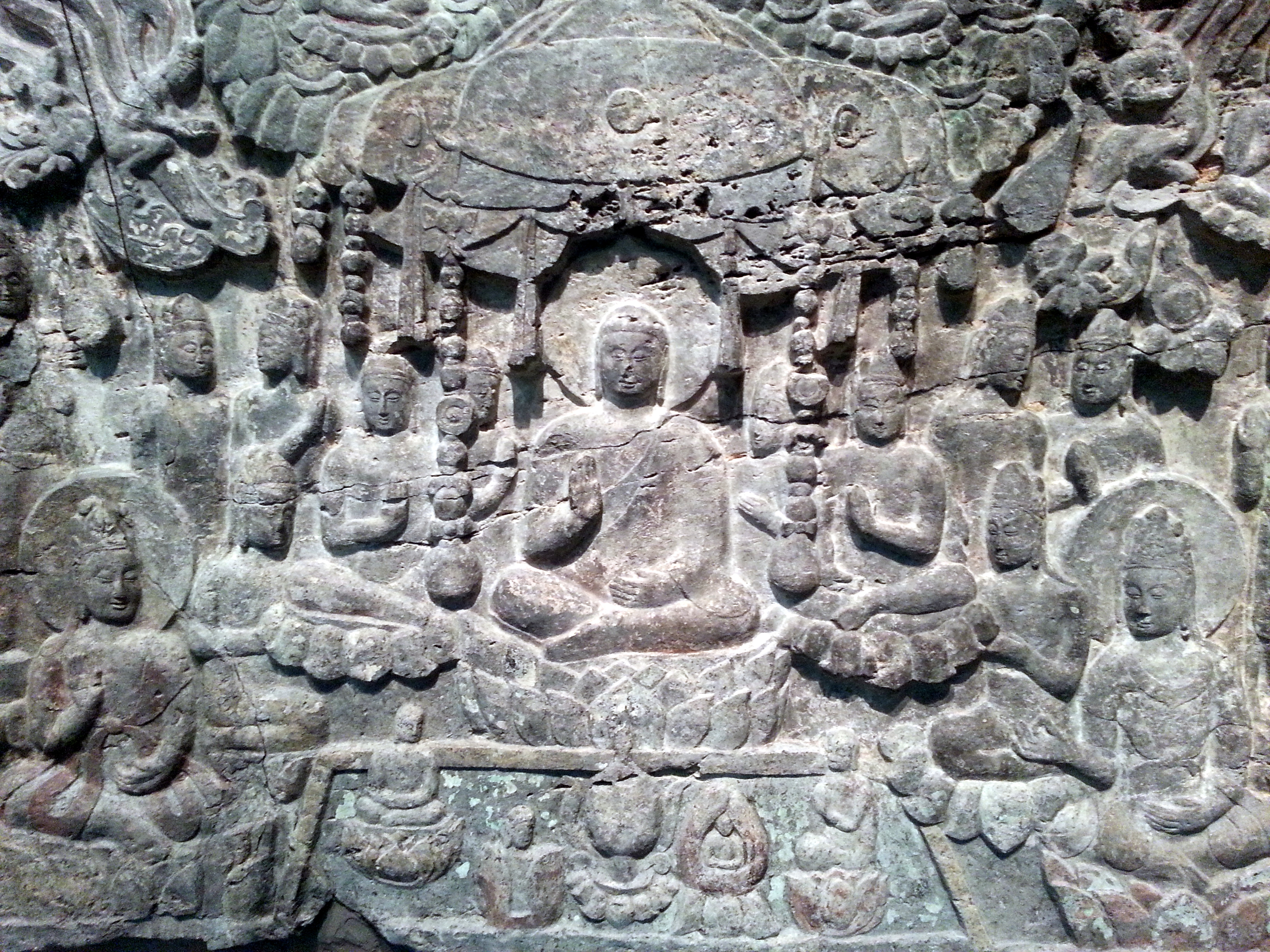
Xiangtangshan Caves
The Northern Qi dynasty lasted barely three decades, from 550 to 577 CE. In that compressed span, its emperors commissioned some of the most remarkable Buddhist art in Chinese history, carved directly into the limestone cliffs southwest of their capital at Ye. The Xiangtangshan Caves -- thirty-six chambers clustered in three groups across the mountains near present-day Handan, Hebei -- survive as the dynasty's most enduring cultural achievement, their sculptures still radiating a serene authority that outlasted the turbulent kingdom that created them.
An Emperor's Commission
The caves are scattered across three sites: a northern group on Mount Gu near the village of Hecun, a southern group on Mount Fu, and a smaller site at Shuiyusi known as Little Xiangtangshan. According to the writings of the monk Min Fen, the northern group was commissioned by Emperor Wenxuan, the first Northern Qi ruler. The largest chamber -- cave 7 in the northern group -- may have served as the emperor's own burial site, a sacred space where Buddhist devotion and imperial power merged in carved stone. The caves sit roughly 20 kilometers northwest of Ye, close enough to the capital that the court could oversee every chisel stroke.
Monks and Nobles at Work
While the northern caves bore the emperor's patronage, the southern group had humbler origins. In 565, a monk named Hui Yi from the Linghua Temple initiated construction on his own initiative. The project soon attracted the attention of Gao Anahong, the King of Huai Ying and one of the highest officials in the Northern Qi government. Under his sponsorship, the southern caves expanded in ambition and scale. Work continued until 577, when the Northern Zhou annexed the Northern Qi and carved this dynasty from the map of Chinese history. The caves preserve the creative energy of those final years -- a culture building monuments even as its political foundations crumbled.
Dense Stone, Lasting Art
The sculptors chose their medium well. The dense limestone of the Taihang Mountains, part of the range that forms the spine of northern China's geography, accepted fine detail and resisted weathering far better than the softer sandstone used at other Chinese cave temple sites. The Buddha figures that survive in the chambers possess a distinctive Northern Qi style: rounded faces, smooth surfaces, and a calm that seems to emanate from the stone itself. Traces of original pigment indicate the sculptures were once brightly painted, their polychrome surfaces catching lamplight in the dark interiors. The caves are designated a Major Historical and Cultural Site Protected at the National Level.
Scattered and Reclaimed
The caves endured centuries of neglect, and in the early twentieth century, many sculptures were removed and sold to Western collectors and museums. Pieces from Xiangtangshan now reside in institutions from the Freer-Sackler Gallery in Washington to the University of Chicago, which operates a dedicated Xiangtangshan Caves Project using digital technology to virtually reunite the scattered works with their original architectural contexts. Inside China, conservation efforts have intensified. The caves that remain intact still reward the journey to these remote mountain slopes, where the devotion of a vanished dynasty persists in stone.
From the Air
Located at 36.534N, 114.155E in the Fengfeng Mining District, about 20 km southwest of Handan, Hebei Province. The caves are carved into the Taihang Mountains -- maintain safe altitude when flying near this terrain. Nearest major airport: Handan Airport (ZBHD). The ancient capital of Ye lies approximately 20 km to the southeast. Recommended viewing altitude: 5,000-8,000 feet AGL.