Xiantong Temple
Fifty thousand kilograms of copper went into building a single hall. The monk Miaofeng supervised the casting during the reign of the Wanli Emperor in the late Ming dynasty, and the result still stands at the northern end of Xiantong Temple's central axis: a gleaming structure 8.3 meters high, its walls carved with ten thousand miniature Buddha statues. It is one small marvel inside the largest temple complex on Mount Wutai, itself the largest Buddhist complex in China.
From the Ashes of Han Dynasty Faith
Xiantong Temple traces its origins to the Yongping period of the Eastern Han dynasty, between 58 and 75 AD, making it one of the oldest Buddhist foundations in China. It was initially called Dafu Lingjiu Temple, a name that tied it to the Indian mountain where the Buddha is said to have delivered key sermons. Over the centuries that followed, the temple grew, was damaged, and was rebuilt repeatedly, but it preserved the fundamental architectural grammar of the Ming and Qing dynasties across its roughly 80,000 square meters. In 1983, the Chinese government designated it a National Key Buddhist Temple, and a major restoration of the granary followed in 1984. The Mahavira Hall was added as recently as 2004, proof that this is not a museum but a living institution, still evolving after nearly two millennia.
Seven Halls on a Sacred Axis
Walking Xiantong Temple's central axis is like reading a theological argument laid out in architecture. Seven main halls march northward in sequence: the Guanyin Hall, Great Manjusri Hall, Great Buddha Hall, Wuliang Hall, Qianbo Hall, Copper Hall, and Buddhist Texts Library. Each serves a distinct devotional purpose. The Wuliang Hall, fourth along the axis, is built entirely of blue brick without a single pillar or column, earning it the alternate name Beamless Hall. Inside sits a statue of Amituofo, the Buddha of Infinite Life, whose epithet gives the hall its formal name. The colors throughout the complex are palace-grade: gorgeous, deliberate, calibrated to convey both beauty and spiritual authority in the distinctive style of Ming and Qing court architecture.
A Thousand Arms, a Thousand Bowls
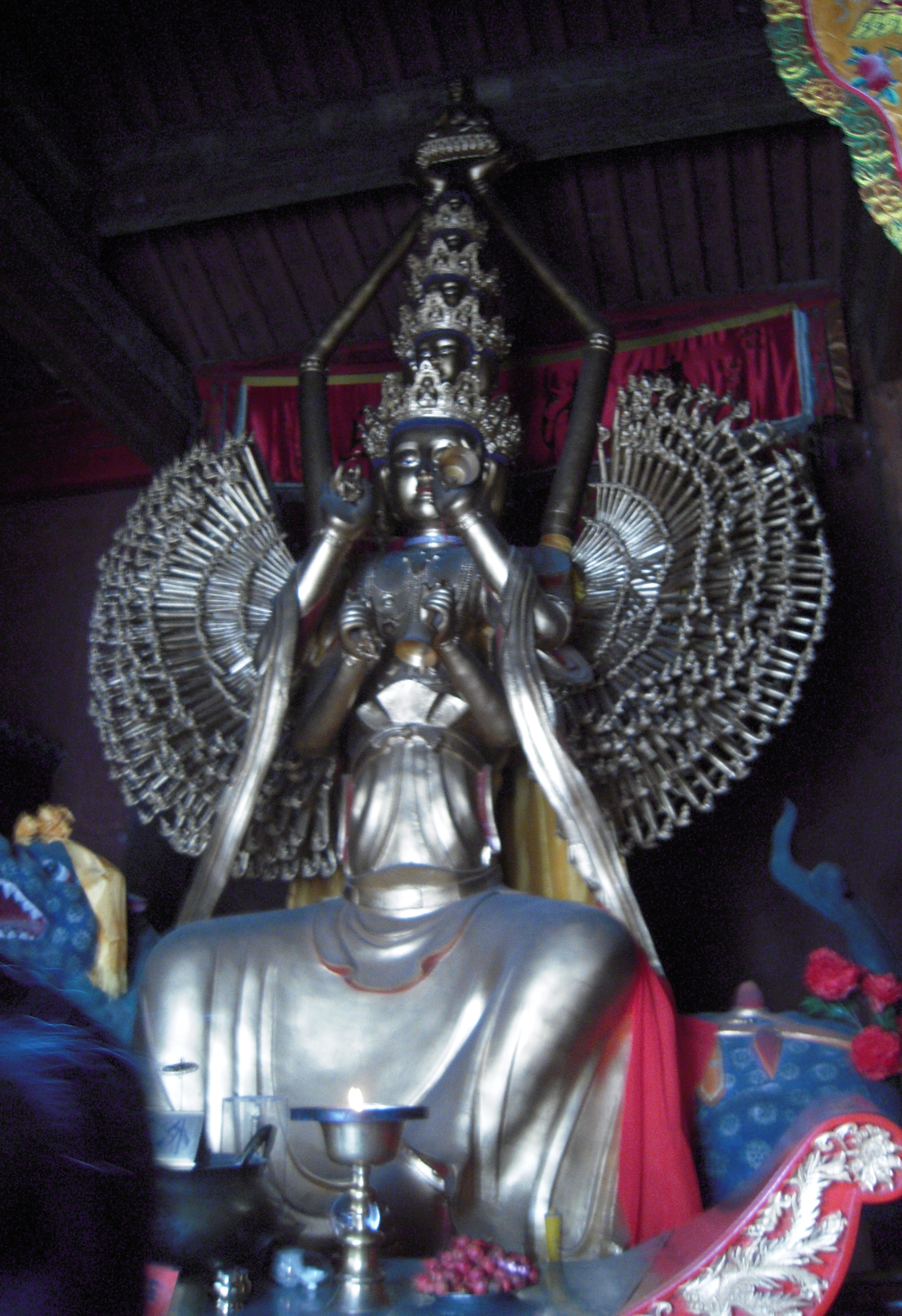
Behind the Beamless Hall stands the Qianbo Hall, housing one of Mount Wutai's most astonishing sculptures. A Ming dynasty copper statue depicts the Thousand-Armed and Thousand-Bowls Manjushri, the bodhisattva of wisdom who is considered the patron deity of Mount Wutai. The statue rises with five heads stacked vertically and six hands extending forward, two of which hold golden alms bowls containing seated figures of the Buddha. From behind the central figure, a thousand arms fan outward, each holding its own golden bowl, each bowl containing its own seated Buddha. The effect is hypnotic and overwhelming, a physical rendering of the Buddhist concept of infinite compassion radiating in all directions simultaneously.
The Longevity Bell
In the bell tower fronting the temple hangs a brass bell cast between 1621 and 1627 during the final decades of the Ming dynasty. It weighs 4,999.75 kilograms and bears over ten thousand words of Buddhist scripture inscribed on its exterior surface. When struck, its tone carries across the mountain valleys for a remarkable distance, which earned it the name Long Toll Bell. But the bell carries a second, more poetic name: the Longevity Bell. In Chinese, the words for 'long toll' and 'longevity' share the same pronunciation, a linguistic coincidence that transformed a simple observation about acoustics into a blessing. Every time the bell sounds, it wishes long life upon everyone who hears it.
Bronze Sanctuary in the Mountains
The Copper Hall remains the temple's most celebrated structure. Though it appears to be two stories from the outside, it is in fact a single-story chamber, nine chi wide and eight chi deep. Four pillars with drum-shaped bases support the interior, while the walls blaze with ten thousand small golden Buddha figures. Flowers, birds, and animals are engraved into the columns and partition boards with a delicacy that belies the material's weight. For all its artistry, the hall also represents an extraordinary feat of metallurgy and logistics: transporting and casting 50,000 kilograms of copper in the mountainous terrain of northern Shanxi during the late sixteenth century required engineering ambition that matched the spiritual devotion driving the project.
From the Air
Xiantong Temple sits at 39.009N, 113.590E in the town of Taihuai, nestled in the valleys of Mount Wutai in northern Shanxi Province. The nearest airport is Wutaishan Airport (ZBWT) in Dingxiang County, which opened in December 2015. From altitude, the temple complex is identifiable as one of the largest built-up clusters within the Wutai mountain basin. The surrounding terrain is mountainous with peaks reaching above 3,000 meters; maintain safe altitude and be prepared for rapidly changing mountain weather conditions.