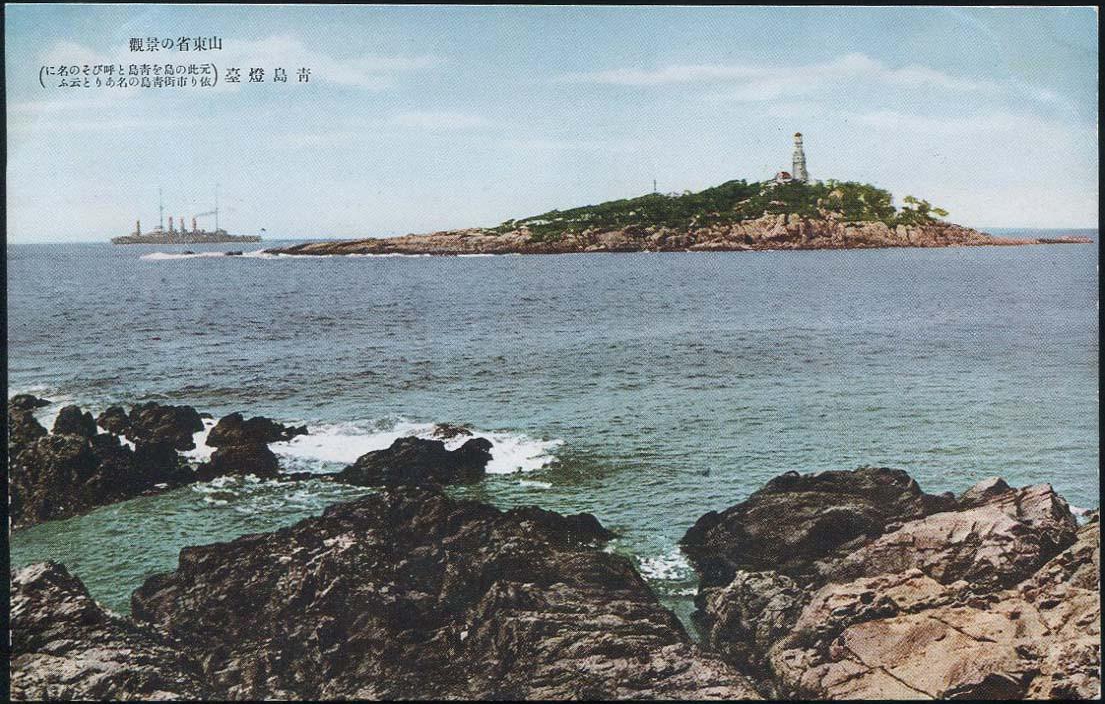
Xiao Qingdao
Every empire that held Qingdao renamed this island. The Chinese called it Xiao Qingdao -- "Little Qingdao," because it was small. The Germans called it Arcona Island, after the cruiser SMS Arcona, which was itself named for Cape Arkona on the Baltic island of Rugen. The Japanese renamed it Kato Island, after Admiral Kato Sadakichi. Through all of it, the island remained what it had always been: a scrap of land barely 0.024 square kilometers in area, sitting 17 meters above the Yellow Sea just southeast of Zhanqiao Pier, with a white lighthouse that has been guiding ships into harbor since 1904.
The Name That Traveled
There is a pleasing irony in Xiao Qingdao's history of names. Before the Germans arrived, this islet was simply called "Qingdao" -- and when Germany leased Jiaozhou Bay in 1898, they adopted the island's name for their entire colonial territory. The island that named a city became, in consequence, the "little" version of itself. The locals also call it Qin Dao, because its shape resembles a qin, an ancient Chinese stringed instrument. Whether you see a musical instrument or just a rocky outcrop depends on your angle of approach and your imagination, but the name has persisted alongside the more prosaic "Little Qingdao."
A Lighthouse Between Empires
In 1904, the harbor department of the German Governor's Office built a lighthouse on the island: 12.5 meters tall, octagonal, white marble, pyramidal in profile. It was a practical structure for a practical purpose -- guiding vessels into the harbor of a colonial port that Germany was developing into a modern trading city. When Japanese forces seized Jiaozhou Bay in 1914 during World War I, the lighthouse stayed lit under new management. It continued operating through decades of Japanese control, the return to Chinese sovereignty, and the Communist revolution. Today it is known as Xiaoqingdao Lighthouse, and it remains one of the most recognizable landmarks on the Qingdao waterfront.
Military Outpost to Public Park
Before 1897, Xiao Qingdao was a restricted military area -- a defensive position guarding the approaches to Jiaozhou Bay. The German occupation transformed it from a fortification into a colonial landmark, and subsequent administrations maintained various military uses for the strategic islet. But the island's significance today is more scenic than strategic. Connected to the mainland and surrounded by the lights of the modern waterfront, Xiao Qingdao offers a view of Qingdao's harbor that compresses the city's entire history into a single panorama: the German colonial buildings climbing the hillside, the naval museum along the shore, the skyscrapers beyond. Hand-drawn Chinese maps from the 1900s that stubbornly labeled the islet "Qingdao" even under German rule turned out to be prophetic. The empire left; the name came home.
From the Air
Xiao Qingdao is a small island at approximately 36.053N, 120.319E in Qingdao's harbor, southeast of Zhanqiao Pier. The white lighthouse is visible from low altitude. Nearest airport: ZSQD (Qingdao Jiaodong International Airport). The island sits in the heart of the Qingdao waterfront, between the pier and the naval museum.