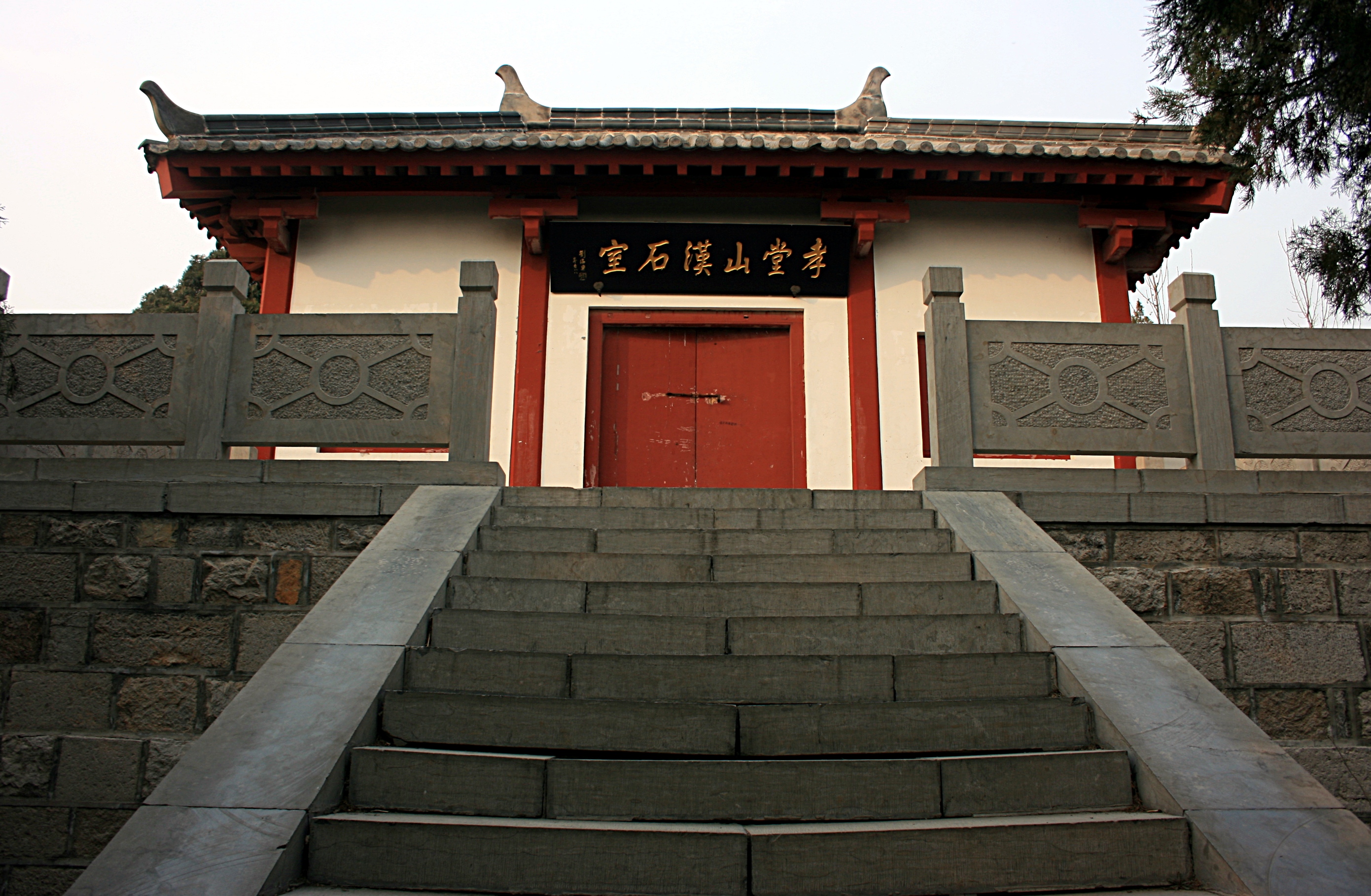
Xiaotang Mountain Han Shrine
Guo Ju was starving. During a famine in the Han dynasty, the filial son faced an impossible choice: there was not enough food for his aging mother and his infant child. According to the story immortalized on this hillside shrine, Guo Ju chose his mother. He began to dig a grave for his baby son. But as he broke the earth, he struck a cache of gold inscribed with a message declaring it a divine gift. The family was saved. This tale -- the thirteenth of China's Twenty-four Filial Exemplars -- is the story that defines the Xiaotang Mountain Han Shrine, the only known offering shrine from the Eastern Han dynasty still standing in its original form.
Stone Walls, Living Stories
The shrine sits on the slopes of Xiaotang Mountain -- literally "Filial Piety Hall Mountain" -- in what is now the Changqing District of Jinan, about 20 kilometers southwest of the city center and a mere 500 meters east of the Yellow River. The mountain has also been known as Guishan (Tortoise Mountain) and Wushan (Witch Mountain), names that hint at the layers of myth and meaning the site has accumulated. Built during the early Eastern Han dynasty (25-220 AD), the shrine is a funerary structure associated with the Guo family, erected atop the tombs of members of the upper nobility. Historical inscriptions date it to before 129 AD, the fourth year of the reign of Emperor Shun of Han.
An Encyclopedia in Stone
What makes the Xiaotang Mountain Shrine remarkable beyond its age is the richness of its carved imagery. The stone walls and triangular girders carry an encyclopedia of Han dynasty life and belief: legendary tales, historical events, timekeeping and astrology, royal audiences, scenes of travel and guest reception, military campaigns, hunting expeditions, cooking, and recreation. Simpler decorative motifs -- lowered curtains, water chestnut patterns -- adorn the supporting architectural elements. The carvings offer a visual window into how the Han elite understood their world, blending mythology with daily life in a way that few surviving artifacts can match. Among the shrine's most culturally valuable inscriptions is the Odes to Moving Filial Piety, composed by the King of Longdong during the Northern Qi dynasty (550-577 AD) and engraved on the outside gable.
The Terrible Virtue
The story of Guo Ju, which gives the mountain its name, illuminates a moral framework that can feel alien to modern sensibilities. Filial piety -- devotion to one's parents above all other obligations -- was the supreme virtue in Confucian ethics, and the Twenty-four Filial Exemplars were its most extreme illustrations. Guo Ju's willingness to sacrifice his own child to feed his mother was presented not as horror but as the highest moral achievement. The miraculous intervention that saves the baby transforms the tale from tragedy into fable, but the underlying message is unambiguous: parental duty supersedes everything. That this story was carved permanently into the stone of a funerary shrine speaks to how deeply these values were embedded in Han dynasty culture.
Sole Survivor
Funerary shrines were once common features of noble tombs across Han dynasty China, but time, war, and neglect have destroyed nearly all of them. The Xiaotang Mountain Shrine stands alone as the only known example still in its original form, a distinction that has made it an invaluable resource for historians of Chinese art, architecture, and religion. Studies by institutions including Harvard's Fine Arts Library and Yale University Press have examined its carvings in detail. For visitors who find their way to this quiet hillside near the Yellow River, the shrine offers something rare: an unmediated encounter with the beliefs and artistry of people who lived nearly two thousand years ago.
From the Air
Located at 36.40N, 116.60E on the slopes of Xiaotang Mountain in Changqing District, Jinan. The site is approximately 500 meters east of the Yellow River, which serves as a strong visual navigation reference. Nearest major airport is Jinan Yaoqiang International (ZSJN). Best viewed below 5,000 feet; the shrine complex and surrounding landscape are visible in clear conditions.