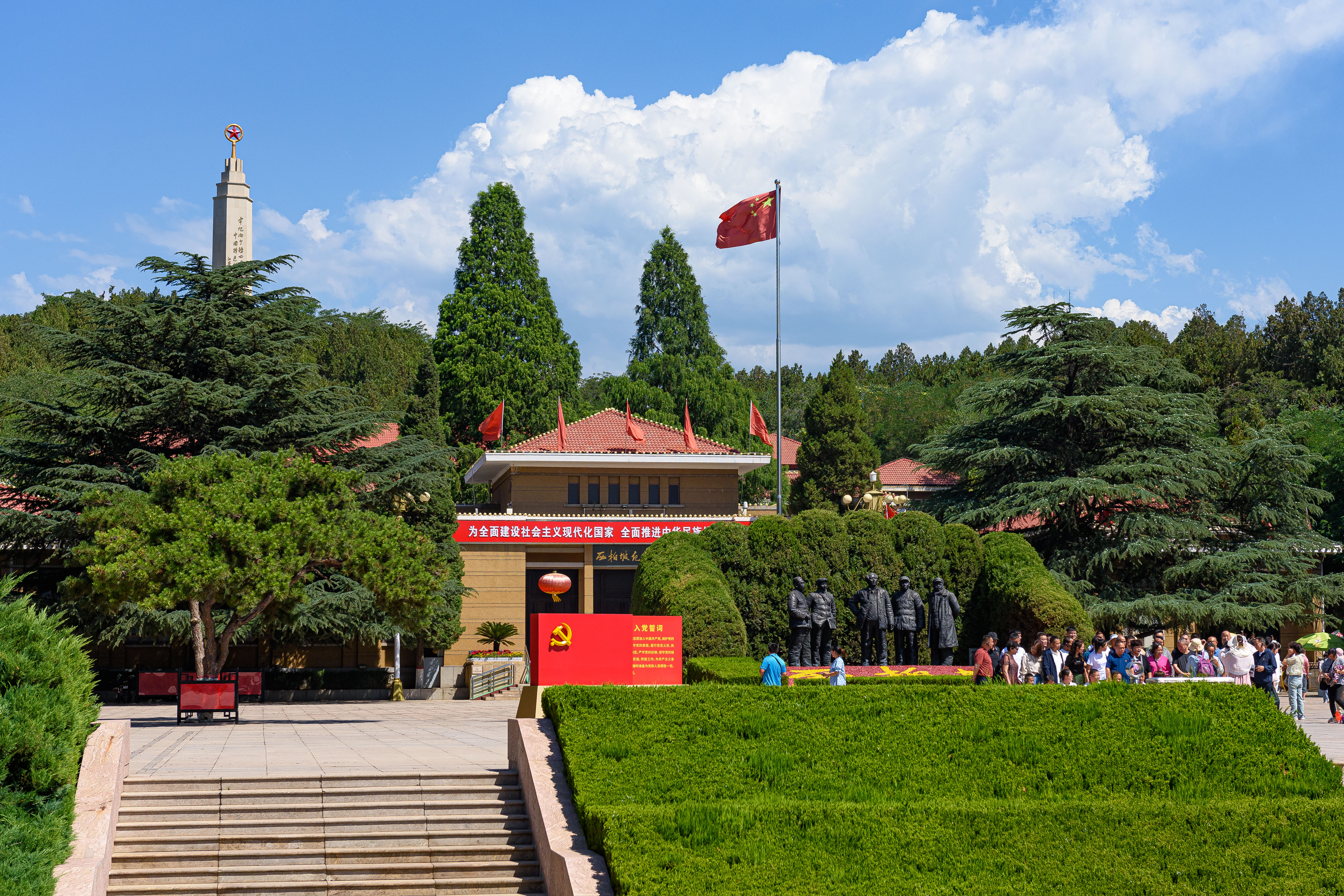
Xibaipo
The phrase has become part of China's political mythology: 'New China came from here.' The 'here' in question is not Beijing, not Shanghai, not any of the great cities. It is Xibaipo, a township in Pingshan County on the western edge of the North China Plain, where the Central Committee of the Chinese Communist Party established its headquarters during the final, decisive phase of the Chinese Civil War.
Command Post in a Village
From this unlikely base in rural Hebei, Mao Zedong and the Party leadership directed three campaigns that would determine the fate of China: the Liaoshen, Huaihai, and Pingjin campaigns. Together, these battles between 1948 and 1949 destroyed the military power of the Nationalist government and cleared the path for the founding of the People's Republic. Xibaipo served not only as a military command center but as a political one. It was here that the Second Plenary Session of the 7th Central Committee of the Chinese Communist Party convened, and here that the National Land Conference addressed the redistribution of land that would reshape rural China. The village earned a second epithet that captures the scale of decisions made within its modest buildings: 'the destiny of China turned in this village.'
From Headquarters to Shrine
Today Xibaipo functions as one of China's most important revolutionary heritage sites. The Xibaipo Memorial Hall anchors a complex that draws visitors seeking to understand the origins of the People's Republic. The site has been designated both a national key cultural relic protection unit and a national AAAAA-level tourist attraction, the highest rating in China's tourism system. The buildings where decisions were made during the Civil War have been preserved and reconstructed as exhibits, allowing visitors to walk through the rooms where strategy sessions took place and telegrams were dispatched. For domestic Chinese tourists especially, a visit to Xibaipo carries civic and educational weight comparable to visiting Independence Hall in Philadelphia or the Kremlin in Moscow.
The Landscape of Revolution
Xibaipo's location was not accidental. Nestled in the foothills where the Taihang Mountains meet the North China Plain, the area offered both defensibility and access to communication routes. Pingshan County sits west of Shijiazhuang, Hebei's capital, in terrain that provided natural concealment during a period when control of China's cities remained contested. The surrounding hills and valleys allowed the Party leadership to operate with a degree of security that urban locations could not have offered. Water from nearby reservoirs now submerges much of the original village site, adding another layer to the place's history: the landscape itself has been transformed by the state that was conceived within it.
The Weight of a Phrase
Every nation constructs origin stories, and Xibaipo occupies a central place in China's. The claim that 'New China came from here' compresses an enormously complex historical process into a geographic point, turning a village into a symbol. Whether this framing oversimplifies the revolution's many threads or usefully anchors an abstract transformation in a concrete place depends on the visitor's perspective. What is undeniable is that consequential decisions were made in this location, by people who understood the stakes, at a moment when China's future was genuinely uncertain. The memorial preserves that moment not as history alone but as a founding narrative, still actively shaping how China understands itself.
From the Air
Xibaipo is located at 38.318N, 114.013E in Pingshan County, approximately 80 km west of Shijiazhuang, the capital of Hebei Province. The nearest major airport is Shijiazhuang Zhengding International Airport (ZBSJ). The site sits in the foothills where the Taihang Mountains transition to the North China Plain, at moderate elevation. From the air, look for the reservoir system west of Shijiazhuang and the memorial complex near the shoreline. The terrain transitions from flat agricultural plain in the east to hilly upland in the west.