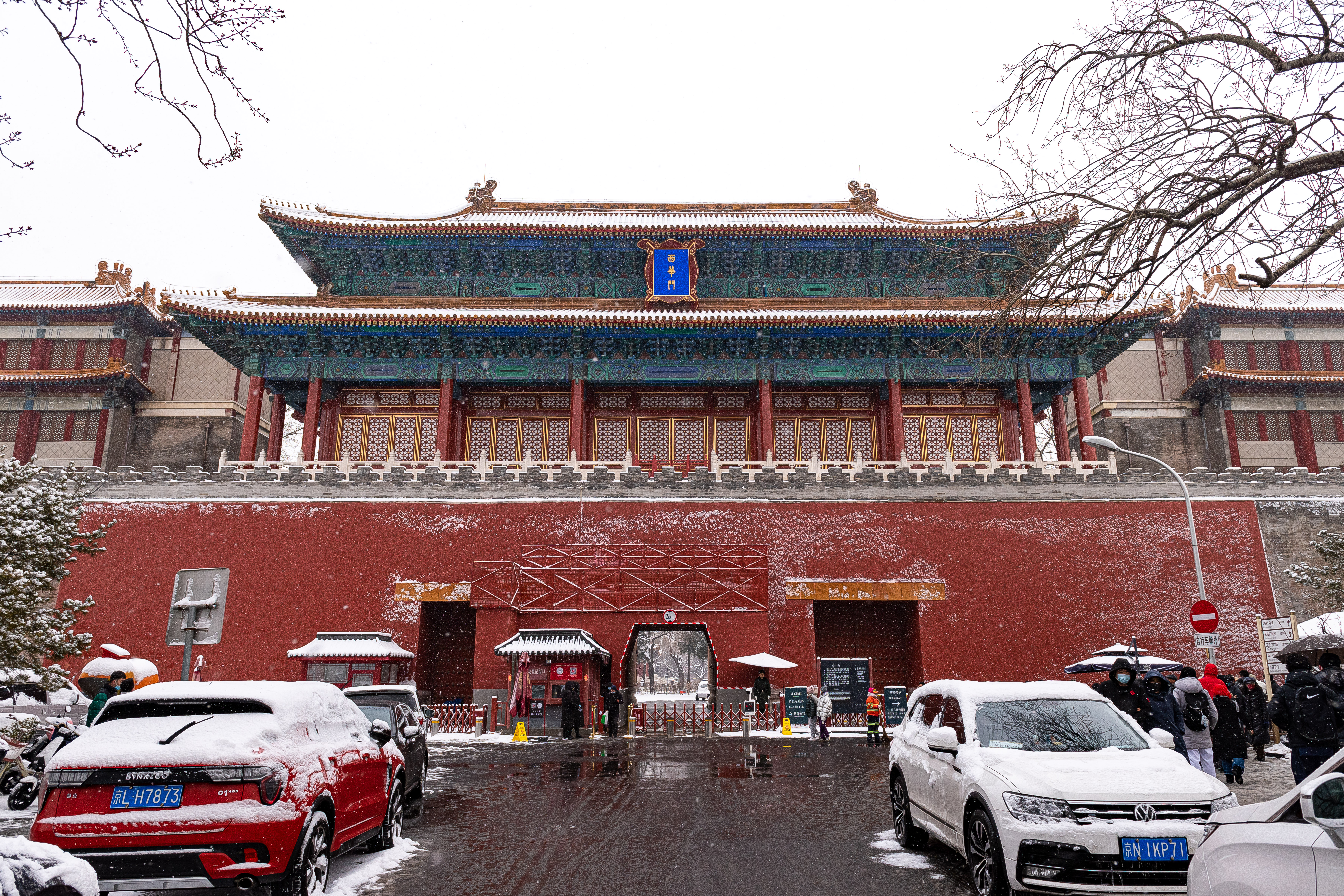
Xihua Gate
On October 8, 1813, a band of Tianli Sect rebels charged through the western entrance of the Forbidden City, blades drawn, intent on toppling the Qing dynasty. The attack on Xihua Gate -- the West Prosperity Gate -- was part of a coordinated assault on both sides of the imperial palace, and it stunned the court so thoroughly that the Jiaqing Emperor later called it "an event without precedent in the Han, Tang, Song, or Ming dynasties." Nearly a century later, a far more powerful figure would pass through these same arched openings in the opposite direction, fleeing rather than attacking.
Six Centuries Standing Guard
Xihua Gate was built in 1420, during the eighteenth year of the Yongle Emperor's reign, as the western entrance to the vast imperial complex he was constructing in Beijing. The gate faces east and west, directly opposite its twin, Donghua Gate, on the eastern wall. Three arched openings pierce a red-painted platform resting on a white marble base, and above them rises a gate tower crowned with a double-eaved hip roof of yellow glazed tiles. The tower stretches five bays wide and three bays deep, its interior beams decorated with black-line spiral motifs dotted with gold in the traditional Qing style. A plaque bearing the gate's name once displayed inscriptions in Manchu, Mongolian, and Chinese. Over time the Mongolian was removed, and after the 1911 revolution, only copper Chinese characters remained -- a quiet record of shifting political power written on a single piece of wood.
Rebels at the Threshold
The 1813 rebel assault was audacious in its conception. Lin Qing, leader of the Tianli Sect, dispatched fighters to attack both Xihua Gate and Donghua Gate simultaneously, hoping to breach the Forbidden City from two directions. The rebels managed to penetrate the outer defenses before Qing forces suppressed them. The emperor was away at his summer retreat in Rehe when news of the attack reached him. Upon his return, he personally interrogated the captured rebel leader and the eunuchs who had facilitated the breach, then ordered their immediate execution. Prince Li Zhaolian captured the era's shock when he asked: "Has such an incident ever occurred since the beginning of time?" The arrows embedded in the Longzong Gate nearby survive as physical reminders of how close the rebels came.
An Empress in Flight
In 1900, the Forbidden City faced a threat no internal rebel force could match. The Eight-Nation Alliance invaded Beijing in response to the Boxer Rebellion, and as foreign troops advanced through the capital, Empress Dowager Cixi made a desperate decision. She gathered Emperor Guangxu and a small entourage, and they fled through Xihua Gate into the chaos of a city under siege. The escape was hasty and disordered -- the most powerful woman in China slipping through the same gate that stored cotton armor and ceremonial military equipment for imperial reviews. The irony of fleeing through a gate named for prosperity was lost on no one, though nobody dared say so at the time.
The Premier's Midnight Concern
Xihua Gate's story took an unexpected turn in 1973 when Premier Zhou Enlai, walking the grounds of Zhongnanhai late at night, noticed construction lights from the new East Wing of the Beijing Hotel. Concerned that the tall building could compromise the security and visual integrity of the government compound, Zhou dispatched his commissar to investigate. When someone proposed raising the Meridian Gate tower of the Forbidden City to block the view, Zhou rejected the idea instantly: "First, we must not damage cultural relics; second, we shouldn't do something as foolish as trying to hide what's plainly there." He insisted that Beijing needed no buildings taller than fifty meters along Chang'an Avenue. The episode revealed something about the relationship between old Beijing and new -- the gate stood at the intersection of imperial heritage and modern governance, a boundary that Premier Zhou understood could not simply be built over.
A Gate Between Two Worlds
The placement of Xihua Gate is itself a lesson in imperial planning. Rather than centering it on the western wall, the architects positioned it slightly south, closer to the Meridian Gate, to align with the horizontal axis running through the Outer Court. This deliberate asymmetry connected Xihua Gate to the Gate of Supreme Harmony and onward through the Imperial City to Xi'anmen, making it a crucial transit point between the imperial world within and the capital beyond. For centuries, the flow of officials, soldiers, and supplies passed through these three arched openings. In more recent decades, dozens of military buses entered and exited daily, until preservation advocates began pushing for the removal of modern military facilities from the palace grounds. The gate remains what it has always been: a threshold between power and the world it governs.
From the Air
Located at 39.91N, 116.39E on the western wall of the Forbidden City. From altitude, look for the vast rectangular compound of the Forbidden City in central Beijing, with the golden-roofed gate towers visible at each wall. Nearest airport is Beijing Capital International (ZBAA/PEK), approximately 25 km northeast.