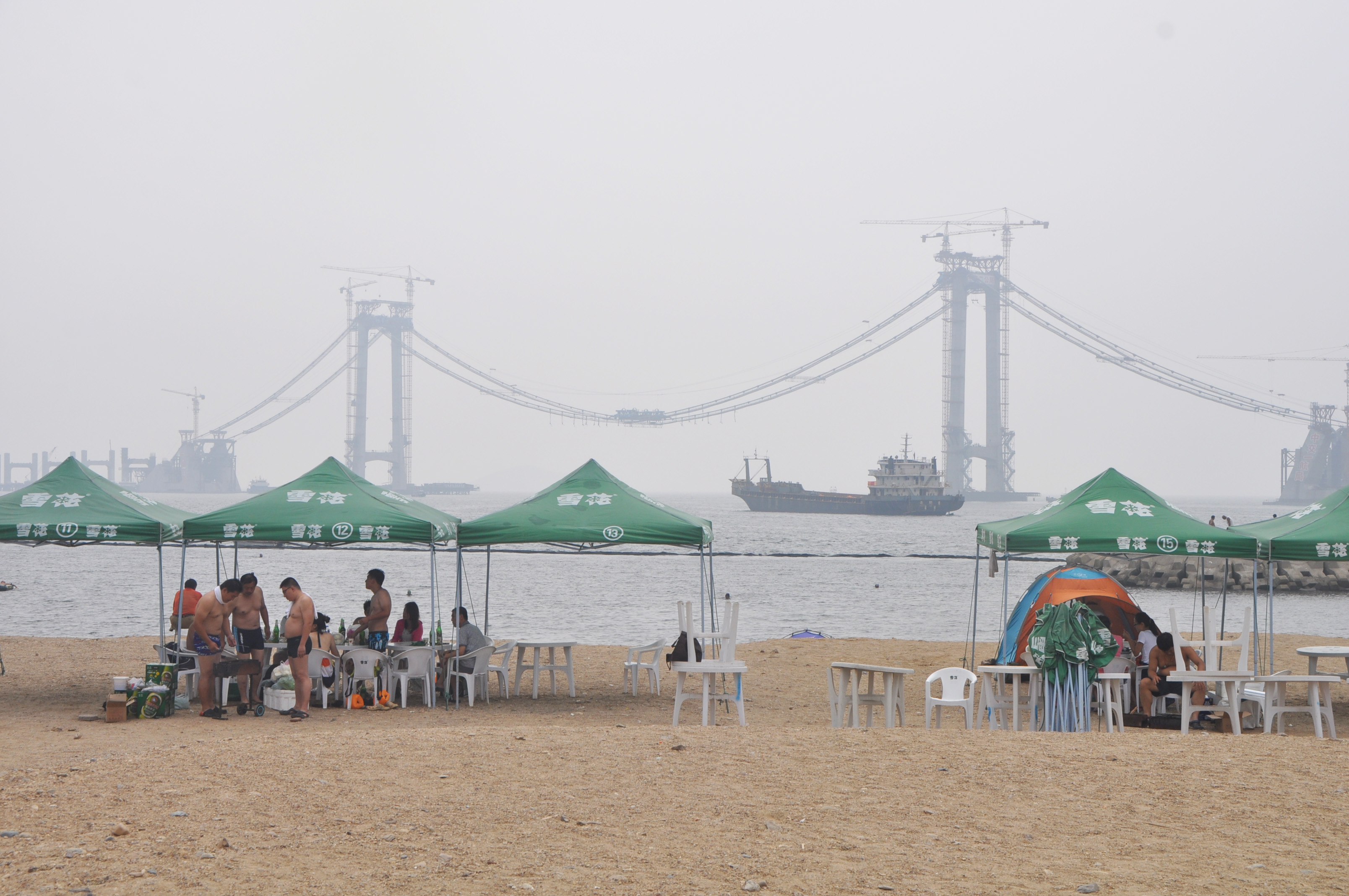
Xinghai Park
The Japanese called it Hoshi-ga-Ura, Star Beach, and in 1909 the South Manchuria Railway Company turned it into a resort complete with a bathing beach, a golf course, and one of their signature Yamato Hotels. It was named one of the Eight Scenic Spots of Lushun-Dalian, a designation that said as much about colonial aspiration as natural beauty. When the colonial era ended in 1945, the resort kept its spot on the coast but shed its Japanese name, becoming Xinghai Park, which carries the same meaning in Chinese: Star Sea. More than a century later, the stars have faded from the name but not from the shoreline.
800 Meters of Yellow Sea Coastline
Xinghai Park covers 150,000 square meters of Dalian's southern coast, anchored by an 800-meter beach that ranks among the city's four major swimming beaches. The water is shallow enough for safe bathing, the sand accessible enough for families, and the location convenient enough that the park draws steady crowds from spring through autumn. A 55-meter bungee jumping platform, imported from New Zealand, extends over the sea, offering a view of the Xinghai Bay Bridge that stretches across the water offshore. A coastal walkway connects the park to Xinghai Square, Dalian's massive waterfront plaza to the east. To the east of the park sits the Sunasia Ocean World, an oceanarium that adds another draw to a stretch of coastline that has been attracting visitors since Teddy Roosevelt was president.
From Colonial Playground to Public Beach
The South Manchuria Railway Company built resorts across its network, and the one at Hoshi-ga-Ura was among the most scenic. The Yamato Hotel chain was the railway's hospitality arm, placing luxury accommodations at key stops along the line. Star Beach combined that hotel tradition with recreational facilities designed for the colonial elite: the golf course and bathing beach served Japanese residents and visiting dignitaries. After 1945, the resort's transformation into a public park democratized what had been an exclusive space. The golf course is gone. The Yamato Hotel is history. What remains is the beach and the view, both of which were always the real attractions. The park is now free and open daily, from 7:30 to 17:30 with extended hours in summer.
Gateway to Dalian's Southern Shore
Xinghai Park sits on Zhongshan Road, the arterial boulevard that forms part of the historic Lushun South Road connecting Dalian's downtown to the old port district of Lushun. The road follows the coast, threading through some of the city's most scenic stretches. Dalian Metro's Line 1 stops at Second Hospital of Dalian Medical University Station, a 500-meter walk to the west. The park functions as the western anchor of Dalian's premier coastal recreational zone, with Xinghai Square and the Xinghai Bay Bridge extending the waterfront experience eastward. On clear days, the bridge's graceful arc frames the horizon beyond the bungee platform, and the Yellow Sea stretches south toward the open Pacific. A park that began as one empire's beach retreat has become a city's front porch to the ocean.
From the Air
Located at 38.88N, 121.56E on the southern coast of Dalian, facing the Yellow Sea. The park and beach are visible from altitude along the coastline between Xinghai Square (to the east) and Lushun (to the west). The Xinghai Bay Bridge is a prominent visual landmark offshore. Nearest major airport is Dalian Zhoushuizi International (ZYTL/DLC), approximately 12 km to the north-northwest.