Xinglongwa Culture
Eight thousand years ago, on a hillside in what is now Aohan Banner in Inner Mongolia, someone decided that houses should be built in rows. This was not a casual arrangement. At the Xinglongwa type site, 120 pit-houses were organized in deliberate patterns, with a large central building at the village's heart and a ditch surrounding the entire settlement. It is the earliest discovered site in China to be surrounded by a defensive ditch. The Xinglongwa culture, dating from approximately 6200 to 5400 BC, was not just an early settlement. It was an early experiment in community planning.
A Village with a Blueprint
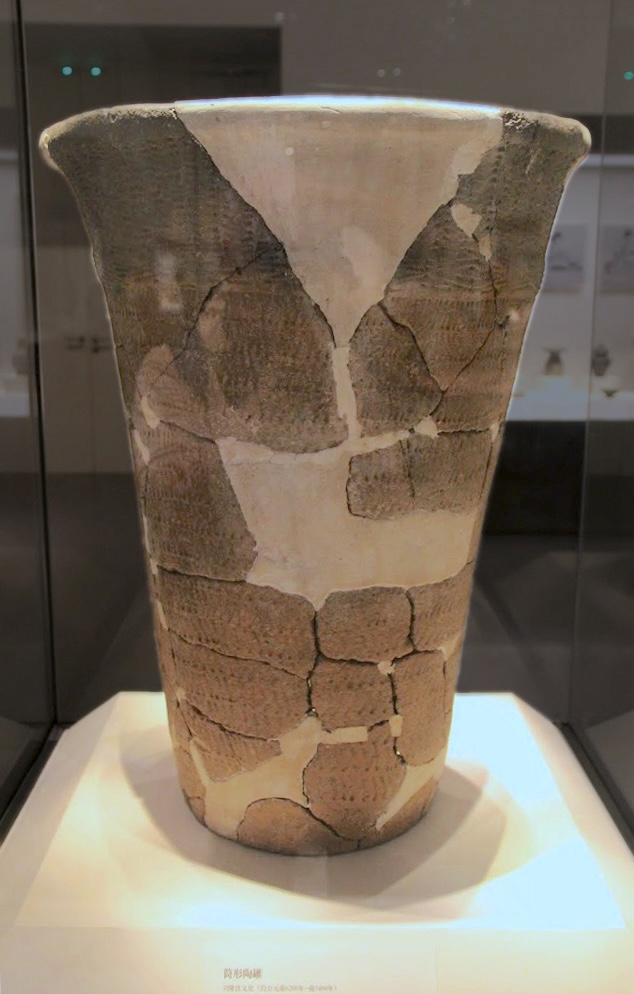
At three separate Xinglongwa sites, archaeologists found houses built in rows, a pattern that implies collective decision-making about spatial organization. Several sites featured large central buildings that may have served communal or ceremonial purposes. The ditches surrounding some settlements suggest awareness of external threats or, at minimum, a desire to define boundaries. Each home at the type site contained a central hearth. The village named after Xinglongwa sits on the southwest side of a hill, 1.3 kilometers from the modern village that gave it its name. The pottery produced here was cylindrical and fired at low temperatures, functional rather than decorative, the work of people focused on survival and organization rather than aesthetic display.
The Dead Beneath the Living
The Xinglongwa culture practiced an unusual burial custom: some bodies were interred directly under the houses where people lived. Of 34 sets of human remains studied from these in-house burials, males outnumbered females roughly two to one, and no children younger than 13 or 14 were found, suggesting that young children may have been buried elsewhere or by different means. The most lavish grave contained a man buried with a pair of pigs and jade objects, indicating social stratification even in this early period. The jade artifacts are among the earliest found in China. Living above the bones of ancestors may have served a spiritual function, binding generations together in a shared space that was simultaneously domestic and sacred.
First Farmers, First Musicians
The recently discovered site at Xinglonggou is the only Xinglongwa-culture site to provide evidence of agriculture: remains of broomcorn millet in the early stages of domestication, directly dated to around 7,700 years before present. This makes it the earliest directly dated millet in the archaeological record. Yet the Xinglongwa people were not primarily farmers. They subsisted mainly on hunting and gathering, with millet cultivation representing an early experiment rather than a dietary staple. Beyond food and shelter, they also made music. A bone flute with five finger holes was found at a Xinglongwa site, and some of the oldest Comb Ceramic artifacts known have been recovered from the culture's deposits.
Ancestors of the Northeast
The Xinglongwa culture preceded the better-known Hongshan culture by more than a millennium, laying foundations that subsequent societies would build upon. Some scholars have proposed that the Xinglongwa people may be the distant ancestors of present-day Northeast Asian peoples belonging to the proposed Transeurasian language family, though this view has been debated. What is less disputed is the culture's place in the long sequence of Neolithic development in the Liao River basin: from Xinglongwa through Xinle and Zhaobaogou to Hongshan and beyond, this region of Inner Mongolia and Liaoning supported continuous cultural development for thousands of years. The row houses and central buildings of Xinglongwa were the first chapter in a very long story.
From the Air
Located at 42.46°N, 120.28°E in Aohan Banner, Chifeng, Inner Mongolia. The site is on a hillside in a semi-arid landscape near the Inner Mongolia-Liaoning border. Nearest major airport is Chifeng Yulong Airport (ZBCF), approximately 80 km to the northwest. The terrain from altitude shows rolling steppe transitioning to the low mountains of the Liao River headwaters.