Xinhuamen
Folk legend says the Qianlong Emperor built Baoyue Tower in 1758 so his beloved concubine Xiangfei could climb to the top and see the mosque beyond the imperial walls, easing her homesickness for the Western Regions. The story is almost certainly apocryphal, but it captures something true about the building: it was designed for looking. From the tower, the moon reflected in Taiye Lake below, and the emperor gave it a name that meant "Precious Moon." What no one anticipated was that this lakeside pavilion for contemplating reflections would one day become Xinhua Gate -- the most politically charged doorway in China.
From Pavilion to Portal
In 1913, the Beiyang government needed a grand entrance for its new presidential palace in Zhongnanhai, the sprawling lakeside compound adjacent to the Forbidden City. The problem was that Zhongnanhai had no proper gate facing the capital's main thoroughfare, Chang'an Avenue. Its access had always been through the Forbidden City itself. Under the supervision of Interior Minister Zhu Qiqin, workers demolished a section of the imperial city wall south of Baoyue Tower and constructed new angled walls to connect the tower to what remained. The pavilion became a gatehouse. The section of Chang'an Avenue in front was renamed Fuqian Street -- literally "In Front of the Prefecture" -- and the transformation was complete. Baoyue Tower, built for gazing at moonlight, became Xinhua Gate, the Gate of New China.
Stone Lions and Shifting Slogans
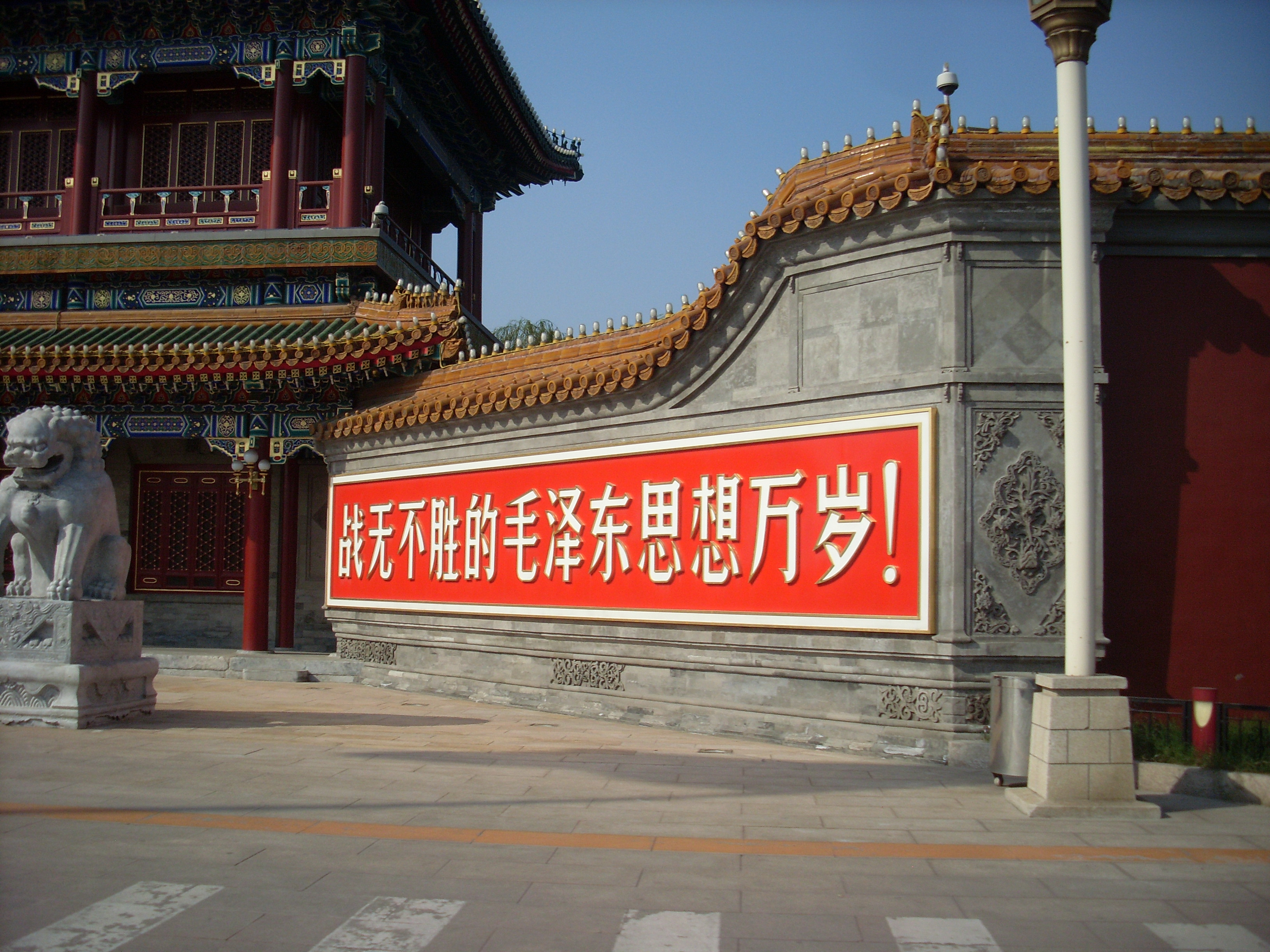
The pair of stone lions flanking Xinhua Gate are said to have come from the original Prince Duan's Mansion, and they were reportedly the largest such pair in old Beijing. Behind them, the gate's architecture tells a layered story. The two-story brick and wood structure is seven rooms wide, with three central rooms serving as doorways on the ground floor. Yellow glazed tiles with green trimmings cap a hip roof, and the national emblem of China hangs above the second story. But the most politically revealing features are the inscriptions. On the screen wall inside, Mao Zedong's calligraphy spells out "Serve the People" in gold on red. The eight-character walls on either side carry slogans that have been revised over the decades, reflecting each era's political priorities.
What Survived the Reckoning
After the Cultural Revolution was officially repudiated in 1981, China began removing the slogans, quotation boards, and political graffiti that had accumulated across the country over fifteen years of ideological upheaval. Zhongnanhai was no exception -- the Central Security Bureau conducted a careful review of every inscription in the compound, determining which should be removed and which retained. The slogans flanking Xinhua Gate and Mao's calligraphy on the screen wall survived the review. They remain today, reading "Long live the great Chinese Communist Party" and "Long live the invincible Mao Zedong Thought" -- artifacts of an era that was officially disavowed, preserved at the entrance to the government that disavowed it. The decision to keep them was pragmatic rather than nostalgic: removing Mao's handwriting from the gate of power would have raised more questions than leaving it in place.
The Gate That Remade a Neighborhood
Xinhua Gate did not just transform a building; it reshaped the surrounding streets. When the pavilion became a gatehouse, the neighborhood south of Zhongnanhai was reorganized around it. A Western-style flower wall was erected across the avenue to hide the dilapidated bungalows behind it and improve the view from the presidential palace. The project also demolished the main gate of a nearby Hui mosque, erasing one community's landmark to create another's. New streets were named for the new political geography: Fuyou Street for the presidential compound, Xinhua Street for the gate. In 1999, the entire Xinhuamen area was renovated with lighting as part of a broader upgrade of Chang'an Avenue for the fiftieth anniversary of the People's Republic. The gate that began as a private place for watching moonlight has become inseparable from the avenue that represents Chinese state power.
From the Air
Located at 39.91N, 116.38E on the north side of West Chang'an Avenue, directly south of the Zhongnanhai compound. From the air, Xinhua Gate is identifiable by the wide boulevard of Chang'an Avenue and the walled lakeside compound behind it. Nearest airport is Beijing Capital International (ZBAA/PEK), approximately 26 km northeast.