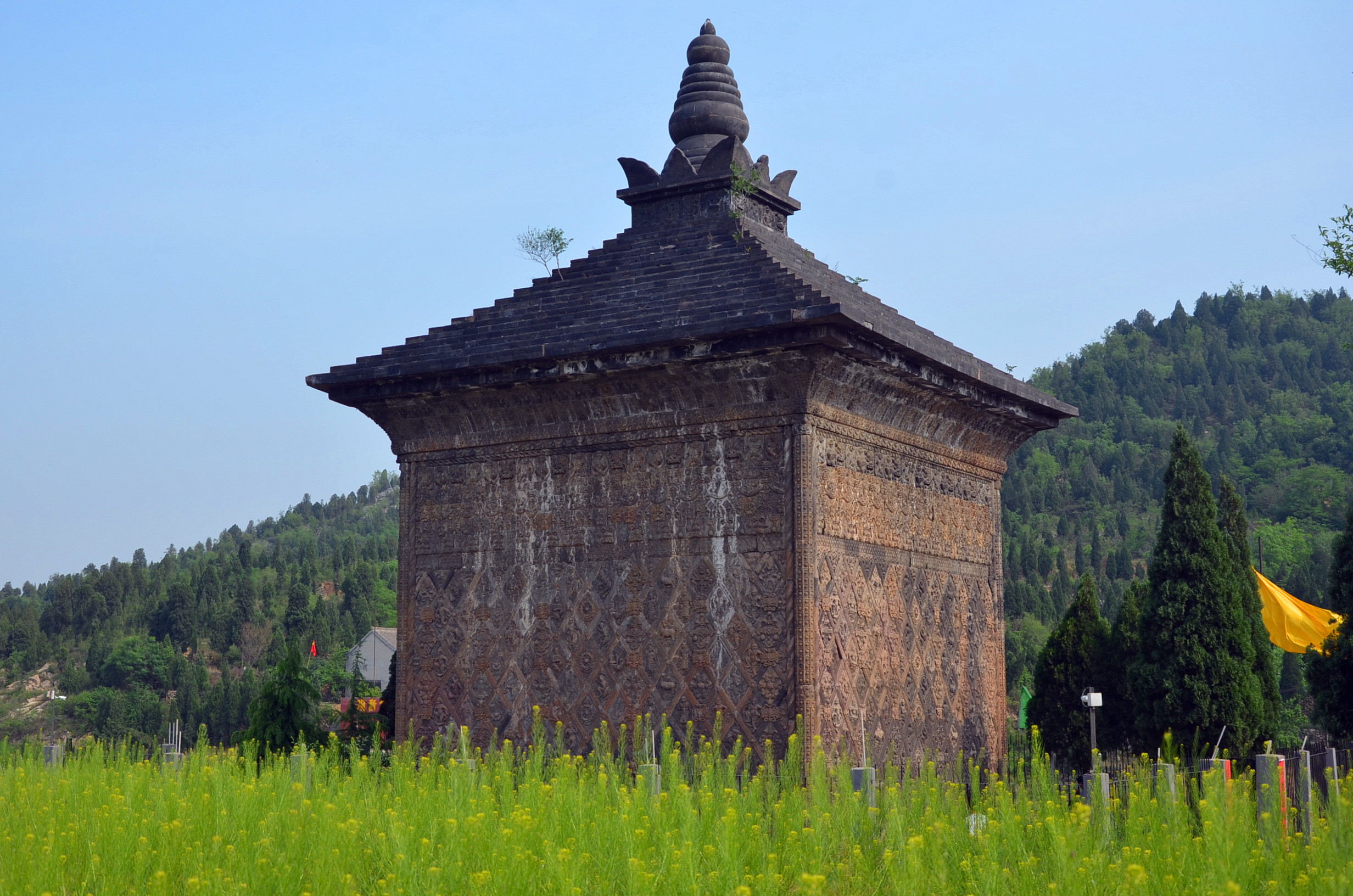
Xiuding Temple Pagoda
Every brick tells a story, and this pagoda has 3,775 of them. The Xiuding Temple Pagoda stands on a hillside near Anyang in Henan Province, a squat, single-story tower whose four walls are covered entirely in carved bricks. Each brick bears its own design: guardian figures, celestial beings, floral patterns, geometric motifs. The technique is so unusual that architectural historians call it an oddity in the Chinese pagoda tradition, a building whose surfaces function less as walls than as a gallery of Tang dynasty sculptural art assembled one brick at a time.
Five Dynasties, One Temple
The temple that gave the pagoda its name has a tangled history. It was founded in 494 during the Northern Wei dynasty as Tiancheng Temple. The Northern Qi dynasty renamed it Heshui Temple. Then Emperor Wu of the Northern Zhou destroyed it during one of the periodic anti-Buddhist campaigns that swept through Chinese history like wildfires. The Sui dynasty rebuilt the complex and renamed it Xiuding Monastery, meaning "Temple of Cultivated Meditation." Through each destruction and rebirth, the site accumulated layers of architectural and spiritual history. The pagoda that survives today dates to the Tang dynasty, though it sits on an octagonal base that archaeologists believe was built during the earlier Northern Qi period.
A Wall of Stories
The pagoda rises 20 meters from its base, a square tower whose proportions are modest compared to the soaring multi-story pagodas of other Tang dynasty sites. But what it lacks in height, it compensates for in surface detail. The 3,775 carved bricks that make up its walls transform the structure into something closer to a sculptural monument than a conventional building. Four-armed guardian figures flank the south-facing arch doorway, their weapons raised against spiritual threats. The remaining surfaces display a catalog of Buddhist and decorative imagery that represents decades of skilled brick-carving by artisans whose names have been lost.
The Last Building Standing
By the end of the Qing dynasty, the temple complex had been abandoned. What had once been a monastery of three courtyards, with halls dedicated to the Four Heavenly Kings, the Grand Buddha, Lord Guan, and the bodhisattva Ksitigarbha, fell to ruin. Only the pagoda survived. Its position between the Hall of Four Heavenly Kings and the Mahavira Hall, the central worship building, can be inferred from the layout, but the wooden structures are gone. Before restoration work in 1984, the pagoda itself had settled to just 9.4 meters in height with a width of 8.3 meters, its upper sections having partially collapsed. The hollow interior, accessible only through the south-facing arch, offers a view upward into the structure's surviving brickwork.
Protected Heritage
In 1982, the Xiuding Temple Pagoda was listed in the second group of major cultural heritage sites under national-level protection, an early recognition of its architectural significance. Research by the National Museum of Asian Art has traced connections between the pagoda's decorative motifs and Sogdian artistic influences that traveled the Silk Road, suggesting that the artisans who carved these bricks drew from a visual vocabulary that extended far beyond China. The pagoda near Anyang, built against a hill and facing south in the traditional manner, stands as evidence that some of the most extraordinary art in Chinese architecture was produced not by imperial workshops but by provincial craftspeople working in brick and mortar on a Henan hillside.
From the Air
Xiuding Temple Pagoda is located at approximately 36.20°N, 114.00°E in Anyang County, Henan Province, on a hillside near Qingliangshan Village, Leikou Town. The pagoda is a small structure and would be difficult to identify from high altitude. Nearest airport is Anyang Airport, with Zhengzhou Xinzheng International (ZHCC/CGO) as the nearest major hub, approximately 180 km to the south. The terrain transitions from the flat North China Plain to the foothills of the Taihang Mountains in this area.