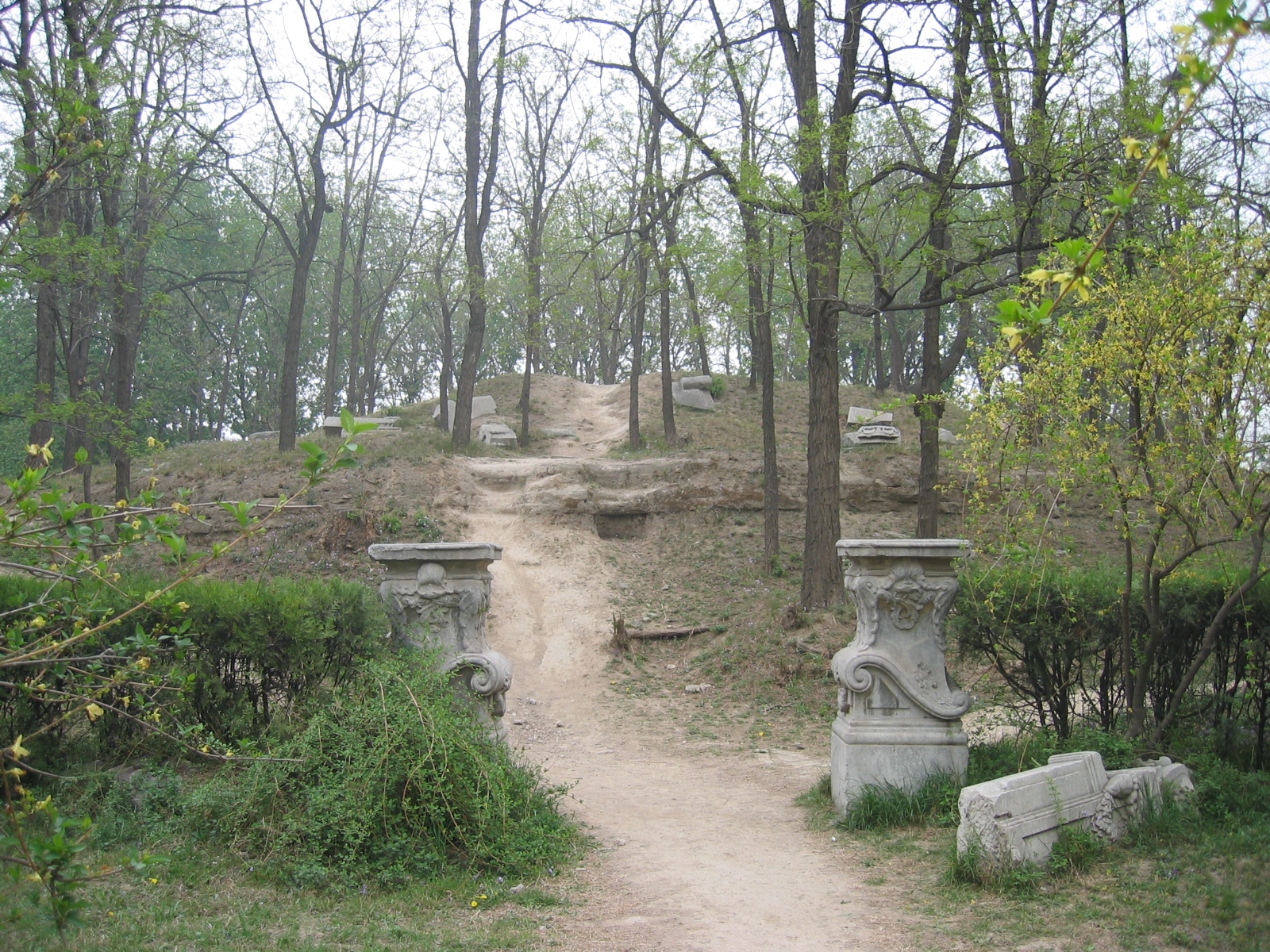
Xiyang Lou
An Italian Jesuit painter, a French Jesuit engineer, and a Chinese emperor walked into a garden -- and the result was one of the strangest architectural projects of the 18th century. The Xiyang Lou, or Western Mansions, were a cluster of European-style buildings commissioned by the Qianlong Emperor and designed primarily by Giuseppe Castiglione, who served the Qing court as a painter but found himself recruited as an architect when the emperor became fascinated by an engraving of a European fountain. What Castiglione and his colleague Michel Benoist created, between 1747 and 1783, was a hybrid that existed nowhere else on earth: Italian baroque facades, built by Chinese craftsmen, filled with European perspective paintings, and surrounded by gardens inspired by Versailles's Grand Trianon. Today, only the ruins remain.
Fountains for an Emperor
The Qianlong Emperor's interest in the Xiyang Lou began and ended with water. Fountains were the chief attraction -- specifically, the mechanical water features that European courts used to demonstrate their mastery of engineering. Castiglione designed the buildings, but it was Benoist who solved the hydraulic challenges, creating China's first European-style water feature at the Xieqiqu complex in the southwest corner of the site. The fountain basins were shaped like crabapple and chrysanthemum flowers, fed by bronze waterspouts cast in the forms of animals -- rams, ducks, and fish. Water was pumped from a tower filled by a mule-drawn water wheel. The most famous fountain, at the Haiyan Tang, featured twelve bronze waterspouts with human bodies and animal heads representing the Chinese zodiac, each activated in sequence every two hours to form a water clock.
A Labyrinth for Lanterns
Among the most remarkable structures was the Huanghuazhen, a maze formed of 1.2-meter-high embossed brick walls stretching 1.6 kilometers in total length across an area of roughly 89 square meters. At its center sat a circular pavilion in the European style. According to tradition, the Qianlong Emperor would sit in this pavilion during the Mid-Autumn Festival and watch his concubines race through the labyrinth carrying yellow lanterns, their progress visible above the walls as bobbing points of light. The labyrinth was destroyed along with the rest of the complex in 1860 but was rebuilt during conservation work between 1977 and 1992 -- one of the few structures on the Old Summer Palace grounds to be restored.
The Belvedere and the Concubine
The Fangwai Guan, a two-story mansion built in 1759, was decorated with European landscape paintings by the French Jesuit Jean Denis Attiret and by Castiglione himself. But its most intriguing association is with Consort Rong, a Uyghur woman in the Qianlong Emperor's favor, who is said to have frequented the mansion. The building reportedly contained tablets inscribed in Arabic, which were lost in the early 20th century. In a complex designed to showcase European aesthetics for a Chinese emperor, the presence of a Uyghur consort and Arabic inscriptions adds another layer to an already extraordinary cultural collision. The Fangwai Guan's ruins survive today -- broken walls that once held French paintings viewed by a Qing emperor's Uyghur companion, a story that no single cultural tradition can fully claim.
Ruins That Refuse to Fade
When Anglo-French forces set fire to the Old Summer Palace in October 1860 during the Second Opium War, the Xiyang Lou's stone and brick construction proved more durable than the mostly timber Chinese buildings elsewhere on the grounds. The masonry survived the flames, leaving the carved marble pillars, broken archways, and scattered stone blocks that visitors see today. These ruins are the most photographed features of the Old Summer Palace site, which has led to a widespread misconception that the entire Yuanmingyuan was European in design. In fact, the Xiyang Lou occupied only about 7 hectares in the northern part of the Garden of Eternal Spring -- a small fraction of the palace's total 3.5 square kilometers. Their survival is an accident of materials, not a reflection of their importance. But as ruins, they have become more eloquent than the buildings ever were, speaking simultaneously of ambition, destruction, and the strange beauty that remains when cultures collide and empires fall.
From the Air
Coordinates: 40.012N, 116.307E. Located within the Old Summer Palace grounds in Haidian District, northwest Beijing. The ruins are in the northern section of the Garden of Eternal Spring. The restored lakes and parkland of the Yuanmingyuan are visible from the air, with the Summer Palace and Kunming Lake providing nearby landmarks. Nearest major airport is Beijing Capital International (ZBAA/PEK), about 25 km northeast.