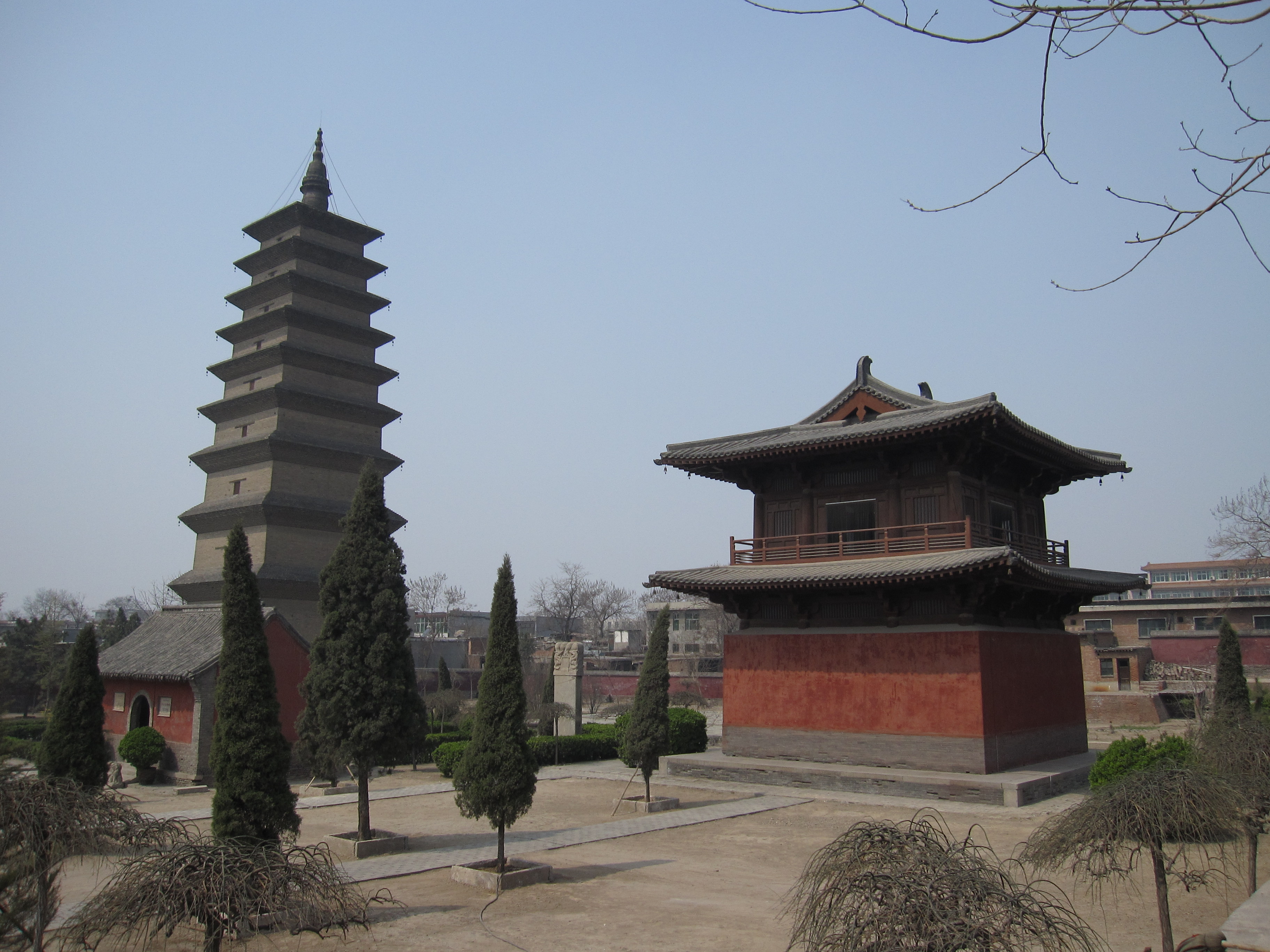
Xumi Pagoda
Fourteen centuries is a long time to stand in one place. The Xumi Pagoda has managed it. Built in 636 AD, during the reign of Emperor Taizong of the Tang dynasty, this square-base tower of stone and brick rises 48 meters above the grounds of the Kaiyuan Monastery in Zhengding, Hebei Province. It is one of the oldest well-preserved pagodas in China, a survivor from an era when the Tang dynasty was still consolidating the empire that would become medieval China's golden age.
Emperor Taizong's Tower
The year 636 AD places the Xumi Pagoda's construction early in the Tang dynasty, during the reign of one of China's most celebrated emperors. Taizong had secured the throne in 626 after a period of fratricidal conflict and was in the process of building the administrative and military structures that would make the Tang one of the most powerful empires in the world. Buddhism was expanding rapidly under Tang patronage, and pagodas like the Xumi served both religious and political purposes. They were reliquaries, markers of sacred space, and statements of imperial piety all at once. The Kaiyuan Monastery where the pagoda stands takes its name from a later Tang era, but the pagoda's foundation belongs to the dynasty's earliest decades.
Stone and Brick Against the Centuries
The Xumi Pagoda's survival is partly a matter of material. Unlike the wooden halls that surrounded it, which have long since disappeared, the pagoda is constructed of stone and brick, materials that resist fire, the most common destroyer of traditional Chinese buildings. Its square base gives it stability that octagonal or circular plans sometimes lack, and its proportions, at 48 meters tall, balance ambition with structural conservatism. The tower has been well preserved since its initial construction, a statement that glosses over whatever quiet maintenance and repair must have occurred across fourteen centuries. But the essential structure dates to the seventh century, making it a direct physical link to the early Tang period.
A Broken Statue Made Whole
For centuries, a statue associated with the pagoda was incomplete, its left side broken off and missing. The gap was simply accepted as the price of time. Then, in 2000, during an excavation at a nearby street, workers discovered the missing fragment. The reunion of statue and fragment after what may have been centuries of separation is one of those small archaeological triumphs that rarely make headlines but restore a measure of wholeness to the historical record. How long the pieces had been apart, and how the fragment came to be buried beneath a street rather than within the temple grounds, remain open questions.
Zhengding's Forest of Towers
The Xumi Pagoda does not stand alone in Zhengding's architectural landscape. Within this small county north of Shijiazhuang, the Lingxiao Pagoda, the Guanghui Temple Flower Pagoda, the Chengling Stupa of Linji Temple, and the great Longxing Monastery all cluster within walking distance of one another. Together they span from the sixth century to the eleventh, representing Sui, Tang, Song, Liao, and Jin dynasty construction in a single compact area. Zhengding has been called one of the densest concentrations of historic Buddhist architecture in northern China, and the Xumi Pagoda, as the oldest of the group, anchors the timeline. Standing at its base and looking up at nearly 1,400 years of brick and stone, you understand why the Chinese have a phrase for structures like this: they say the building 'has bones.'
From the Air
The Xumi Pagoda is located at 38.139N, 114.565E in Zhengding, Hebei Province, approximately 15 km north of Shijiazhuang. Shijiazhuang Zhengding International Airport (ZBSJ) is located nearby to the northeast. The 48-meter tower is one of several historic pagodas in Zhengding visible from the air. The terrain is flat North China Plain. Look for the square-base tower among the historic structures of Zhengding's town center.