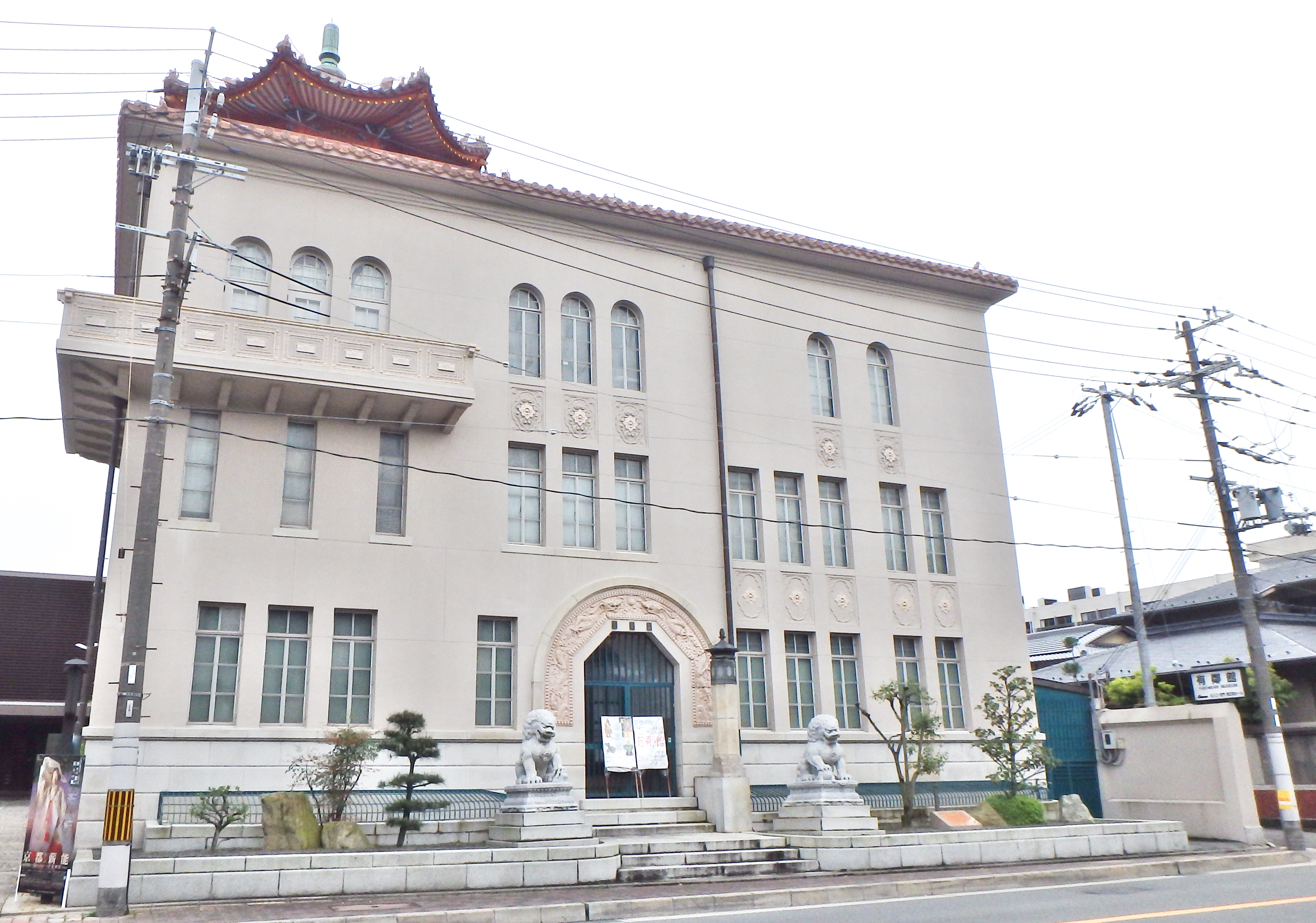
Yurinkan Museum
Thirty-six thousand yellow glazed roof tiles catch the Kyoto sun from atop an octagonal pavilion, a flash of imperial Chinese gold rising above a quiet residential street. The tiles date to the era of the Qianlong Emperor, and they crown a building that is itself a work of art: the Yurinkan Museum, a private collection of East Asian treasures assembled by a single man over a lifetime of passionate acquisition. Open only two Sundays a month, the museum rewards those who plan their visit with one of the most concentrated displays of Chinese art outside mainland China.
The Collector's Obsession
Fujii Zensuke was born in 1860 and built his fortune as an entrepreneur and politician before turning his considerable resources toward Chinese art. By the time he established his museum in 1926, Fujii had assembled a collection spanning from the Shang dynasty through the Qing, a sweep of roughly three thousand years of Chinese civilization. The breadth is staggering: bronze ritual vessels, ceramics, Buddhist statues, carved seals, calligraphic scrolls, textiles, and paintings. The name he chose for his museum comes from the Analects of Confucius, expressing what Fujii described as a feeling of good neighborly relations between cultures. He died in 1934, but his collection endures as the second oldest private museum in Japan, preceded only by the Okura Shukokan in Tokyo.
Treasures from the Silk Road
Among the Yurinkan's holdings, nearly one hundred manuscripts from the Dunhuang caves stand out as particularly rare. These documents, recovered from a sealed library cave in China's Gansu Province, represent one of the great archaeological discoveries of the twentieth century. The Yurinkan's cache includes twenty-three manuscripts in Uighur and others in Tibetan, Mongolian, and Sanskrit, testimony to the multilingual crossroads that Dunhuang once was along the Silk Road. The museum's single designated National Treasure is a fragmentary Tang dynasty manuscript containing a commentary on the Spring and Autumn Annals, one of the Five Classics of Chinese literature. Nine additional items hold the designation of Important Cultural Property, placing this modest private institution alongside Japan's great national museums in the significance of its holdings.
A Building Between Two Worlds
Architect Goichi Takeda designed the main building in 1926 to house Fujii's growing collection, and he made the architecture itself a statement of cross-cultural admiration. The structure is Chinese in style both inside and out, from the layout of its exhibition halls to the octagonal pavilion that crowns the roof. Those 36,000 yellow glazed tiles are not reproductions; they date to the reign of the Qianlong Emperor, the eighteenth-century ruler whose era is considered a high point of Chinese arts patronage. The building is registered as a Municipal Tangible Cultural Property by the city of Kyoto, recognition that the container is nearly as valuable as what it holds. Walking through the entrance is like stepping into a Chinese scholar's residence transplanted to the streets of eastern Kyoto.
Behind Closed Doors
The Yurinkan keeps unusual hours. It opens to the public only on the first and third Sunday of each month, and not at all in January or August. This limited schedule gives the museum an air of exclusivity that matches the rarity of its contents. Visitors who do make it through the doors find themselves in intimate galleries where bronze vessels three thousand years old sit within arm's reach, where ink brushstrokes from the Tang dynasty still look fresh on their silk backing. The neighborhood around the museum, in Kyoto's Sakyo ward near the Heian Shrine, offers no hint of the treasures inside. There are no billboards, no tour buses. The Yurinkan trusts that those who seek it will find it.
From the Air
Located at 35.012N, 135.781E in Kyoto's Sakyo ward, near the Heian Shrine and the Okazaki cultural district. The building's distinctive octagonal pavilion with yellow-tiled roof may be visible at low altitude among the dense urban fabric east of the Kamo River. The nearest major airport is Osaka Kansai International (RJBB), about 75 km south. Itami/Osaka International Airport (RJOO) is closer at roughly 40 km west. Approach from the south over the Kyoto basin for the best view of the eastern hills and cultural district.