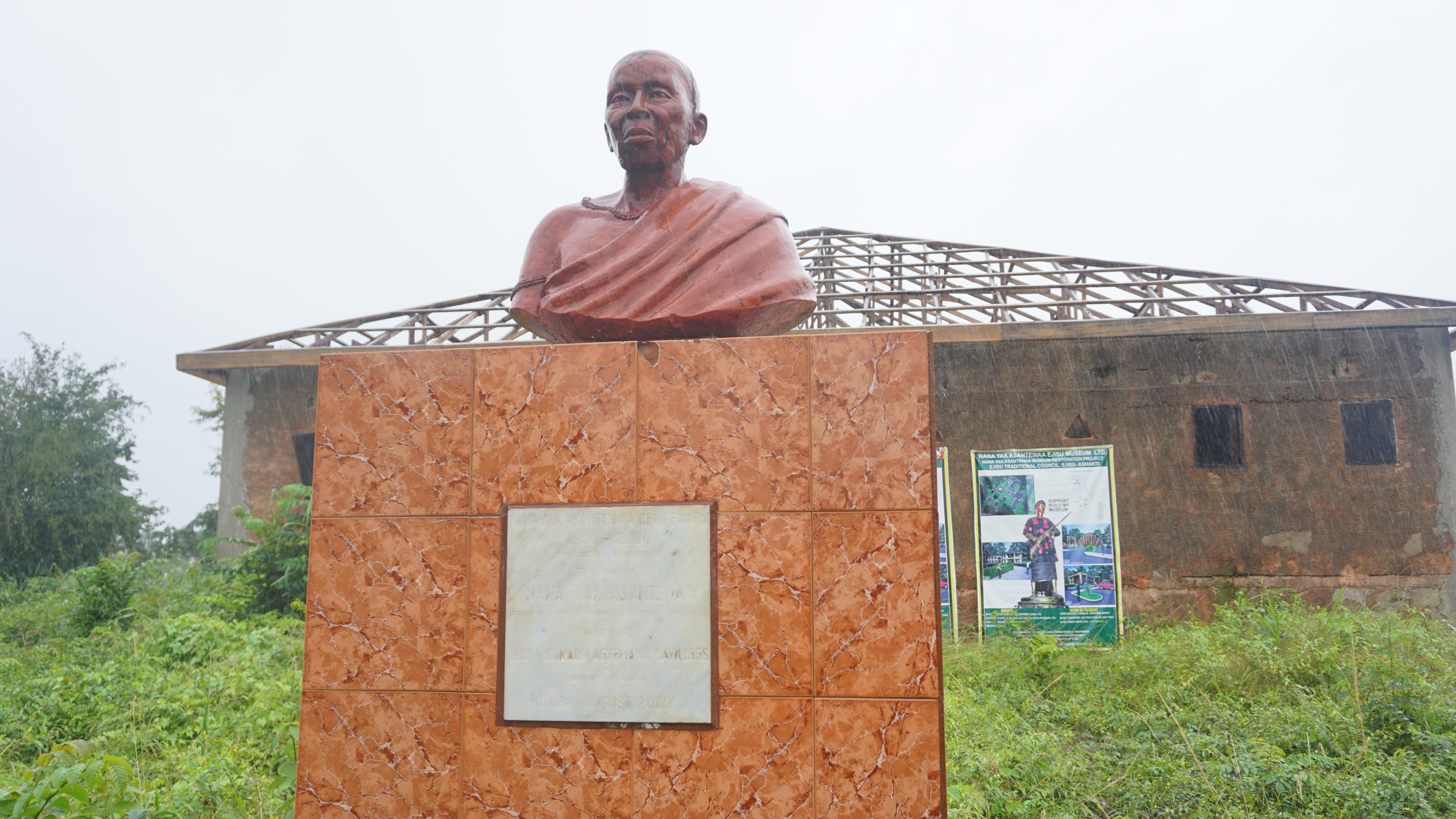
Yaa Asantewaa Museum
"If you, the men of Ashanti, will not go forward, then we will. We, the women, will. We will fight till the last of us falls in the battlefields." These words, spoken in 1900 by a queen mother in her sixties, launched the last major war between the Ashanti Kingdom and the British Empire. The Yaa Asantewaa Museum in Besease, in Ghana's Ashanti Region, was built a century later to honor the woman who spoke them. That it has since burned, been abandoned, and been pledged for reconstruction more than once only adds another layer to a story about persistence against long odds.
The Queen Mother Who Shamed the Chiefs
Yaa Asantewaa was born around 1840 in Besease, near the town of Ejisu. Her brother, Nana Akwasi Afrane Okpase, held a position of power in the Ashanti Empire, and he elevated her to the role of queen mother of the Ejisu-Juaben district. When he died in 1894, Yaa Asantewaa exercised her right to nominate her own grandson as the new Ejisuhene. But the British were tightening their grip. In 1896, they exiled the Asantehene, Prempeh I, along with other leaders, to the Seychelles Islands -- more than 7,000 kilometers away. Yaa Asantewaa's grandson was among those taken. She became regent of the district in his absence, and for four years she watched the remaining chiefs deliberate without acting. When the British governor Frederick Hodgson arrived in Kumasi in 1900 and demanded the Golden Stool -- the sacred symbol of Ashanti nationhood -- the chiefs hesitated. Yaa Asantewaa did not.
Five Thousand Against an Empire
The War of the Golden Stool, also known as the Yaa Asantewaa War, began in March 1900 when the queen mother raised an army of approximately 5,000 fighters and laid siege to the British fort at Kumasi. For months, the garrison was trapped. The British eventually broke through with reinforcements and superior firepower, but the cost was real. In 1901, Yaa Asantewaa was captured and exiled to the Seychelles along with other Ashanti leaders. She died there in 1921, never returning home. But the Golden Stool was never surrendered to the British. It was hidden throughout the conflict and remained with the Ashanti people -- exactly the outcome Yaa Asantewaa had fought to ensure. Ghana gained its independence from Britain on March 6, 1957, fulfilling in a broader sense what she had begun.
A Century Later, Then Ashes
In 2000, a week-long centenary celebration marked the hundredth anniversary of the war. As part of these events, a museum was established at Besease, Yaa Asantewaa's hometown, beside her grave. The museum recreated a typical Asante royal residence from around 1900, filling its rooms with relics and artifacts that connected visitors to the era of the queen mother's defiance. But in 2004, fire gutted the building. Most of its contents were destroyed; only a few clay pots survived. Tourism in the area declined sharply, and the museum sat abandoned. Local leaders called for refurbishment in 2009, and in 2016 reports indicated that funding of up to ten million US dollars had been pledged toward reconstruction on a fourteen-acre site. The Ejisu-Juaben Municipal Assembly was tasked with leading the effort, but progress stalled.
A Legacy Still Being Built
In February 2024, the Asantehene pledged to lead construction of a new facility to be called the Yaa Asantewaa Memorial Heritage Museum, envisioned with a modern design that evokes traditional memory. Whether this latest attempt succeeds where others have faltered remains to be seen. But the story of the museum mirrors, in miniature, the story of its namesake: setback and resilience, loss and determination to rebuild. Yaa Asantewaa's fame has only grown since her death. She is celebrated in Ghana as a symbol of resistance and female leadership, invoked in textbooks and political speeches, and recognized across West Africa and beyond. The grave in Besease still draws visitors, museum or no museum. The building is a tribute. The woman needs no walls to be remembered.
From the Air
Located at 6.71N, 1.47W in Besease, Ejisu Municipal District, Ashanti Region, Ghana. The museum site is near Ejisu town along the main road east of Kumasi. Nearest major airport is Kumasi Airport (DGSI), approximately 15 km to the west. Best viewed at 2,000-3,000 feet AGL. The surrounding area is a mix of small towns and farmland along the Accra-Kumasi corridor.