Yad Vashem
The name comes from Isaiah 56:5: "I will give them an everlasting name that shall not be cut off." In Hebrew, "yad" means a memorial or monument, and "vashem" means name. The institution exists because the Nazis tried to erase not just people but the fact that those people had ever existed, to annihilate names along with the named. Yad Vashem's central mission, codified by the Knesset in 1953, is to make that erasure impossible. Perched on the Mount of Remembrance in western Jerusalem, 804 meters above sea level on the western slope of Mount Herzl, it is both a research institution and a place of reckoning, a complex where scholarship and grief share the same corridors.
Born from the News of Atrocity
The idea for Yad Vashem emerged while the killing was still underway. In September 1942, as accounts of mass murder in Nazi-occupied Europe reached Palestine, Mordecai Shenhavi, a member of Kibbutz Mishmar Ha'emek, proposed a memorial at a board meeting of the Jewish National Fund. It took more than a decade for the proposal to become law. On July 29, 1954, the cornerstone was laid on a hill in western Jerusalem designated as the Mount of Remembrance. The first building was inaugurated in 1957, and initial exhibits, opening in 1958, focused on documentation. A second exhibition in 1959 presented paintings from the ghettos and camps, works created by people who knew they might not survive to see them displayed. From its inception, Yad Vashem was conceived not as a static monument but as an active institution: collecting, researching, educating, and preserving testimony.
The Prism on the Mountain
In 1993, planning began for a new museum to replace the original, and Canadian-Israeli architect Moshe Safdie designed something unprecedented. The new Holocaust History Museum, which opened in 2005, is shaped like a triangular concrete prism that cuts through the landscape, 200 meters long, illuminated by a skylight that runs its entire length. Visitors follow a preset route through underground galleries branching off from a central corridor, each of the ten exhibition halls dedicated to a different chapter of the Holocaust. The museum combines the personal stories of 90 victims with the broader historical narrative, using original artifacts, survivor testimonies, and personal possessions. It ends in the Hall of Names, a cone-shaped repository designed to hold the names and biographical details of every victim. Since the 1950s, Yad Vashem has collected approximately 110,000 audio, video, and written testimonies, along with millions of pages of documents and tens of thousands of artifacts.
The Righteous Who Chose to Act
One of Yad Vashem's most distinctive programs honors non-Jews who risked their lives, freedom, or livelihoods to save Jews during the Holocaust. A special commission, headed by a retired Supreme Court justice and including historians, public figures, and survivors, evaluates each case against strict criteria. Those recognized receive a certificate of honor and a medal, and their names are inscribed on the Wall of Honor in the Garden of the Righteous. Irena Sendler, a Polish social worker who smuggled more than 2,500 Jewish children out of the Warsaw Ghetto, is among the honored. So is Raoul Wallenberg, the Swedish diplomat who issued thousands of protective passports in Budapest. The program rejects the notion that nothing could be done; it proves, case by documented case, that individuals made choices, and some of those choices saved lives.
The Weight of Names
At its core, Yad Vashem is an institution of names. The Central Database of Shoah Victims' Names works to recover the identity of every person murdered in the Holocaust, collecting Pages of Testimony, one-page biographical records submitted by survivors, family members, and researchers. Each page records a name, birthplace, parents' names, occupation, and the circumstances of death, insofar as they are known. The effort is enormous and necessarily incomplete: for many victims, no one survived who knew them well enough to fill in a form. The database, now accessible online, represents the largest effort ever undertaken to restore individual identities to the victims of a genocide. Yad Vashem Studies, published since 1957 in both English and Hebrew, remains one of the leading peer-reviewed journals on Holocaust research, ensuring that the scholarship continues alongside the commemoration.
Remembrance as Obligation
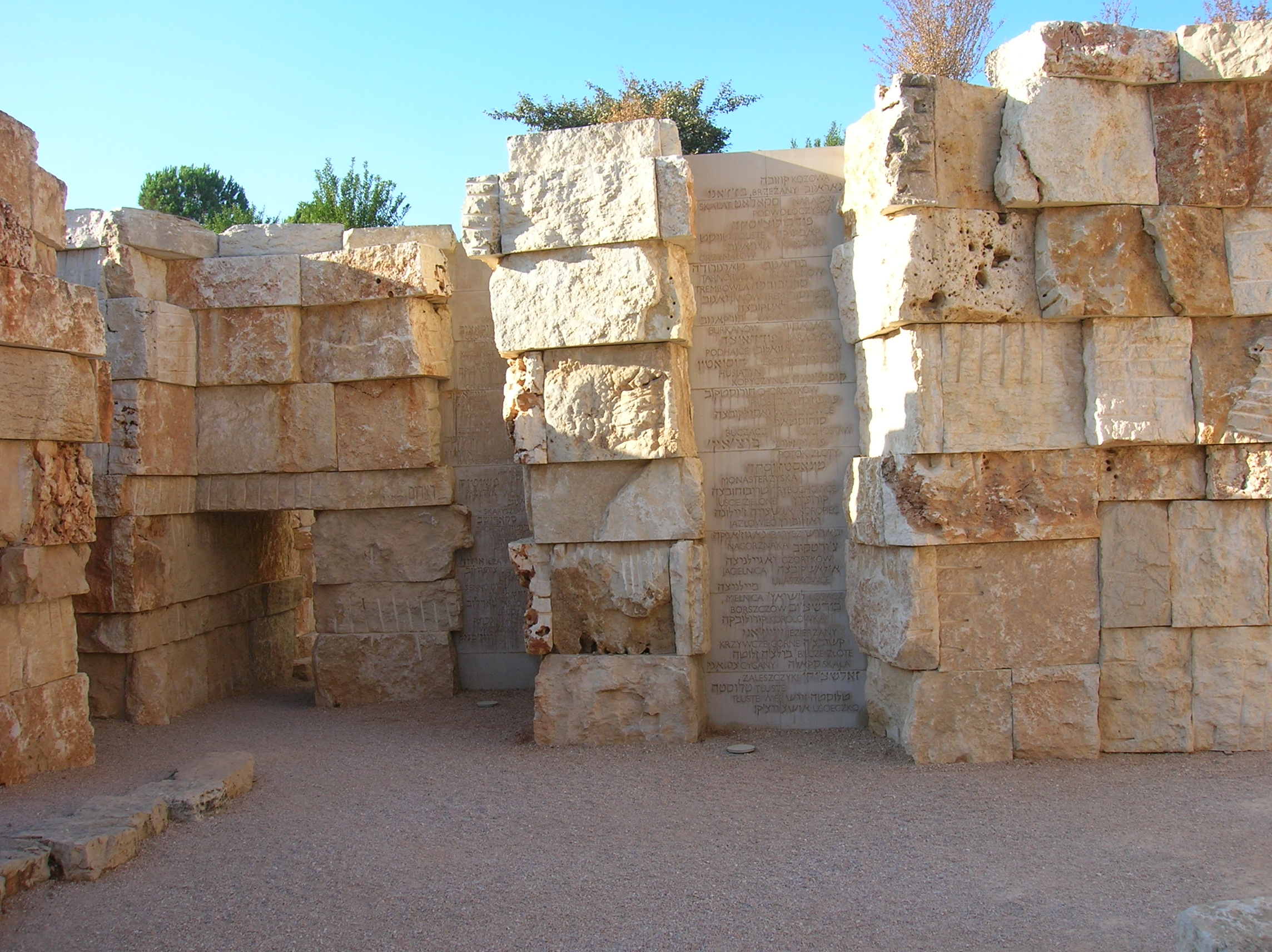
Yad Vashem's campus on the Mount of Remembrance includes monuments that arrest visitors in their tracks: Nathan Rapoport's tribute to the Warsaw Ghetto Uprising, the Children's Memorial that reflects five candles into an infinity of lights representing 1.5 million murdered children, and the Valley of the Destroyed Communities, carved from bedrock, inscribed with the names of more than 5,000 Jewish communities that ceased to exist. The International School for Holocaust Studies develops curricula for students worldwide, training educators in Israel and abroad. The institution does not treat the Holocaust as a closed chapter. It functions as an active warning, grounded in the conviction that understanding how genocide happens is the only defense against its repetition. The prism on the mountain ends not in darkness but in light, its final gallery opening onto a view of the Jerusalem hills, an assertion that life continued.
From the Air
Located at 31.774N, 35.177E on the Mount of Remembrance in western Jerusalem, on the western slope of Mount Herzl. The campus is set among the Jerusalem Forest and is visible as a large institutional complex on the western heights of the city. Ben Gurion International Airport (LLBG) is approximately 45 km to the northwest. Best viewed from 5,000-8,000 ft AGL. Mount Herzl military cemetery is immediately to the east.