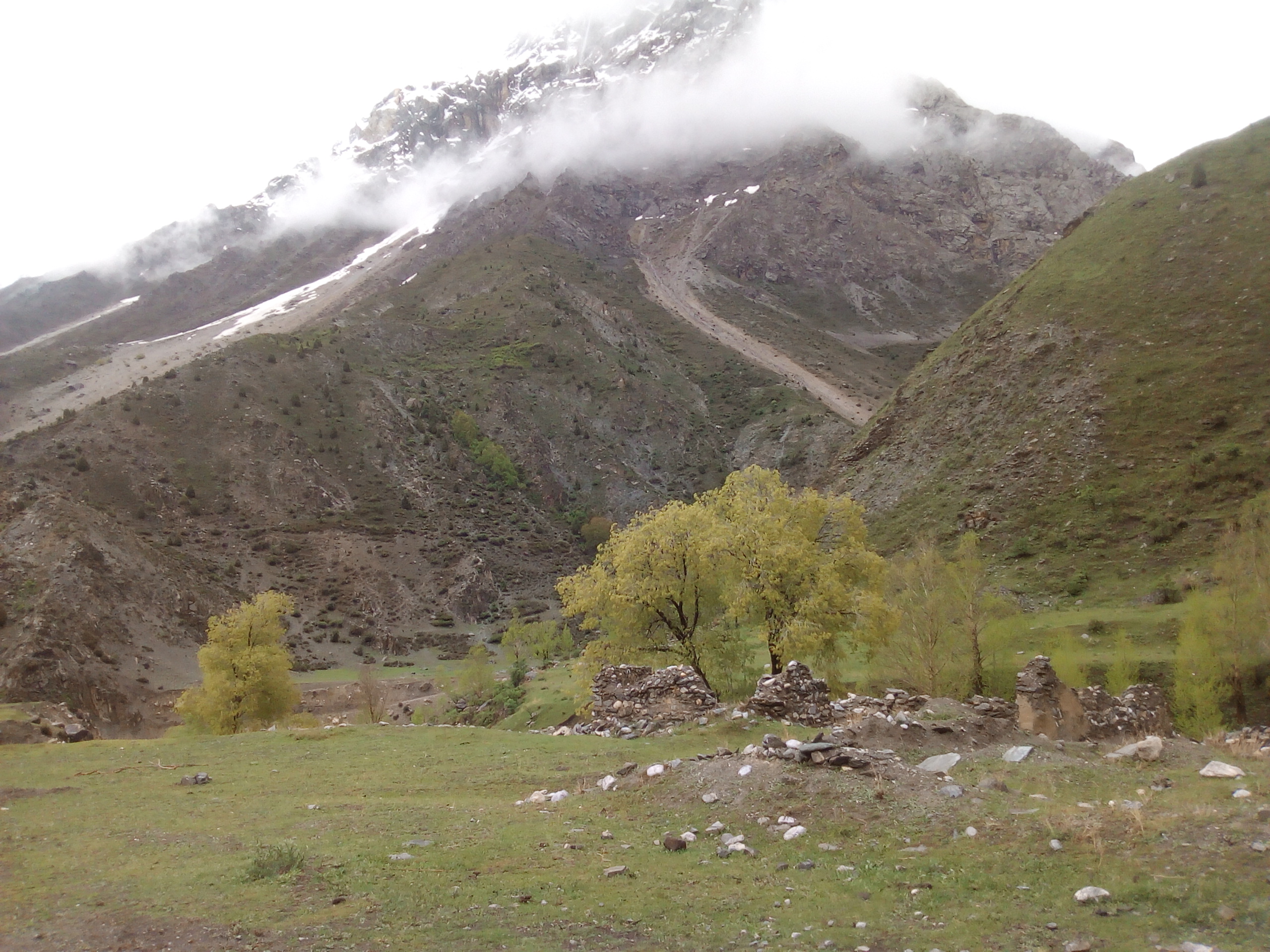
Yaghnob Valley
Somewhere between 2,500 and 3,000 meters above sea level, wedged between the Zarafshan and Gissar mountain ranges in northwestern Tajikistan, a handful of villages cling to a valley that vanishes from the outside world for half the year. Snow seals the passes from autumn through spring, and for six months the roughly 500 people who live here exist as their ancestors have for over a millennium. They speak Yaghnobi, a language so close to ancient Sogdian that linguists treat it as a living fossil -- the last direct descendant of the tongue that once served as the common language of Silk Road commerce from Samarkand to China. The Yaghnob Valley is not a museum. It is a place where an ancient civilization quietly persists.
Heirs of the Silk Road
The Sogdians were the great merchants of Central Asia. From roughly the 4th century BC through the 8th century AD, they dominated the trade routes linking China, Persia, and the Mediterranean, and their language became the lingua franca of the Silk Road. When Arab armies swept through Central Asia in the 8th century, conquering the Sogdian heartland around Samarkand and Bukhara, some Sogdians fled into the mountains. The Yaghnob Valley, nearly inaccessible even today, became their refuge. The valley's first permanent settlements date to this period. While the Sogdian language died out everywhere else -- absorbed into Persian and Turkic tongues over the following centuries -- it survived here, evolving into what linguists now call Yaghnobi. Pre-Islamic customs and beliefs persisted alongside the language, carried forward by the same geographic isolation that kept the rest of the world at bay.
The Mystery Revealed
Russian military topographers first visited the valley in the 1820s, but the wider world learned about its remarkable inhabitants only in 1883, when the German scientist G. Capus published an article titled "Yaghnob Valley and its People" in the European Journal of Geography. Capus recognized what he called the "Mystery of Yaghnob" -- a community speaking a language thought to have died out centuries earlier, living in a valley that seemed to exist outside of time. In the 1870s, General Abramov of Russia had led the first scientific expedition into the valley, but it was Capus who brought international attention. Sustained research proved difficult. The valley's remoteness, the Soviet period's restrictions, and then the Tajik Civil War of 1992-1997 all conspired to keep scholars away. It was not until the Glasnost reforms of 1990 that the Tajik Cultural Fund could organize proper expeditions.
A Valley Half Empty
Walk through the Yaghnob Valley today and you pass as many abandoned villages as inhabited ones. Of the three traditional districts -- Lower, Middle, and Upper -- many settlements are marked with the grim dagger symbol that indicates abandonment. A 2008 census counted 492 people in 82 families, and the trend points downward. Young people leave for Dushanbe or other lowland cities, drawn by the health services and education the valley cannot provide. The ten remaining settlements house between three and eight families each. For more than six months of the year, heavy snow makes the valley effectively unreachable, cutting residents off from emergency medical care. The community pooled its own resources to build a road to Bedef village, but without maintenance funds, the road deteriorated. A newer road has since been constructed into the valley's interior, but this has been a mixed blessing -- improving access in both directions and attracting outsiders interested in exploiting the valley's economic potential.
Protecting What Remains
Efforts to protect the valley formally began in 1991, when Anvar Buzurukov and the newly formed Tajik Social and Ecological Union began developing a proposal for a protected area. The Tajik Civil War shelved the plans for years. In 2007, Buzurukov organized a multidisciplinary expedition with support from the Ayni Development Committee, the UNDP, and the UK government, producing a feasibility study for the Yaghnob Natural Ethnography Park. The proposal, discussed at an international conference in Dushanbe in October 2007, envisions protection from environmentally damaging activities like overgrazing while supporting sustainable tourism. The conference delegates appealed to the Tajik government and international organizations for support, concluding that the first priority must be improving the living conditions of the Yaghnobi people themselves. The park, if created, would be the first of its kind in northern Tajikistan.
A Language Against the Odds
What makes the Yaghnob Valley extraordinary is not its scenery, though the Zarafshan and Gissar ranges are spectacular. It is the fact that a language and culture survived here for twelve hundred years through nothing more than geography and stubbornness. The Sogdian merchants who once haggled in bazaars from Xi'an to Constantinople left descendants who farm small plots at 3,000 meters, tend livestock through brutal winters, and speak to their children in a language that scholars once believed extinct. Every young person who leaves for the lowlands makes the survival of Yaghnobi less certain. Every winter that seals the passes buys the culture another season. The valley exists in a tension between preservation and livability -- the same isolation that kept Sogdian alive also keeps doctors, teachers, and economic opportunity out. Whether the Yaghnobi can hold on for another generation depends on whether Tajikistan and the wider world decide that a living link to one of Central Asia's greatest civilizations is worth sustaining.
From the Air
Located at 39.20N, 69.00E in northwestern Tajikistan, between the Zarafshan Range (north) and Gissar Range (south). The valley runs roughly east-west at 2,500-3,000m elevation along the Yaghnob River, a tributary of the Zarafshan. Nearest major city is Dushanbe (UTDD), approximately 100km to the south. The Anzob Pass connects the valley to the Dushanbe-Khujand highway. Terrain is steep mountain valleys with snow cover from October through April. Best viewed at 15,000-20,000 ft to appreciate the valley's isolation between the two ranges.