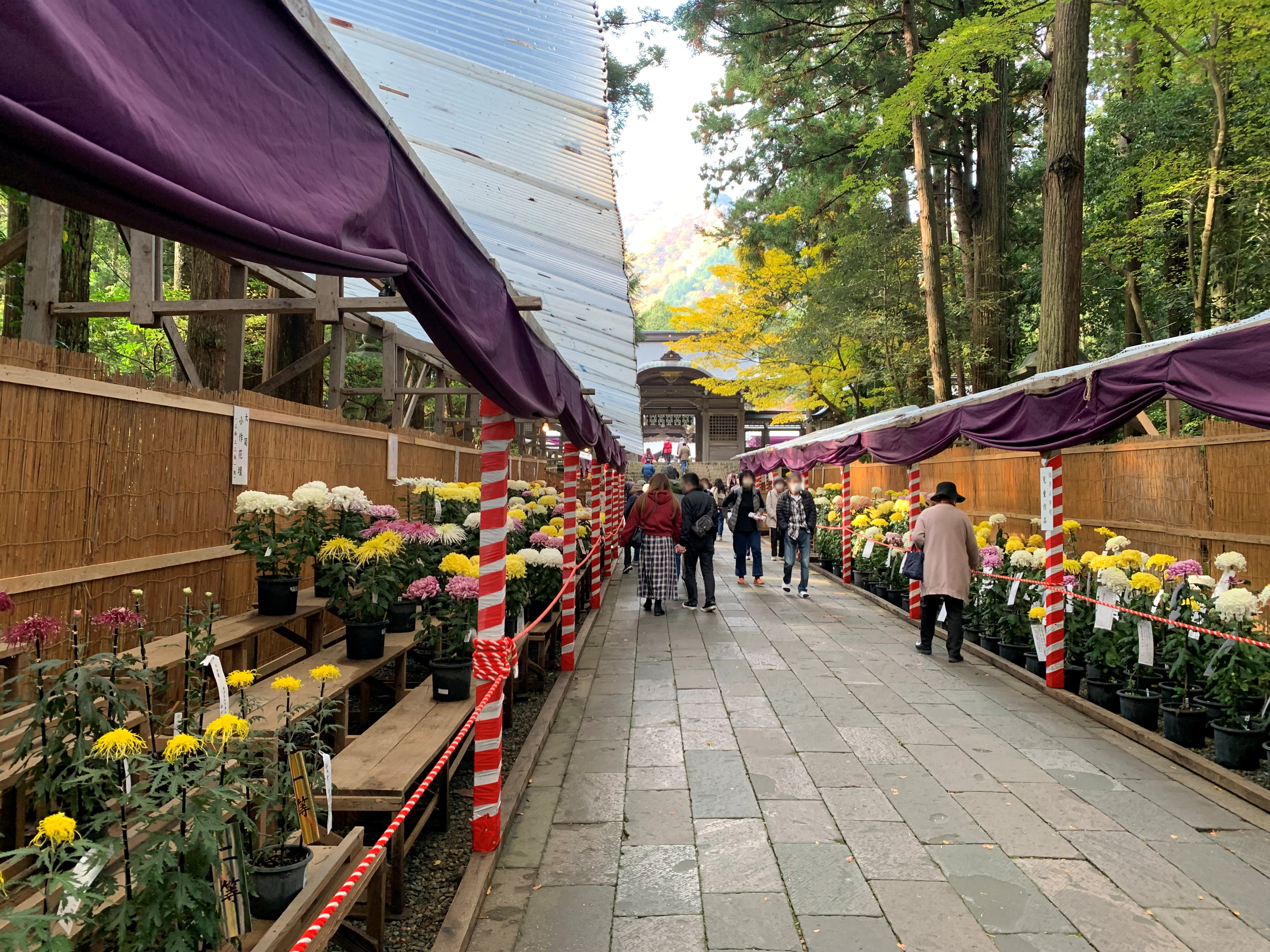
Yahiko Shrine
It was already old when Japan's first poets wrote about it. The Man'yoshu, compiled in the eighth century during the Nara period, refers to this shrine as "ancient" -- which means Yahiko Shrine was venerable more than 1,200 years ago. Nestled at the eastern base of Mount Yahiko, a 634-meter sacred peak overlooking the Sea of Japan in Niigata Prefecture, the shrine is one of three that claim the prestigious title of ichinomiya -- first shrine -- of the former Echigo Province. Its founding legend tells of a deity named Ame-no-Kaguyama-no-mikoto who descended from the heavens at a beach near present-day Nagaoka and taught the local people to fish, cultivate rice, produce salt, and raise silkworms. The mountain itself serves as the shrine's shintai, the physical vessel of the divine. To stand here is to stand at a place where the spiritual and natural worlds have been considered inseparable for millennia.
Ranks, Records, and Flames
The shrine's documented history begins in 833 AD, when it appears in the Shoku Nihon Koki, a chronicle of the imperial court. By 842, it had been awarded the rank of Junior 5th Rank, Lower Grade -- an official measure of a shrine's spiritual prestige in the Heian court system. By 861, it had risen to Junior 4th Rank, and by 927, it was listed in the Engishiki, the comprehensive register of Shinto shrines maintained by the imperial government. Much of its older history, however, has been lost. Fires repeatedly consumed the shrine's records and buildings over the centuries. The Edo-period scholar Hirata Atsutane once claimed that Yahiko had preserved texts written in jindai moji -- a script predating the introduction of Chinese kanji -- but those, too, were said to have been destroyed by fire. The most devastating blaze came in 1912, when a fire that started in the village consumed the shrine buildings entirely. The present structures, completed in 1916, are what visitors see today.
Warlords and Blades
Yahiko Shrine drew the devotion of Japan's warrior class for centuries, and its treasury reflects that patronage. The most remarkable artifact is a Muromachi-period odachi -- an oversized Japanese sword -- forged in 1415 with a blade measuring an extraordinary 220.4 centimeters. Designated an Important Cultural Property of Japan, it is one of the longest surviving swords from the period. The shrine also holds armor and weapons donated by some of the most storied names in Japanese martial history: Minamoto no Yoriie, the second Kamakura shogun; his uncle Minamoto no Yoshitsune, perhaps the most romanticized warrior in Japanese literature; and Uesugi Kenshin, the fearsome sixteenth-century lord known as the Dragon of Echigo. During the Edo period, Matsudaira Tadateru, the daimyo of Takada Domain, granted the shrine estates valued at 500 koku to support its maintenance.
Lanterns in the Summer Dark
Every July 25, the shrine transforms. Hundreds of lanterns -- large and small, donated by parishioners from across the region -- fill the grounds around the mikoshi, the portable shrine that carries the deity's spirit during festivals. The large lanterns are elaborate constructions: lattice frames roughly one meter wide and 2.5 meters long, covered in paper and crowned with vivid artificial flowers that represent the seasons -- cherry blossoms, peonies, chrysanthemums, irises, and maple leaves. Small lanterns, square and delicate, hang from three-meter bamboo poles donated by individuals. After a procession through the grounds, the large lanterns are installed along the railings of a temporary dance hall, and young boys perform ancient bugaku and kagura dances surrounded by the warm glow. The lantern ritual is designated a National Intangible Cultural Folk Property, one of Japan's highest honors for living tradition.
Power Spot on the Sacred Peak
Modern visitors know Yahiko Shrine as a "power spot" -- a place believed to radiate spiritual energy, particularly for love and good fortune. The shrine sits within Sado-Yahiko-Yoneyama Quasi-National Park, surrounded by dense groves of centuries-old cedar trees that filter the light into green-gold columns. Mount Yahiko rises behind the complex, accessible by ropeway or hiking trail, its summit offering sweeping views of the Echigo Plain, the Sea of Japan, and on clear days, the distant silhouette of Sado Island. The approach to the shrine passes through a series of torii gates, the largest of which -- the Otorii, built in 1982 to commemorate the launch of the Joetsu Shinkansen -- stands 30.16 meters high on a prefectural road some three kilometers from the entrance. A total of 20 structures at the shrine, all dating from the 1916 reconstruction, are Registered Tangible Cultural Properties. After the Meiji Restoration, Yahiko was designated a nationally ranked shrine in 1871. Each New Year's, more than 200,000 worshippers pass through its gates.
From the Air
Located at 37.707N, 138.826E at the eastern base of Mount Yahiko (634m / 2,080ft), a distinctive solitary peak on the Niigata coastline overlooking the Sea of Japan. The shrine complex is nestled in cedar forest at the mountain's foot and is not individually visible from high altitude, but Mount Yahiko itself is unmistakable -- an isolated summit rising from the flat Echigo Plain. The massive Otorii gate on Prefectural Road 29, standing over 30 meters tall, may be visible on approach. Nearest airport: Niigata Airport (RJSN), approximately 35nm east-northeast. Approach from the east at 3,000-5,000 feet AGL for the best perspective, with the mountain silhouetted against the Sea of Japan. The Yahikoyama Ropeway line is sometimes visible running up the mountain's eastern slope.