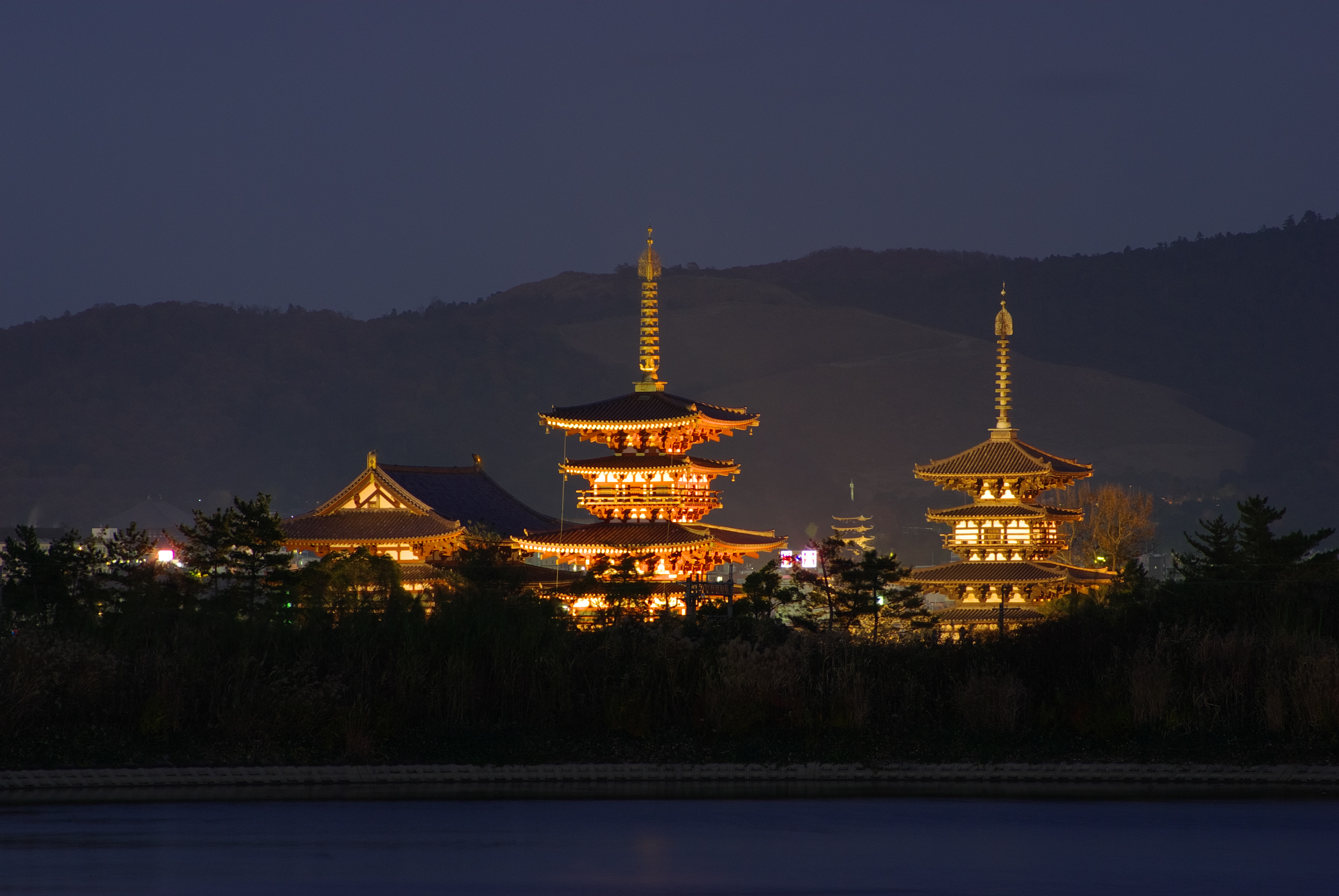
Yakushi-ji: The Temple That Moved With an Empire
An emperor built it for love. In 680, Emperor Tenmu commissioned a grand temple dedicated to the Medicine Buddha, Yakushi Nyorai, as an offering for the recovery of his ailing consort -- the woman who would become Empress Jito. He never saw it finished. By the time the complex was completed around 698, Tenmu was dead and his consort ruled Japan in her own right. The temple she finished in his memory would outlive dynasties, survive fires, and travel with an empire from one capital to the next. Today, Yakushi-ji stands in the western reaches of Nara, a UNESCO World Heritage Site and the headquarters of the Hosso school of Japanese Buddhism, its symmetrical pagodas rising above the Yamato Plain as they have since the eighth century.
A Temple Uprooted
Yakushi-ji was not always in Nara. It was first erected in Fujiwara-kyo, Japan's capital during the Asuka period, a city modeled on Chinese urban planning in hopes of forging a centralized state. When the Imperial Court relocated to the new capital of Heijo-kyo -- present-day Nara -- in 710, the temple followed. Tradition holds it was physically disassembled and moved in 718. But excavations of the original Fujiwara-kyo site in the 1990s complicated that tidy narrative: archaeological evidence suggested that both temples may have existed simultaneously for a time, with the Nara version possibly built as a meticulous replica rather than a relocation. The Fujiwara original is now known as Moto Yakushi-ji -- the 'original' -- though only its foundation stones survive. Whether copied or carried board by board, the temple at Nara was designed as a faithful reproduction, its layout so precise that eighteen column foundation stones at Fujiwara match the spacing of those in Nara exactly.
One Pagoda Standing
Fire has been Yakushi-ji's persistent adversary. Blazes in 973 destroyed most of the complex. The main hall burned again in 1528. Across the centuries, what survived was a single structure: the East Pagoda, completed in 730. It is the only original Nara-period building at the temple, and one of the oldest wooden structures in Japan. The pagoda appears to have six stories from the outside, but this is an illusion -- it has only three, each with a decorative rooflet called a mokoshi that creates the layered silhouette. The American scholar Ernest Fenollosa reportedly called it 'frozen music,' a description that has stuck. The rest of the complex is a 20th-century reconstruction: the main hall rebuilt in 1976, the West Pagoda in 1981, the central gate in 1984, and the east and west gates in 1995. These reconstructions followed historical plans and traditional techniques, but the East Pagoda remains the authentic survivor, nearly 1,300 years old.
The Yakushi-ji Style
The temple's layout is so distinctive that architectural historians gave it its own name: the Yakushi-ji style. The plan is symmetrical, with two pagodas flanking the Golden Hall on the east and west, drawing the eye inward toward the central worship space. This twin-pagoda arrangement was common in Nara-period temple design but has survived in so few examples that Yakushi-ji became the defining case. The Golden Hall houses the temple's most important treasure: the Yakushi Triad, a bronze sculpture of the Medicine Buddha flanked by attendant bodhisattvas. The triad is one of the most celebrated Buddhist icons in Japan, though scholars still debate whether it was cast for the original Fujiwara-kyo temple or created anew for the Nara site. Of the 247 known Yakushi sculptures across Japan, 224 are carved from wood. The Yakushi-ji triad, rendered in bronze, belongs to an older tradition -- one that predates the shift to wooden sculpture that dominated the Nara period and beyond.
Seven Temples, One Survivor
Yakushi-ji was one of the Seven Great Temples of Nanto, a designation given by Emperor Shomu to the most important Buddhist institutions in the capital. The other six were Todai-ji, Kofuku-ji, Gango-ji, Daian-ji, Saidai-ji, and Horyu-ji. Together they anchored a city conceived as the spiritual and political center of a unified Japan. Nara's era as capital lasted less than a century -- the court moved to Kyoto in 794 -- but the temples endured, accumulating centuries of patronage, scholarship, and art. Yakushi-ji remains the headquarters of the Hosso school, one of the six schools of Nara Buddhism, which focuses on the philosophy of consciousness and perception. It is a living monastery, not just a museum, hosting annual ceremonies that connect practitioners to a lineage stretching back to Emperor Tenmu's bedside prayer for his wife's health over thirteen hundred years ago.
From the Air
Located at 34.668°N, 135.784°E in the western part of Nara, Japan, roughly 3 km southwest of central Nara and 30 km east of Osaka. The twin pagodas and symmetrical compound are visible amid flat terrain on the Yamato Plain. The nearby Akishino River runs to the north. Kansai International Airport (RJBB) lies approximately 65 km to the southwest; Osaka Itami Airport (RJOO) is about 30 km to the west-northwest. Nara Airport is no longer operational. Best viewed at 3,000-5,000 feet AGL to appreciate the temple layout against surrounding low-rise development and the green belt of Nara's western temple corridor.