
Yala National Park
The leopard yawns on a sun-warmed granite boulder, entirely indifferent to the jeep idling twenty meters away. This is Yala, where the world's densest population of leopards has learned that vehicles are boring, not dangerous -- and where that calculated indifference gives visitors something almost impossible to find elsewhere: unhurried, close-range encounters with one of the planet's most elusive big cats. Yala National Park, on Sri Lanka's southeastern coast about 300 kilometers from Colombo, covers 979 square kilometers of dry monsoon forest, thorn scrub, grasslands, lagoons, and sandy beaches. Designated a wildlife sanctuary in 1900 and elevated to national park status in 1938 alongside Wilpattu, it was one of Sri Lanka's first protected areas. Today it is the island's most visited park, and the leopards are the reason most people come -- though they are far from the only reason to stay.
The Leopard's Kingdom
Block One, the western section open to visitors, has been documented as having one of the highest leopard concentrations anywhere on Earth. The cats thrive here partly because Yala lacks other large predators competing for the same prey. No tigers, no lions -- the leopard sits alone at the top of the food chain, a position that has made them bolder and more visible than their counterparts on the African continent. February through July is the prime season for sightings, when dropping water tables force animals to congregate around shrinking pools and water holes. During these months, a single morning's drive can produce encounters with leopards basking on rocks, sloth bears shuffling through undergrowth, elephants bathing at the edge of tanks, and mugger crocodiles lurking motionless in shallows. The park shelters 44 mammal species in total, including 300 to 350 Sri Lankan elephants, wild water buffalo, and the elusive fishing cat.
A Mosaic of Habitats
Yala's landscape is not one thing. The Menik River anchors the park's forest cover, winding through moist and dry monsoon woodlands before emptying into the Indian Ocean through 100 hectares of mangrove estuary. Away from the river, the terrain shifts to open parkland -- the Pelessa grasslands -- and then to thorn forests and coastal scrub. Lagoons dot the coastline: Buthuwa, Pilinnawa, Mahapothana. Their brackish waters support mangrove stands of Rhizophora mucronata, and their mudflats attract thousands of waterbirds during the northeast monsoon. The park's elevation barely registers -- 30 meters near the coast, rising gently to 125 meters inland -- yet this low, flat terrain compresses an astonishing range of ecosystems into a relatively small area. Sandy beaches along the southern edge complete the picture, and all five species of sea turtle that visit Sri Lanka -- leatherback, olive ridley, loggerhead, hawksbill, and green -- have been recorded on Yala's shores.
Wings by the Thousand
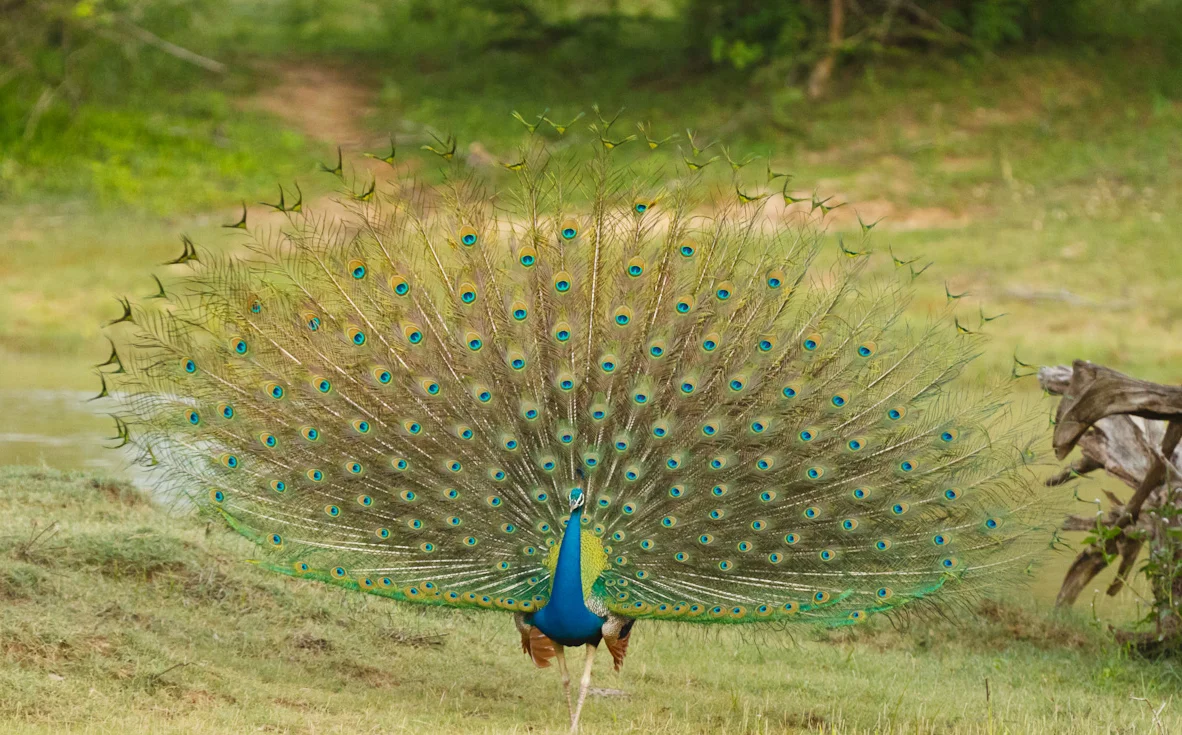
For birders, Yala is staggering. The park list stands at 215 species, six of them endemic to Sri Lanka: the Grey Hornbill, Junglefowl, Wood-pigeon, Crimson-fronted Barbet, Black-capped Bulbul, and Brown-capped Babbler. But the real spectacle arrives with the monsoon. When the northeast winds push across the Indian Ocean from November onward, thousands of migratory waterfowl descend on Yala's lagoons -- northern pintail, Eurasian curlew, whimbrel, godwits, ruddy turnstones, and white-winged terns mixing with resident lapwings and whistling ducks. Painted storks stand like sentinels in the shallows, and the rare black-necked stork makes occasional appearances. Overhead, crested serpent-eagles and white-bellied sea eagles patrol the canopy and coastline. In the forest interior, flashes of color reveal orange-breasted green pigeons, paradise flycatchers trailing their absurdly long tails, and Indian peafowl displaying to an audience that never seems impressed.
Sacred Ground Beneath the Scrub
Yala is not only a wildlife park. Within its boundaries lies Situlpahuwa, an ancient Buddhist monastic settlement that has drawn pilgrims for over two thousand years. The rock temple, perched on a granite outcrop surrounded by forest, was once home to thousands of monks who chose the wilderness as the backdrop for meditation. Reaching it requires passing through the park itself, which means pilgrims and leopards share the same landscape -- a coexistence that stretches back centuries. Other archaeological and sacred sites are scattered through the park, reminders that this land carried human meaning long before anyone thought to draw boundaries around it for conservation. The juxtaposition is striking: ancient devotion and modern wildlife management occupying the same ground, each giving the other a kind of depth it would not have alone.
Into the Dust
Most visitors enter from the gateway town of Tissamaharama, known locally as Tissa, where guesthouses and hotels arrange early-morning and afternoon safari drives. The jeeps leave at five in the morning to catch the golden light and the animals' peak activity, bouncing along sandy tracks through scrub forest while drivers scan the branches for the telltale drape of a spotted tail. The rides are rough. Crocodiles hide in every waterway, and the park rules are simple: stay in the vehicle, do not feed the animals, and remember that everything here -- from the sloth bear turning over rocks for termites to the monitor lizard basking on a fallen log -- is genuinely wild. Both mugger and saltwater crocodiles breed in the park. Russell's vipers and Indian cobras inhabit the undergrowth. The beauty is real, and so is the danger. Yala does not pretend otherwise.
From the Air
Located at 6.27N, 81.33E on Sri Lanka's southeastern coast, about 300 km from Colombo. The park is visible as a large expanse of forest and scrub bordered by the Indian Ocean to the south and east. Coastal lagoons and the Menik River estuary are visible landmarks. Nearest major airport: Mattala Rajapaksa International Airport (VCRI), approximately 20 nm west. Colombo Bandaranaike (VCBI) is 160 nm northwest. Best viewed from 8,000-12,000 feet AGL to appreciate the coastline, lagoon systems, and the contrast between park forest and surrounding agricultural land. Clear visibility typical during the dry season (February-July).
Nearby Stories
- Taprobane Island 48 km away
- 2014 Badulla Landslide 49 km away
- Adam's Peak 52 km away
- Sinharaja Forest Reserve 64 km away
- Japanese Submarine I-64 1038 km away
- Action of 18 November 1809 1198 km away
- Northern Circars 1223 km away
- Weh Island 1540 km away