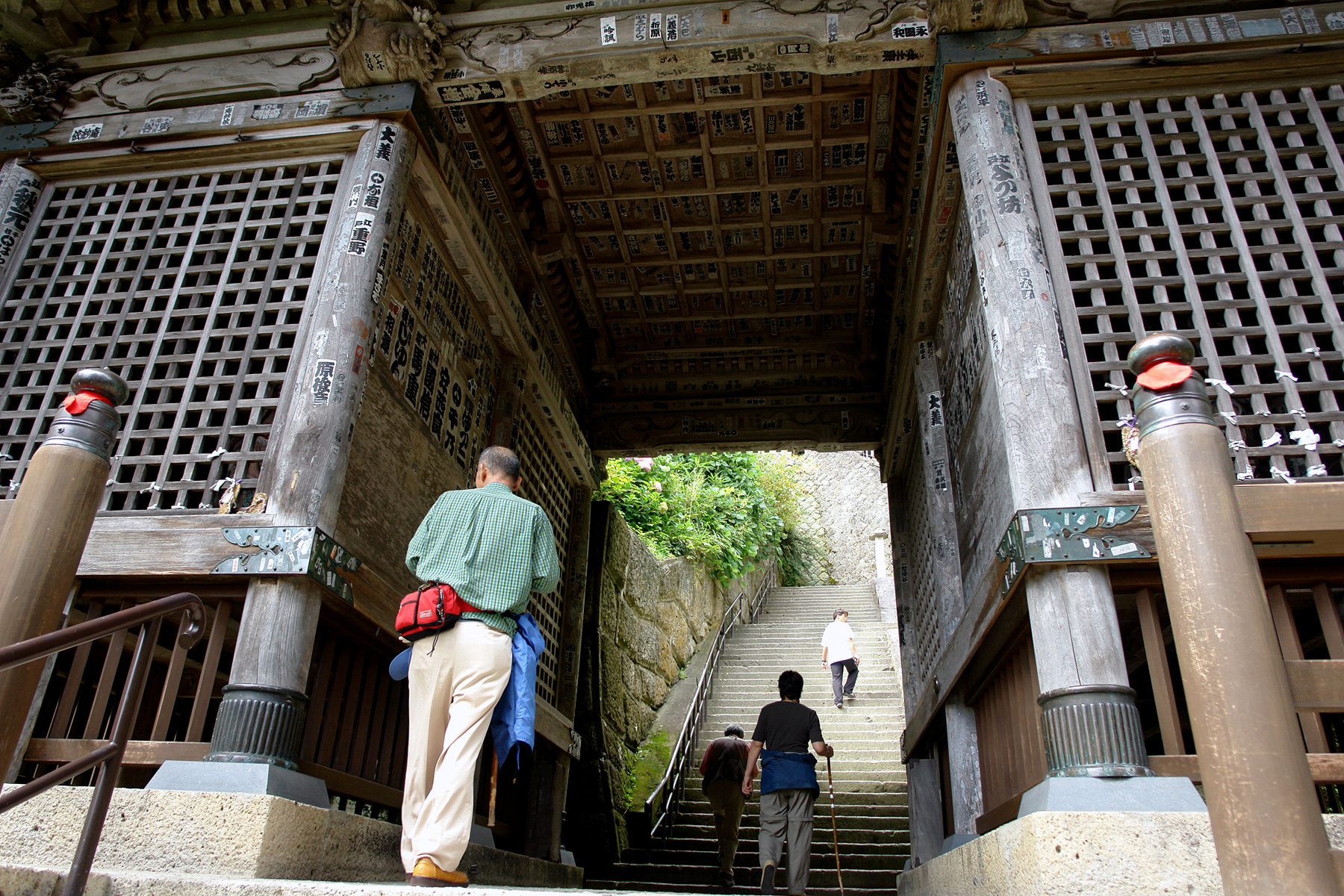
Yamadera: A Thousand Steps Into Silence
Shizukasa ya / iwa ni shimiiru / semi no koe -- such stillness, the cries of the cicadas sink into the rocks. Matsuo Basho composed those words here in the summer of 1689, partway up a steep, forested mountainside in Yamagata Prefecture where temple buildings cling to bare rock like something grown rather than built. He had not planned to visit. Locals at Obanazawa insisted he make the detour to Risshaku-ji, the Buddhist temple known simply as Yamadera -- the mountain temple. Basho climbed the stone steps, listened to the silence between the insect cries, and wrote one of the most celebrated haiku in the Japanese language. Over three centuries later, pilgrims still make the same climb, past the same rocks, through the same forest, up 1,015 stone steps to the inner sanctuary where the view opens across the valley below.
A Flame From Mount Hiei
According to temple tradition, Risshaku-ji was founded in 860 AD by the priest Ennin, one of the most important figures in Japanese Buddhism. Ennin had spent years studying in Tang dynasty China before returning to Japan in 847 AD, eventually becoming chief priest of the Tendai sect at the great monastery of Enryaku-ji on Mount Hiei near Kyoto. Emperor Seiwa ordered the founding of Risshaku-ji as a branch temple, and Ennin carried a ritual flame from Enryaku-ji to light the altar at the new mountain sanctuary. That flame, according to the temple, has never gone out. Over eleven centuries later, the fire still burns in the main hall, an unbroken thread connecting this remote Yamagata mountainside to the mother temple near the old imperial capital.
The Mystery in the Cave
Yamadera has long claimed to house the grave of its founder within a cave on the temple grounds -- a remarkable assertion, given that Ennin died on Mount Hiei in 864 AD with no historical record of his remains being moved. The claim lingered as pious legend until 1948, when archaeologists opened the cave and discovered a gold-leaf encrusted casket containing five sets of human remains and fragments of a Heian-period wooden statue of Ennin. The find raised more questions than it answered. Whose remains were these? Why five sets? The temple offers no definitive explanation, and the mystery only deepened Yamadera's reputation as a place where the boundary between history and faith blurs among the cedars. What is certain is that Risshaku-ji became the major center for Buddhism in Dewa Province, the ancient name for what is now Yamagata and Akita prefectures.
Burned, Rebuilt, and Painted by Sesshu
Like most great Japanese temples, Yamadera has a history written in fire and reconstruction. The temple grew under the patronage of the Kamakura shogunate, expanding its territory across the mountainside. A fire in the mid-thirteenth century destroyed much of the complex, and during the rebuilding the temple was briefly converted to Zen Buddhism. The current main hall, the Konpon-chudo, was rebuilt in 1356 by Shiba Kaneyori, lord of Yamagata Castle, who restored it to the Tendai sect. The hall still stands today, making it one of the oldest wooden structures in the Tohoku region. In 1482, the legendary ink painter Sesshu Toyo visited and sketched the temple precincts, drawn by the same dramatic scenery that would later captivate Basho. The wars of the Sengoku period burned the temple yet again, but the Date and Mogami clans restored it, and under the Tokugawa shogunate it was awarded estates worth 1,420 koku for its upkeep.
Treasures Along the Stone Path
The climb up Yamadera's 1,015 stone steps is itself a pilgrimage through centuries of accumulated art and devotion. The Konpon-chudo at the base houses the eternal flame and a hidden Buddha statue -- a hibutsu image of Yakushi Nyorai, the Medicine Buddha, shown only on rare occasions. Higher up the mountain, a three-storied miniature pagoda standing just 2.5 meters tall sits in a stone chapel, dating to 1519. A stone stele inscribed with the Lotus Sutra, dated 1144, marks one of the oldest monuments on the mountain. The treasure house, called the Hihokan, holds standing wooden images of Shaka Nyorai, Yakushi Nyorai, and Amida Nyorai, along with a wooden mandala and a seated image of Dengyo Daishi. The temple is designated both a Place of Scenic Beauty and a National Historic Site, and lies within the borders of the Zao Quasi-National Park.
The View Basho Earned
At the top of the steps, the Oku-no-In -- the innermost sanctuary -- opens onto a panoramic view across the forested valley below. Cedar-covered slopes fall away steeply, and the Yamadera railway station appears as a cluster of rooftops far below, connected to the temple by a seven-minute walk that begins the long ascent. The view is essentially unchanged from what Basho saw in 1689 -- the same ridgelines, the same valley floor, the same stone under foot. A monument to his haiku stands between the Konpon-chudo and a statue of the poet. Yamadera appears in his masterwork, Oku no Hosomichi -- The Narrow Road to the Deep North -- as the twenty-sixth of forty-three stops on a journey that defined Japanese travel literature. The cicadas still sing in summer, and the rocks still absorb the sound.
From the Air
Located at 38.31°N, 140.44°E on the western slopes of the mountains between Yamagata and Sendai. The temple complex clings to a steep, forested mountainside and is difficult to distinguish from the air, but the narrow valley containing Yamadera Station and the river gorge below the temple are identifiable landmarks. From 4,000-6,000 feet AGL, the Senzan Line railway threading through the mountain pass is visible. Yamagata Airport (RJSC) lies approximately 12 nautical miles to the northwest. Sendai Airport (RJSS) is approximately 30 nautical miles to the east. The Zao mountain range rises to the south, with the volcanic crater lake Okama visible in clear conditions.