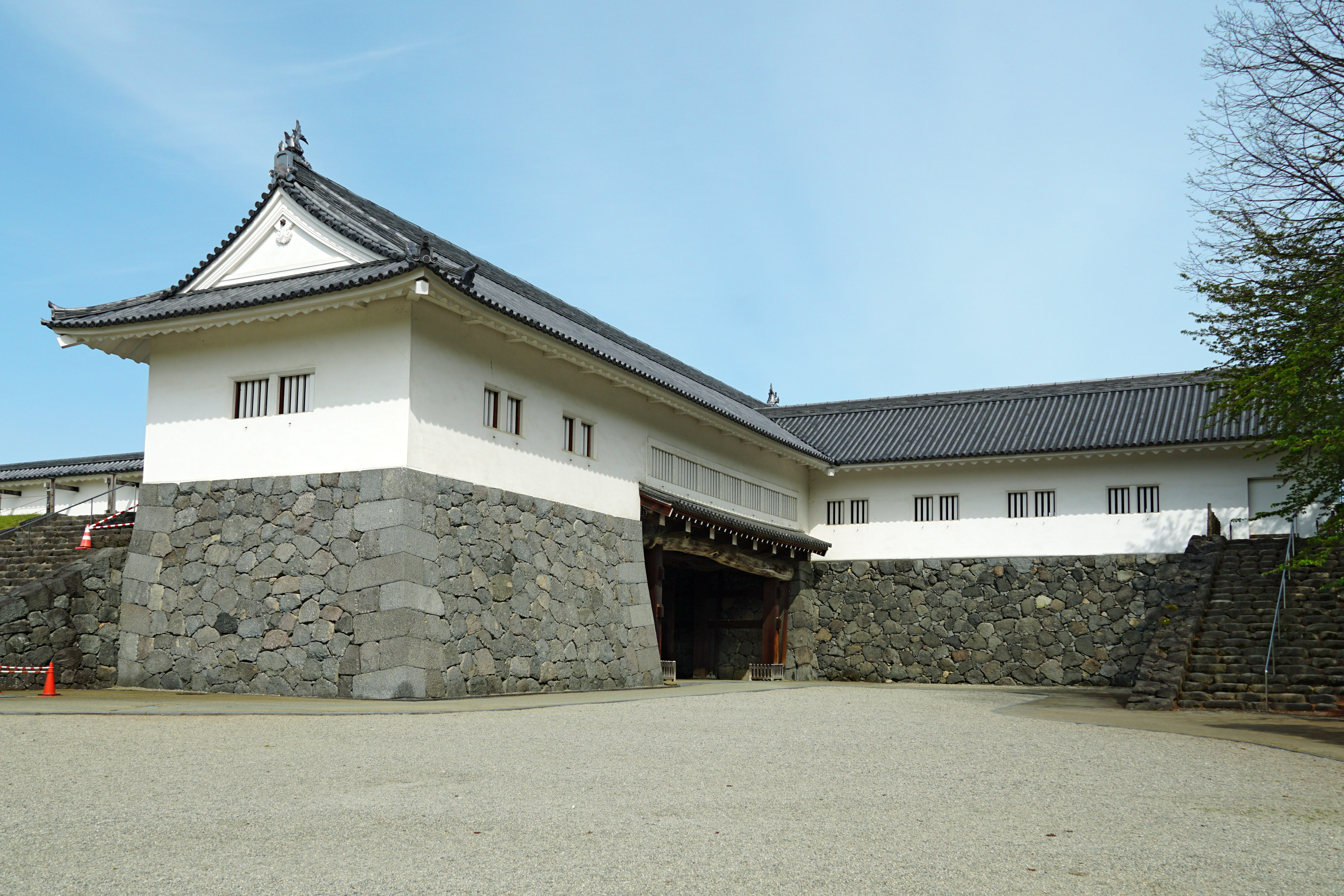
Yamagata Castle
Yamagata Castle was built to deceive. Its three concentric baileys stretched two kilometers across -- larger than Aoba Castle in Sendai, larger than Aizuwakamatsu Castle -- making it by far the biggest fortification in the entire Tohoku region. Yet it never had a tenshu, the soaring tower keep that defined most great Japanese castles. No stone walls, either. Just clay ramparts and wet moats guarding an enormous flatland compound that most passing travelers would have mistaken for a well-defended estate. That paradox -- a castle of immense scale dressed in humble materials -- mirrors the turbulent story of the Mogami clan that built it, a family that rose from obscurity to regional dominance and then vanished from power in a single generation.
The Mogami Gambit
The castle's origins reach back to the Muromachi period, when Shiba Kaneyori claimed lordship over Dewa Province and built a fortified residence on a site that would become the inner bailey. He changed his surname to Mogami, and the clan he founded held the surrounding territory for some 275 years. But by the Sengoku period, internal feuds and short-lived leaders had eroded their strength. The aggressive Date clan invaded, reducing the Mogami to vassals. Only when the Date themselves stumbled into political crisis did Mogami Yoshimori seize his chance, reclaiming independence and cementing an alliance by marrying his daughter to Date Terumune. Their grandson, Date Masamune -- one of the most famous warlords in Japanese history -- was the product of this strategic union. The Mogami had traded a daughter for survival.
Daughter Lost, Domain Won
It was Mogami Yoshiaki, Yoshimori's eldest son, who transformed Yamagata from a fortified residence into a true castle. In 1592 he added the second and third baileys, erected two- and three-story yagura watchtowers, and laid out the surrounding castle town that would become the city of Yamagata. But Yoshiaki's relationship with the ruling Toyotomi regime was poisoned by a personal tragedy: Toyotomi Hideyoshi executed Yoshiaki's daughter Komahime during a purge of Toyotomi Hidetsugu's household. When the Sekigahara campaign erupted in 1600, Yoshiaki needed no persuasion to side with Tokugawa Ieyasu. Despite being severely outnumbered by an invading Uesugi force under Naoe Kanetsugu, the Mogami held their ground. Their reward was enormous: 570,000 koku of territory and recovery of the Shonai region, prompting a further expansion of the castle.
A Fortress Too Big to Keep
The triumph lasted eight years. After Yoshiaki's death in 1614, his retainers fell into civil war, and the Tokugawa shogunate seized the pretext to strip the Mogami of their domain in 1622. The castle passed to Torii Tadamune, then cascaded through a parade of daimyo clans -- sometimes changing hands within a single generation -- each one poorer than the last. With revenues slashed, these lords could not maintain an enormous castle built for a 570,000-koku domain. By the mid-Edo period, the main bailey had crumbled to ruins. The second bailey served as the daimyo's modest residence. The western half of the third bailey was plowed into farmland. A fortress that once dwarfed every castle in northern Honshu was slowly consumed by rice paddies.
Cherry Blossoms on the Ramparts
The Meiji Restoration brought another metamorphosis. In 1872 the castle grounds became a base for the Imperial Japanese Army's 32nd Infantry Regiment. In 1906, some 1,500 cherry trees were planted along the old moats and ramparts to commemorate the Russo-Japanese War, and today Kajo Park -- as the grounds are now known -- is one of Yamagata Prefecture's premier hanami destinations, with blossoms peaking in mid-April. After World War II, the site was converted into a public park and home of the Yamagata Prefectural Museum. Restoration work has been steady: the East Gate was rebuilt in 1986, the Higashi Otemon Gate in 1991, the Inchimon Gate stonework in 2004, and a bridge to the main bailey in 2006. Yamagata City aims to restore the castle to its early Edo-period appearance by 2033. In 2006, it was recognized as one of Japan's 100 Fine Castles.
From the Air
Located at 38.25N, 140.33E in the center of Yamagata city, in the narrow Yamagata Basin of the Mogami River valley. The Ou Mountains rise to the east, and the Shonai Plains extend westward to the Sea of Japan. The castle's broad moat system and park layout are visible from moderate altitude. Nearest airport: Yamagata Airport (RJSC/GAJ), approximately 23 km north. Sendai Airport (RJSS/SDJ) lies approximately 74 km to the southeast across the Ou Mountains. Expect variable weather due to the basin's geography; winter brings heavy snowfall, while spring offers clear conditions ideal for viewing cherry blossoms along the moats.