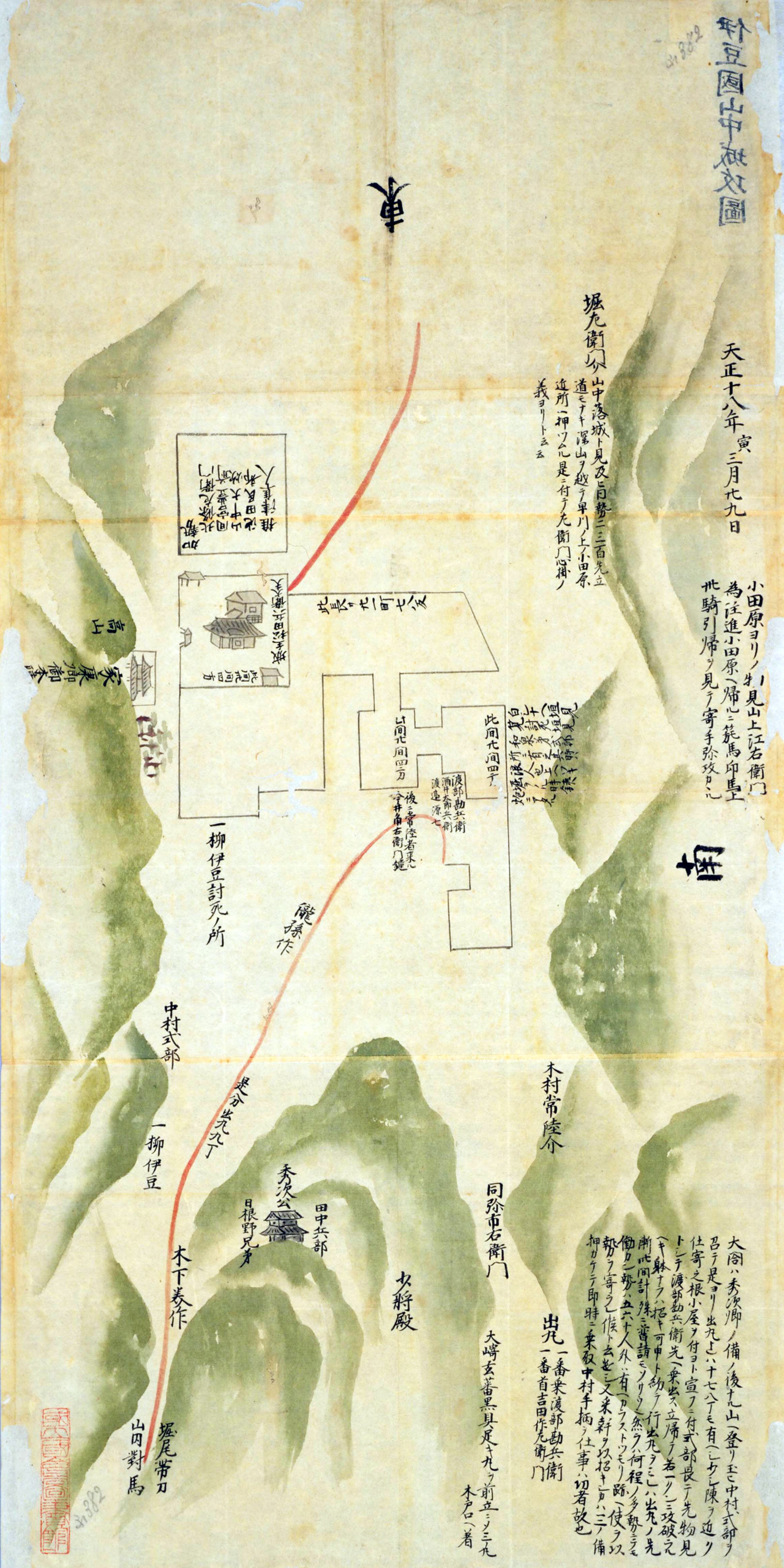
Yamanaka Castle: The Waffle Fortress of Hakone Pass
Four thousand men stood in a castle made of earth and watched fifty thousand coming up the mountain. It was March 1590, and the defenders of Yamanaka Castle knew exactly what those grid-shaped moats were for. Cut into the volcanic soil of Hakone Pass like the lattice of a shoji screen, the castle's extraordinary earthwork defenses divided the ground into a checkerboard of ridges and pits designed to trap, slow, and expose anyone foolish enough to climb down into them. The moats had no name yet -- centuries later, archaeologists would call them shoji-bori and une-bori, the grid moat and the corrugated moat -- but the soldiers of the Hojo clan who dug them understood the principle perfectly. Make the enemy fight the ground itself.
A Fortress Where Roads Meet Mountains
Yamanaka Castle sits on the western slope of Hakone Pass, precisely where the Tokaido highway -- Japan's most important road, linking Kyoto to the Kanto plain -- threads through the volcanic ridges of the Izu Peninsula. The Hojo clan, whose stronghold at Odawara Castle lay just a few kilometers east in Sagami Province, built Yamanaka during the Eiroku era, sometime between 1558 and 1577, to guard against threats from the west. The builder was Hojo Ujiyasu, and his design exploited the mountain terrain to create something unusual among Japanese castles: a long, narrow chain of enclosures strung along the ridgeline, each one connected to the next but separated by deep moats. Rather than a single dramatic keep, Yamanaka Castle was a gauntlet -- a sequence of defensive positions that an attacker would have to fight through one by one.
The Shoji Moats
What makes Yamanaka Castle extraordinary, and what earned it a place among the 100 Fine Castles of Japan in 2006, are its earthwork defenses. The Hojo clan developed castle construction techniques found nowhere else in Japan. The shoji-bori, or grid-shaped moat, divides the trench floor into a pattern of raised ridges that resemble the wooden lattice of a shoji sliding door. An attacker who dropped into the moat would find himself trapped in a small compartment, unable to advance sideways or forward, exposed to arrows and stones from above. The une-bori, or corrugated moat, uses parallel ridges like the furrows of a plowed field to achieve a similar effect. Wet moats and dry moats alternated along the castle's defenses, and every compartment was a killing ground. The Hojo poured all their engineering knowledge into this mountain fortress, and the result was a castle that fought its own battles.
Fifty Thousand Against Four Thousand
By the late 1580s, Toyotomi Hideyoshi was unifying Japan, and the Hojo were among the last holdouts. Despite the growing threat, only modest improvements were made to Yamanaka Castle's defenses in 1586. When Hideyoshi's armies marched on Odawara in 1590, he ordered Toyotomi Hidetsugu and Tokugawa Ieyasu to take Yamanaka Castle quickly -- it sat directly on his supply line between the front and Osaka. The two commanders attacked with 50,000 soldiers. The castle's commander, Hojo Ujikatsu, had just 4,000 men. The grid moats did their work, and the Toyotomi forces took heavy losses, including the death of the general Hitotsuyanagi Naosue. But numbers tell in the end. The castle fell in half a day of combat, and most of its defenders were killed.
What the Forest Remembers
Yamanaka Castle was never rebuilt. The Edo period brought peace under the Tokugawa shoguns, and mountain fortresses lost their purpose. The site reverted to forest, and for centuries the only visitors were trees pushing their roots through earthen ramparts. But unlike stone castles that crumble and scatter, Yamanaka's defenses were carved into the mountain itself, and the volcanic soil preserved them remarkably well. The shoji-bori moats are still clearly visible today -- the grid pattern as sharp as the day the Hojo engineers carved it. In 1988, the Japanese government designated the ruins a National Historic Site, recognizing both the castle's role in the drama of unification and the rarity of its surviving earthworks. Walking the castle grounds today, visitors trace the same ridgeline that the Tokaido travelers once hurried past, and they can look down into the moat compartments and understand, in a visceral way, what it meant to be trapped in the grid while arrows fell from above.
From the Air
Located at 35.156N, 138.992E on the western slope of Hakone Pass in eastern Mishima, Shizuoka Prefecture. The castle ruins occupy a forested ridgeline visible as a distinctive elongated clearing in the mountain terrain. Best viewed at 3,000-5,000 feet AGL. The Tokaido corridor through Hakone Pass is a clear visual reference. Mount Fuji is visible to the northwest in clear weather. Nearby airports include Shizuoka Airport (RJNS) approximately 60 nautical miles to the southwest. The terrain is mountainous with elevations around 1,500-2,000 feet at the castle site.