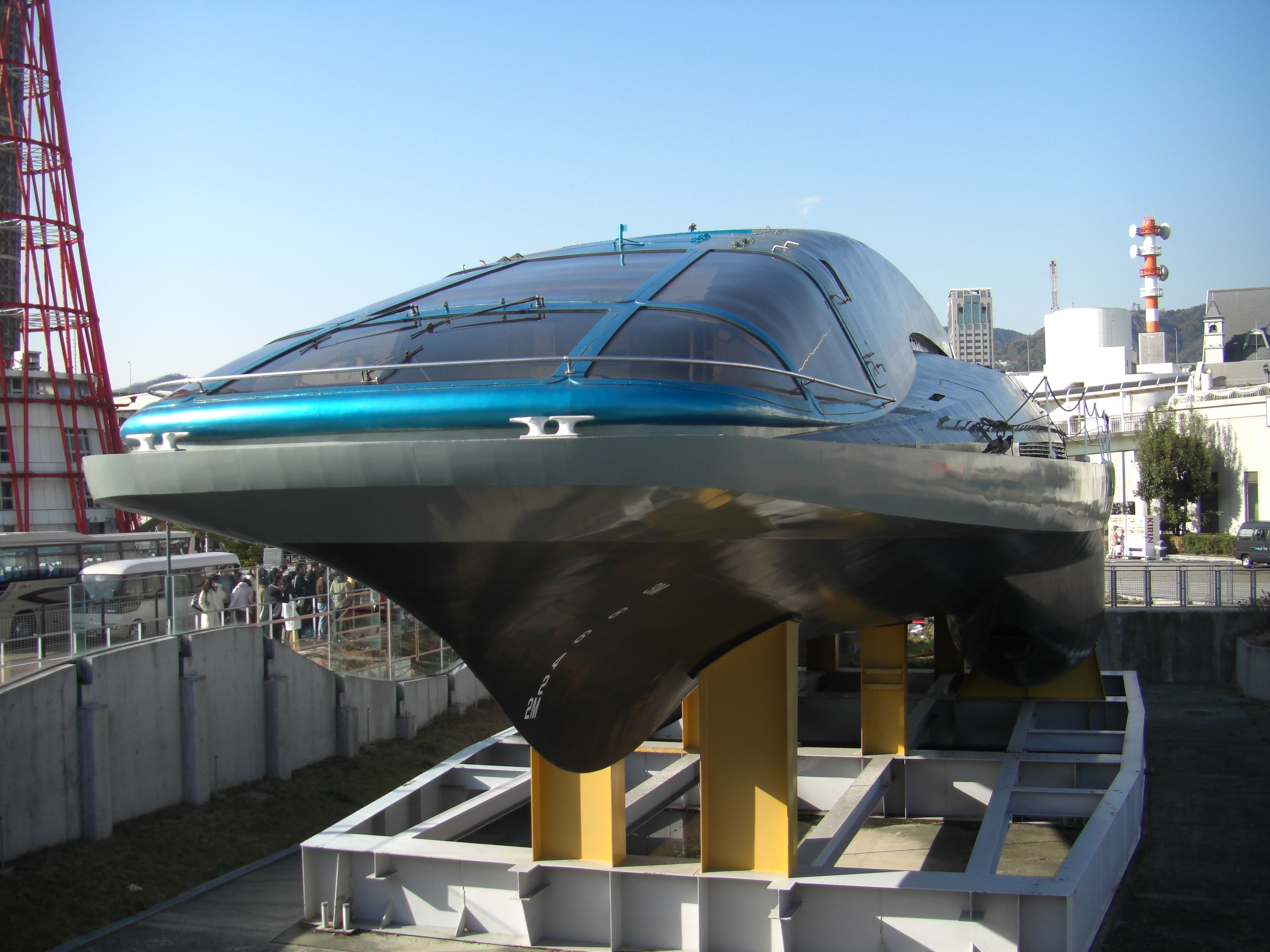
The Ship That Sailed on Magnets
Tom Clancy imagined it first. In his 1984 novel The Hunt for Red October, a Soviet submarine slips through the Atlantic using a silent 'caterpillar drive' that moves water through magnetism rather than spinning propellers. Six years later, Popular Mechanics ran a breathless cover story about '100 MPH Jet Ships' powered by magnetohydrodynamic technology. By 1992, the fiction had become fact -- sort of. In Kobe harbor, a 30-meter experimental vessel named Yamato-1 slid across the water at a modest 15 kilometers per hour, propelled not by any engine with moving parts, but by the Lorentz force acting on seawater itself. It was the first ship in history to carry human passengers using magnetohydrodynamic propulsion, and it proved that the technology worked. It also proved, unfortunately, that working and being practical were two very different things.
Seawater as a Jet Engine
The principle behind magnetohydrodynamic drive is elegantly simple: pass an electric current through a conducting fluid inside a strong magnetic field, and the resulting Lorentz force pushes the fluid in a predictable direction. In the case of the Yamato-1, the conducting fluid was the ocean itself. Seawater, rich with dissolved salt ions, served as both the working medium and the exhaust. Two MHD thruster pods mounted on the hull contained superconducting coils chilled to negative 269 degrees Celsius using liquid helium, generating magnetic fields of roughly four teslas -- strong enough to make those salt ions accelerate backward through the thruster channels, propelling the ship forward. No propeller shaft. No turbine blades. No moving parts whatsoever in the drive system. The Washington Post called it a 'silent drive,' and that silence was the technology's most tantalizing military implication.
Born in the Shipyards of Kobe
Yamato-1 was completed in 1991 by the Ship & Ocean Foundation, later renamed the Ocean Policy Research Foundation, and built by Mitsubishi Heavy Industries at their Wadasaki-cho shipyard in Hyogo-ku, Kobe. The vessel displaced 185 tons and stretched 30 meters in length. Diesel generators supplied up to 2,000 amperes of electrical current to the MHD thrusters. The first crewed sea trial took place in Kobe harbor in June 1992, and the ship performed exactly as designed -- which is to say, it moved. It moved slowly. The top speed of 15 kilometers per hour, roughly eight knots, was a fraction of what conventional vessels of similar size could achieve. System efficiency hovered around 15 percent. The superconducting magnets, while powerful, were extraordinarily heavy, and seawater turned out to be a mediocre electrical conductor. Mitsubishi built several additional MHD prototypes through the 1990s, but none overcame these fundamental constraints.
The Physics of Disappointment
The dream behind Yamato-1 was speed -- Popular Mechanics had predicted magnetohydrodynamic ships reaching 100 miles per hour. The reality fell catastrophically short, and the reasons were rooted in physics rather than engineering. Seawater conducts electricity, but poorly compared to metals or plasma. The energy required to generate sufficient Lorentz force through such a reluctant medium was enormous, and most of it dissipated as heat. The superconducting magnets needed constant cooling, adding weight and complexity. The overall power-to-thrust ratio made conventional propellers look like miracles of efficiency by comparison. Despite decades of research following the Yamato-1 trials, no nation has deployed a magnetohydrodynamic ship for commercial or military service. DARPA has continued exploring MHD concepts for silent naval propulsion, but the technology remains, as one researcher put it, 'an oddity.'
Museum Piece to Memory
After the sea trials ended, Yamato-1 was placed on display at the Kobe Maritime Museum in Meriken Park, just steps from where it had made history in the harbor. For nearly two decades, visitors could walk around the vessel that had briefly made science fiction real. Then, in 2016, the ship was demolished as part of a park renovation. No successor was built. The Kobe Maritime Museum itself remains open, but the Yamato-1 now exists only in photographs, engineering papers archived by NASA and the Ship & Ocean Foundation, and the memory of anyone who watched it glide -- quietly, slowly, impossibly -- across the harbor on the strength of magnets and seawater. The silent drive that Clancy dreamed up remains silent for a different reason now: nobody has figured out how to make it loud enough to matter.
From the Air
Yamato-1 was built and tested in Kobe harbor at approximately 34.682°N, 135.188°E, near the Kobe Maritime Museum in Meriken Park. The ship itself was demolished in 2016, but the museum and harbor remain. Kobe Airport (RJBE) is approximately 4 nautical miles southeast on its artificial island. Osaka Itami Airport (RJOO) lies about 15 nautical miles northeast, and Kansai International Airport (RJBB) is roughly 25 nautical miles southwest. From the air, Kobe's harbor is identifiable by the red Kobe Port Tower and the adjacent white sail-shaped roof of the Kobe Maritime Museum. The Mitsubishi Heavy Industries Wadasaki-cho shipyard where Yamato-1 was built sits to the west along the waterfront.