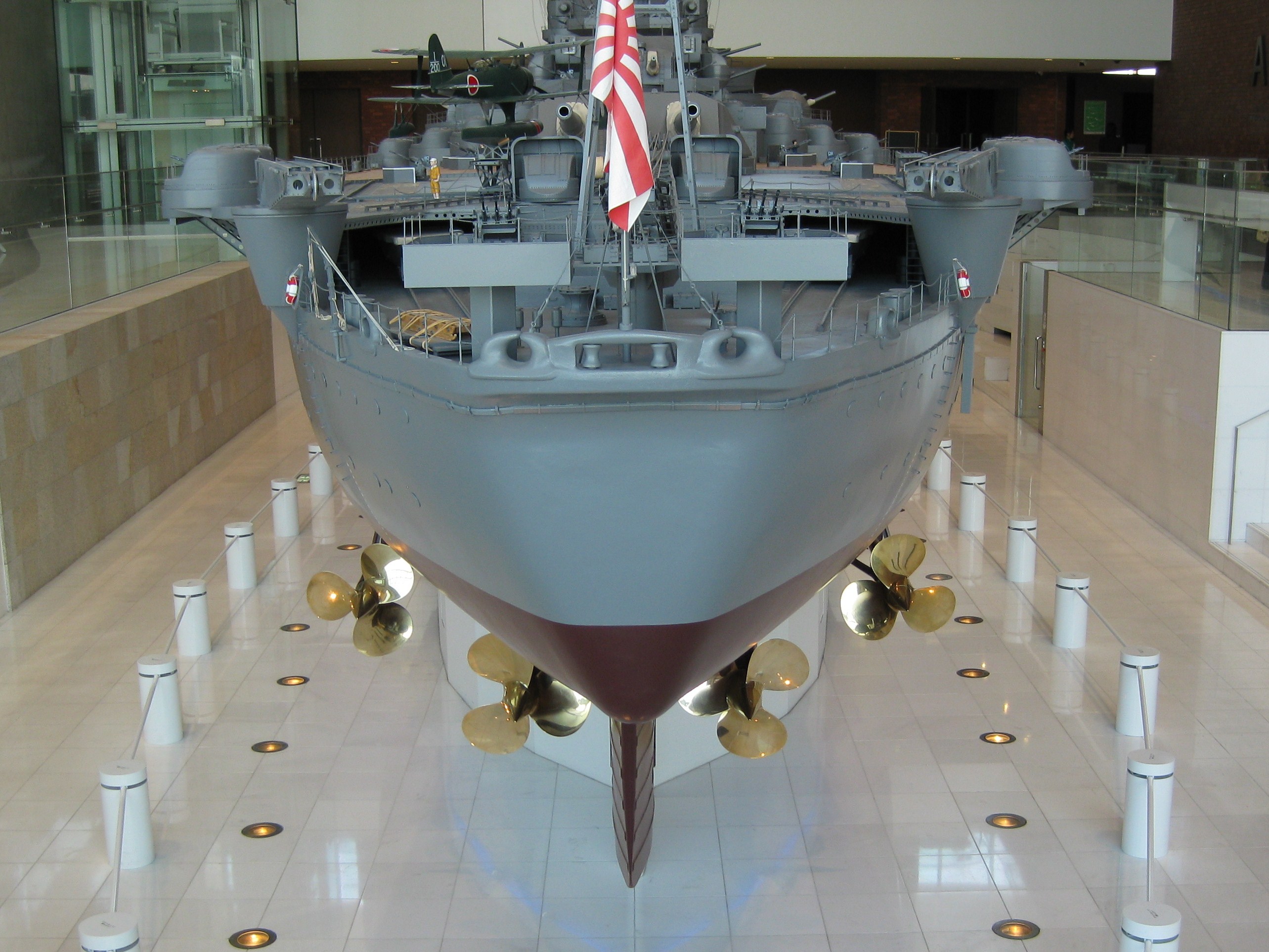
Yamato Museum
In the lobby of the Kure Maritime Museum sits a 26-meter-long model of the battleship Yamato, built at precisely one-tenth the scale of the original. The model occupies the same harbor where the real Yamato was constructed in secrecy during the late 1930s -- the largest and most heavily armed battleship ever built, sunk south of Kyushu in April 1945 during a one-way mission with barely enough fuel for the outbound voyage. The museum, which everyone calls the Yamato Museum, opened in 2005 in Kure, Hiroshima Prefecture, a city whose identity was shaped by the warship it built and the navy it served.
The Ship That Defined a City
Kure was Japan's premier naval shipbuilding port, home to the Kure Naval Arsenal and the Kure Naval District. The Yamato was completed here in December 1941, her construction so secret that the drydock was concealed behind massive curtains of rope and sisal. Her nine 46-centimeter guns were the largest naval weapons ever mounted on a warship, and the lathe that machined them -- the enormous No. 15299 -- still stands outside the museum today. Kure's identity as a naval city runs deep, and the museum traces that history from the age of imperial shipbuilding through to the present Japan Maritime Self-Defense Force. Next door, the JMSDF Kure Museum displays the retired submarine Akishio, a Yushio-class boat that visitors can walk through.
Weapons and Farewell Letters
Beyond the flagship model, the museum's large exhibition hall preserves artifacts that bring the war's human cost into sharp focus. A Mitsubishi A6M Zero fighter, a Kairyu-class midget submarine, and a Kaiten human torpedo sit alongside one another. The Kaiten was a modified torpedo steered by a single pilot on a suicide mission, and the museum displays the farewell letters these young men wrote to their families before their final sorties, along with personal photographs, swords, and wills. Outside, hardware from the battleship Mutsu -- a 41-centimeter naval gun, an anchor, a rudder, and a propeller -- stands at the museum entrance, each piece scaled to remind visitors of the enormity of these vessels. Behind the building, a full-scale outline of the Yamato's bridge gives a sense of the ship's commanding presence.
The Wreck Below
In May 2015, a digital survey of the sunken Yamato captured footage showing identifiable sections of the wreck for the first time: the chrysanthemum crest on the bow, a five-meter-diameter propeller, a detached main gun turret. The museum shows this nine-minute video in its theater. The ship lies in roughly 340 meters of water in the East China Sea, where she sank on April 7, 1945, during Operation Ten-Go. That same year, the museum forged a sister-museum partnership with the USS Missouri Memorial Association in Pearl Harbor -- the Missouri being the ship on whose deck Japan signed the instrument of surrender. The pairing of these two institutions, each preserving the flagship of its respective navy, creates a quiet symmetry that the anniversary of the war's end invites visitors to contemplate.
Living Memory
The Yamato has taken on a cultural life far beyond military history. The anime series Space Battleship Yamato reimagined the sunken warship as a spacecraft, and the franchise's parent company C2 Praparat is an official museum partner, funding restoration projects including the great lathe. The museum also houses models of the aircraft carrier Akagi, exhibits on Kure's shipbuilding technology, and a theater showing films about the Imperial Japanese Navy. From a fourth-floor observation terrace, visitors look out across the harbor where warships were once launched by the dozens, now a commercial port where the scale of what was built here lingers in the landscape.
From the Air
Located at 34.241N, 132.556E on the waterfront of Kure, a port city on the Seto Inland Sea in Hiroshima Prefecture. The museum is adjacent to Kure Port. Nearest airport is Hiroshima Airport (RJOA), about 40 km northwest. Kure's harbor and industrial waterfront are visible from altitude. The submarine displayed next to the museum is a distinctive visual landmark. Best viewed from the south at 2,000-3,000 feet.