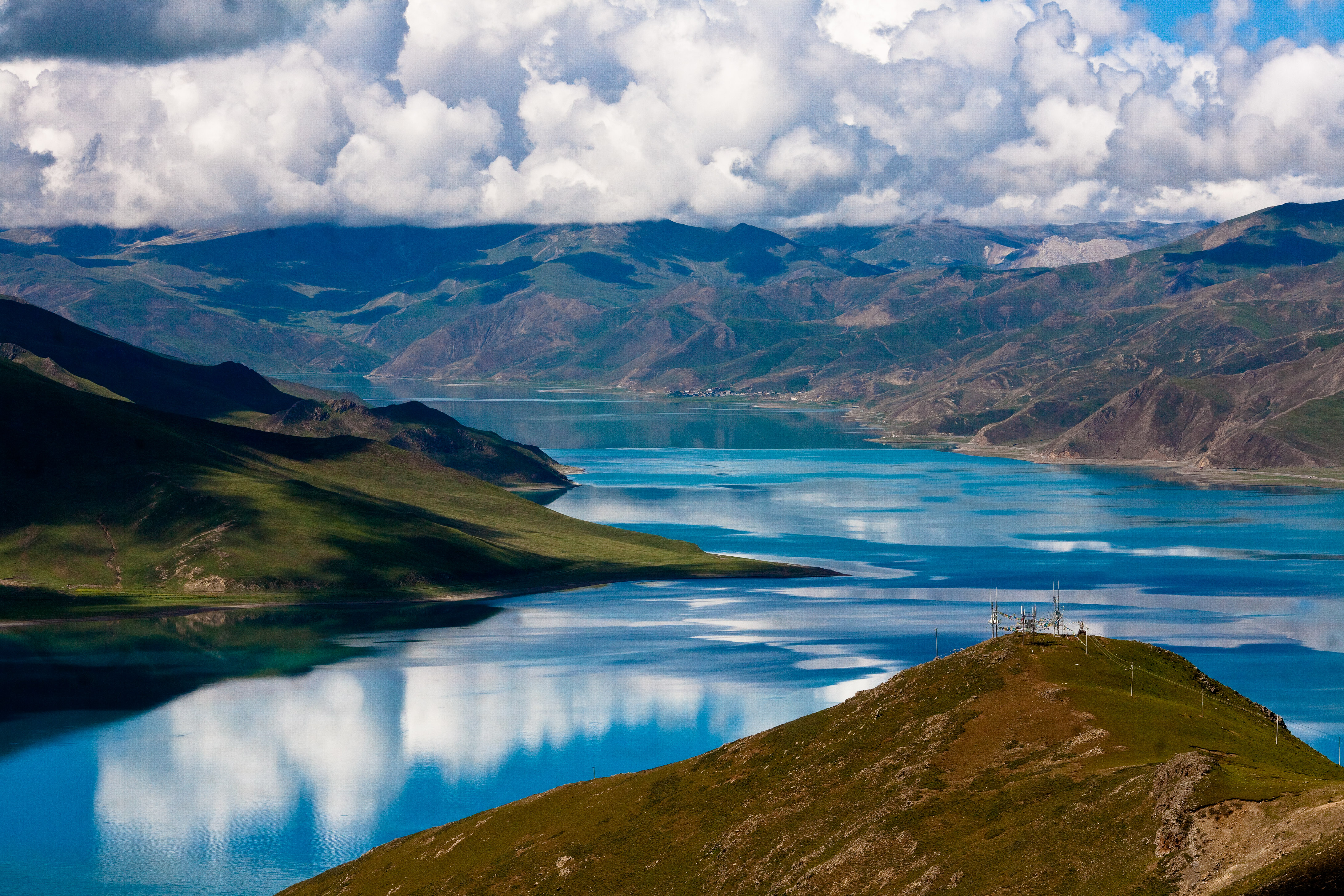
Yamdrok Hydropower Station
The Panchen Lama said no. In 1985, when engineers proposed boring tunnels into the sacred Yamdrok Lake to generate hydroelectric power for Lhasa, Tibet's second-highest religious authority publicly criticized the project. His intervention halted construction the following year. Then the Panchen Lama died in 1989, and the project was relaunched. The Yamdrok Hydropower Station, completed in 1998 at a cost of nearly 2 billion yuan, stands as one of Tibet's most contentious infrastructure projects -- a collision between energy development and spiritual geography that remains unresolved.
Tunnels Through Sacred Ground
The engineering concept was elegant enough: rather than dam the lake, bore four tunnels, each 6 kilometers long, through the mountainside to carry water down an 840-meter vertical drop to turbines below. The water would discharge into the Yarlung Tsangpo River, and during off-peak hours, pumps would reverse the flow, pushing river water back up into the lake. On paper, the lake would lose no water. Four reversible Francis turbines supplied by J.M. Voith AG of Germany would generate 90 megawatts, later expanded to 112.5 MW with a fifth conventional unit. The system would replace the Yangbajain Geothermal Field as Lhasa's primary power source. What the paper did not account for was the difference between the lake and the river: Yamdrok Tso's waters are mineral-rich and low in sediment, fed by rain and snowmelt from the surrounding mountains. The Yarlung Tsangpo carries heavy silt and nitrates. Pumping river water into the lake would change its chemistry. Not pumping would drain it.
The Ceremony That Wasn't
Construction began in 1991 when between 4,000 and 5,000 members of the People's Armed Police started work on the tunnels. By 1993, freshwater wells near the lake had begun drying up. The project spiraled into trouble. When Vice Premier Wu Bangguo arrived for a ceremony to switch on the first turbine in 1996, the plant was not ready. Electricity had to be brought in from the Yangpachen thermal power plant to create the appearance of operation. Investigations revealed that the tunnels were leaking badly -- the earth had collapsed in one -- and the lake level had already dropped. Fang Changquan, commander of the People's Armed Police construction brigade, was dismissed. Trial operations finally began in 1997, and in September 1998, President Jiang Zemin attended the official opening. But the fundamental problem remained: there was not enough power available on the grid to run the pumps. The station operated only for generation, steadily discharging lake water into the river with no replenishment.
A Lake That Cannot Be Repaid
Yamdrok Tso sits at 4,441 meters elevation with a surface area of 638 square kilometers, making it the largest freshwater lake in southern Tibet. For Tibetans, it is far more than a reservoir. Some call it the Scorpion Lake and believe it holds the spirit of Tibet itself. The lake is nearly a closed hydrological system -- rain and snowmelt flow in, evaporation carries water out, and a small tributary connects it to the Yarlung Tsangpo. This equilibrium produces the deep turquoise color created by dissolved minerals, a blue so intense it has become one of Tibet's most recognized landscapes. Indian hydroelectrical experts have pointed out the fundamental physics problem: pumping water uphill to the lake requires more energy than the water generates falling down, and transmission losses from Lhasa to the pumps compound the deficit. Replenishment, they argue, is uneconomical. The lake serves as a resting place for migratory birds, and its waters sustain fish populations that local communities depend on. Each year the turbines run without pumping, the water level drops a little further.
Power and Its Price
The Yamdrok station generates roughly 841 million kilowatt-hours annually, real electricity that powers real homes and businesses in Lhasa. Each of its turbines consumes two cubic meters of water per second. The investment cost nearly 2 billion yuan. These are facts that coexist uncomfortably with other facts: the Panchen Lama's objection was not merely spiritual but environmental, and his concern about draining the lake has proven prescient. The saline lake water discharged downstream may also affect river water quality below the tailrace outlet. Tibet's energy infrastructure has expanded since the station opened -- the Zhikong Hydro Power Station on the Lhasa River came online in 2007, offering an alternative power source. But the Yamdrok station continues to operate, drawing down a lake that many Tibetans consider holy. Whether the water can ever be returned remains an open question, balanced between the physics of pumped storage and the politics of energy development on the Tibetan Plateau.
From the Air
The Yamdrok Hydropower Station is located at 29.26N, 90.61E, about 16 km southwest of Quxu in Lhoka Prefecture, Tibet. The station itself is at the base of the mountain, with the intake tunnels running to Yamdrok Lake to the south. The turquoise lake is one of the most visually striking features in the region from the air. The nearest major airport is Lhasa Gonggar Airport (ICAO: ZULS), approximately 60 km to the northeast. Expect high-altitude conditions above 4,400 meters at the lake surface. The Yarlung Tsangpo River valley is visible as a major east-west corridor below.