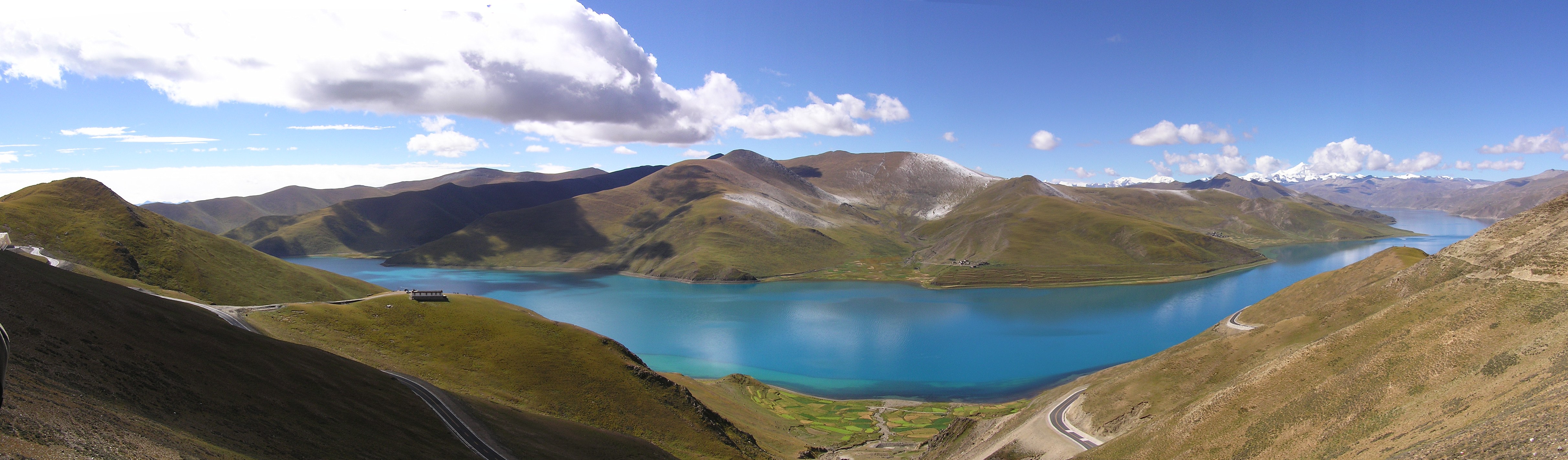
Yamdrok Lake
From the Kamba La pass, the lake appears suddenly below -- an improbable turquoise against brown hillsides, as though someone had poured dye into the mountains. Yamdrok Lake stretches more than 72 kilometers across the Tibetan plateau at 4,441 meters elevation, its fan-shaped body spreading south while narrowing to the north, its shoreline so crenulated with bays and inlets that it seems to grip the land like a hand. Tibetans say the lake is the transformation of a goddess. The color, that impossible turquoise, comes from dissolved minerals suspended in water fed only by rain and snowmelt -- a nearly closed system where what enters through streams departs through evaporation, concentrating minerals until the water glows.
The Wrathful Guardian
Yamdrok Lake is one of Tibet's four "Great Wrathful Lakes," sacred bodies of water believed to be the dwelling places of protective deities invested with special spiritual powers. Its guardian is the goddess Dorje Gegkyi Tso, and the lake is considered divinatory -- used by everyone from the Dalai Lama to local villagers to seek guidance through pilgrimage. The lake, its islands, and the surrounding landscape are closely associated with Padmasambhava, the eighth-century figure known as the Second Buddha, who is credited with bringing Buddhism to Tibet. On one of the lake's islands stands Pede Dzong, an old fort whose stone walls have watched over these waters for centuries. Today, pilgrims and tourists walk the lake's perimeter together, though their purposes differ. For the pilgrims, each step around the lake is an act of devotion, a circumambulation that brings them closer to the sacred geography their tradition maps onto this landscape.
Altitude and Extremes
At nearly four and a half kilometers above sea level, Yamdrok Lake exists in a climate of extremes. Winters are long, cold, and very dry; the lake freezes over entirely. Summers are short, cool, and wet. The difference between day and night temperatures is dramatic -- warm sunlight giving way to bitter cold once the sun drops behind the mountains. The climate hovers at the intersection of cold steppe, alpine tundra, and subarctic classifications, as if the atmosphere cannot quite decide what to make of this place. The lake averages 30 meters deep, reaching 60 meters at its lowest point. Snow-capped mountains ring the water on all sides, feeding it through countless small streams that cascade down from glaciers and snowfields. To the west lies the Tibetan town of Gyantse; to the northeast, Lhasa. Between them, the lake occupies a world that feels set apart from both.
Fish Markets and Pasture Islands
Yamdrok Lake is not only sacred -- it is economically vital. From April to October, fishermen work the lake's shoals, selling their catch at markets in Lhasa. The islands that dot the lake serve double duty as rich pasture land, where local herdsmen graze their animals on grasses fed by the mineral-rich waters and mountain runoff. This practical relationship with the lake coexists with its spiritual significance without apparent contradiction. The people who fish these waters and graze these islands are often the same people who make pilgrimages along the shoreline. Sacred and functional are not opposing categories here; they are simply different aspects of the same place.
A Lake Under Pressure
Near the small village of Baidi at the lake's western end, the Yamdrok Hydropower Station began generating electricity in the late 1990s -- the largest power station in Tibet. The project drew water from the lake through tunnels to turbines below, discharging it into the Yarlung Tsangpo River. The station was designed as a pumped-storage system that would return water to the lake during off-peak hours, but the pumping has proven impractical. The result is a slow, steady drawdown of a lake that has no major river feeding it, only rain and snowmelt. For a body of water that Tibetans believe holds the spirit of their homeland, the implications extend beyond hydrology. The turquoise that draws visitors from around the world -- that mineral-saturated color born of the lake's isolation as a nearly closed system -- depends on a balance of inflow and evaporation that human engineering has begun to tip.
From the Air
Yamdrok Lake is located at 28.98N, 90.75E at an elevation of 4,441 meters (14,570 feet) in southern Tibet. The lake is over 72 km long and immediately recognizable from the air by its intense turquoise color and highly irregular shoreline. The nearest major airport is Lhasa Gonggar Airport (ICAO: ZULS), approximately 90 km to the northeast. The Kamba La pass on the northern approach offers dramatic aerial views. Expect very high altitude conditions and potentially strong winds. The Yarlung Tsangpo River valley runs east-west to the north of the lake.