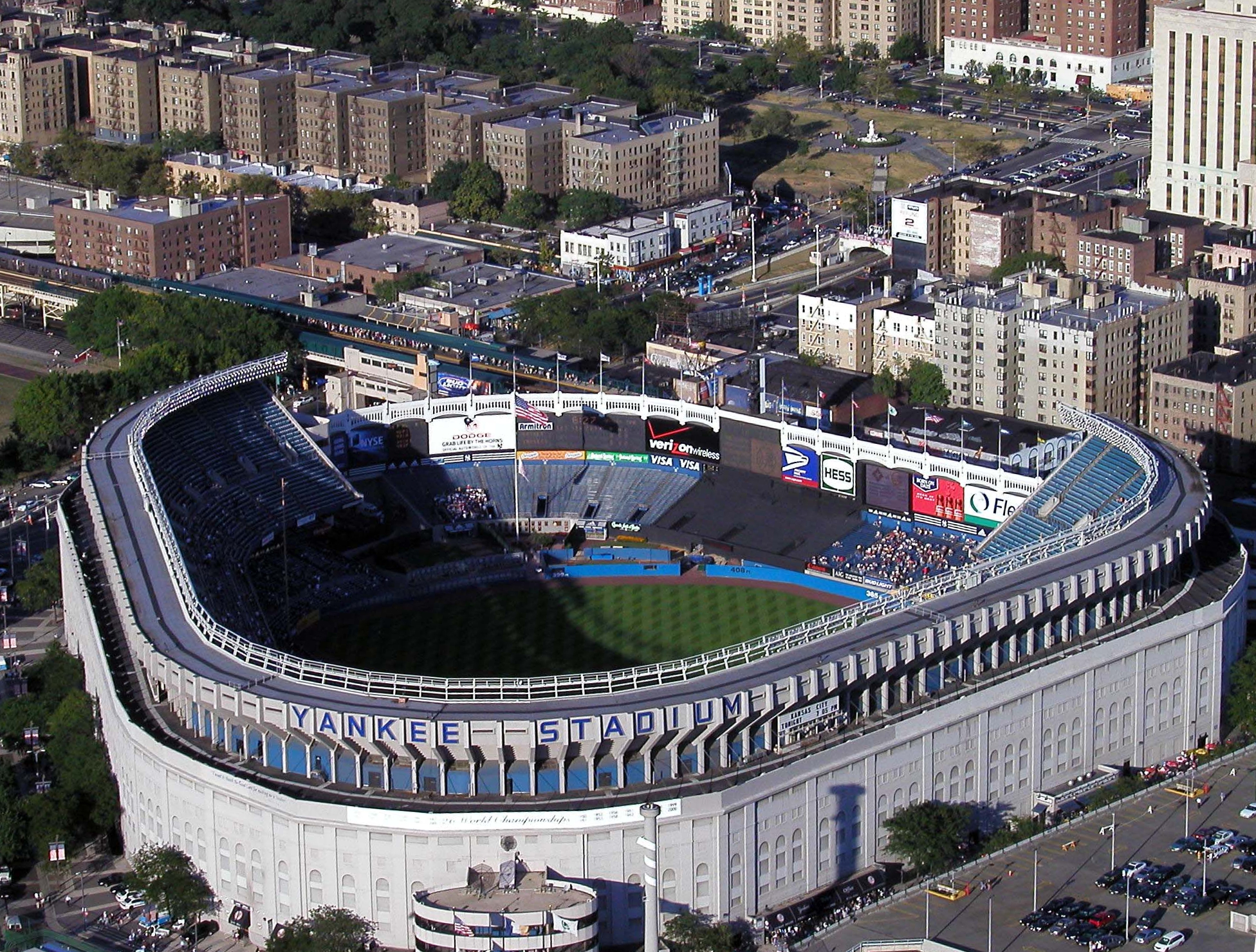
Yankee Stadium (1923)
John McGraw, manager of the New York Giants, had a suggestion for where the Yankees could build their new ballpark: "Queens or some other out-of-the-way place." The year was 1921, and McGraw was furious. His tenants at the Polo Grounds had just won the American League pennant and were outdrawing his Giants by hundreds of thousands of fans, powered by a slugger named Babe Ruth who had arrived from Boston the previous season. So Yankees owners Tillinghast L'Hommedieu Huston and Jacob Ruppert bought a ten-acre lumberyard in the Bronx for $600,000 from William Waldorf Astor. Construction began on May 5, 1922, and less than a year later, on April 18, 1923, Yankee Stadium opened -- not in Queens, but within sight of the Polo Grounds, just across the Harlem River.
Opening Day, 1923
The stadium smelled of fresh paint, fresh plaster, and fresh grass. At three in the afternoon, John Philip Sousa led the Seventh Regiment Band through "The Star-Spangled Banner." Governor Al Smith threw out the first pitch -- not the customary lob into the dirt, but a fastball directly into the glove of catcher Wally Schang. Babe Ruth, presented with a case containing a symbolically oversized bat, stepped to the plate in the first inning and hit a three-run home run into the right-field stands. The Yankees beat Ruth's former team, the Red Sox, 4-1. Asked for his opinion of the stadium afterward, Ruth said: "Some ball yard." Fred Lieb of the New York Evening Telegram gave it the name that stuck: "The House That Ruth Built." The announced attendance was 74,217, though business manager Ed Barrow later admitted the actual figure was closer to 60,000. Either way, it shattered baseball's attendance record.
Death Valley and the Short Porch
The stadium was the first three-tiered sports facility in North America and one of the first baseball venues to earn the title "stadium" -- a word deliberately borrowed from ancient Greece, where a stade was both a unit of measure and the building that housed footraces. Its design reflected Ruth's left-handed power: the right-field fence sat just 295 feet from home plate, a gift to pull-hitters that became known as the "short porch" and the bleachers there as "Ruthville." In the opposite direction, the deepest part of center field stretched to 490 feet, earning the nickname "Death Valley." The stadium was also the first to feature an electronic scoreboard showing lineups and scores from other games, and its outfield running track served double duty as baseball's first warning track -- a feature now standard at every professional field.
Renovation and Reinvention
By the early 1970s, concrete chunks were falling from the stands. Mayor John Lindsay offered $25 million in public funds to renovate the aging venue, and the stadium closed after the 1973 season. The Yankees played at Shea Stadium for two years while the work was done. When the renovated stadium reopened on April 15, 1976, the cost had ballooned to $160 million -- borne by a city teetering on the edge of bankruptcy. The iconic 15-foot metal frieze circling the upper deck was gone, replaced by a concrete replica along the bleacher wall. The 118 support columns that had obstructed views for half a century were removed. Monument Park, previously an in-play area of center field containing the monuments of Lou Gehrig, Miller Huggins, and Babe Ruth, was enclosed behind the new outfield fence. Death Valley shrank by more than 40 feet, and the right-field porch was pushed out. Some sources consider the pre- and post-renovation structures to be two different stadiums entirely.
Rituals and Ghosts
The stadium accumulated rituals the way old churches accumulate traditions. Bob Sheppard announced games from 1951 through 2007, his voice so distinctive that Reggie Jackson called him "the Voice of God." After every home win beginning in 1980, Frank Sinatra's "Theme from New York, New York" played over the loudspeakers; after losses, Liza Minnelli's version played instead. The Bleacher Creatures in Section 39 conducted their roll call at the start of each game, chanting every defensive player's name until he acknowledged them with a wave. When closer Mariano Rivera entered a game, Metallica's "Enter Sandman" announced him. Outside the main gate, a 138-foot exhaust pipe shaped like a Louisville Slugger baseball bat -- modeled on a Babe Ruth bat -- served as the stadium's most recognizable exterior landmark and the default meeting spot for fans.
The Last Game and What Remains
The final game at the original Yankee Stadium was played on September 21, 2008. Demolition began in March 2009, and by May 2010, nothing remained. The site was converted into Heritage Field, a ten-acre public park that opened in April 2012. A blue outline showing the location of the original diamond was woven into the grass, its second base positioned at the approximate spot where home plate once stood. The new Yankee Stadium, built at a cost of $2.3 billion in adjacent parkland, opened in 2009 with a replica of the old frieze along its roof. Monument Park was relocated. The Louisville Slugger bat still stands outside, now beside a Metro-North station. For 85 years and 6,581 regular-season games, the original stadium was more than a ballpark. It was the stage where Ruth, Gehrig, DiMaggio, Mantle, and Jeter played their roles in a story that the Bronx told and retold, game after game, decade after decade.
From the Air
The original Yankee Stadium site is at 40.827°N, 73.928°W in the South Bronx, now occupied by Heritage Field -- a public park with baseball diamonds. The new Yankee Stadium (opened 2009) sits directly to the north and is the dominant structure in the area, visible from considerable altitude. The Harlem River is immediately to the southwest, with the Polo Grounds Towers (on the former Polo Grounds site) visible across the river in Manhattan. Nearest airport: LaGuardia (KLGA), approximately 5 nm east. Best viewed at 2,000-3,500 ft AGL. The Major Deegan Expressway (I-87) runs along the east side of the stadium complex.