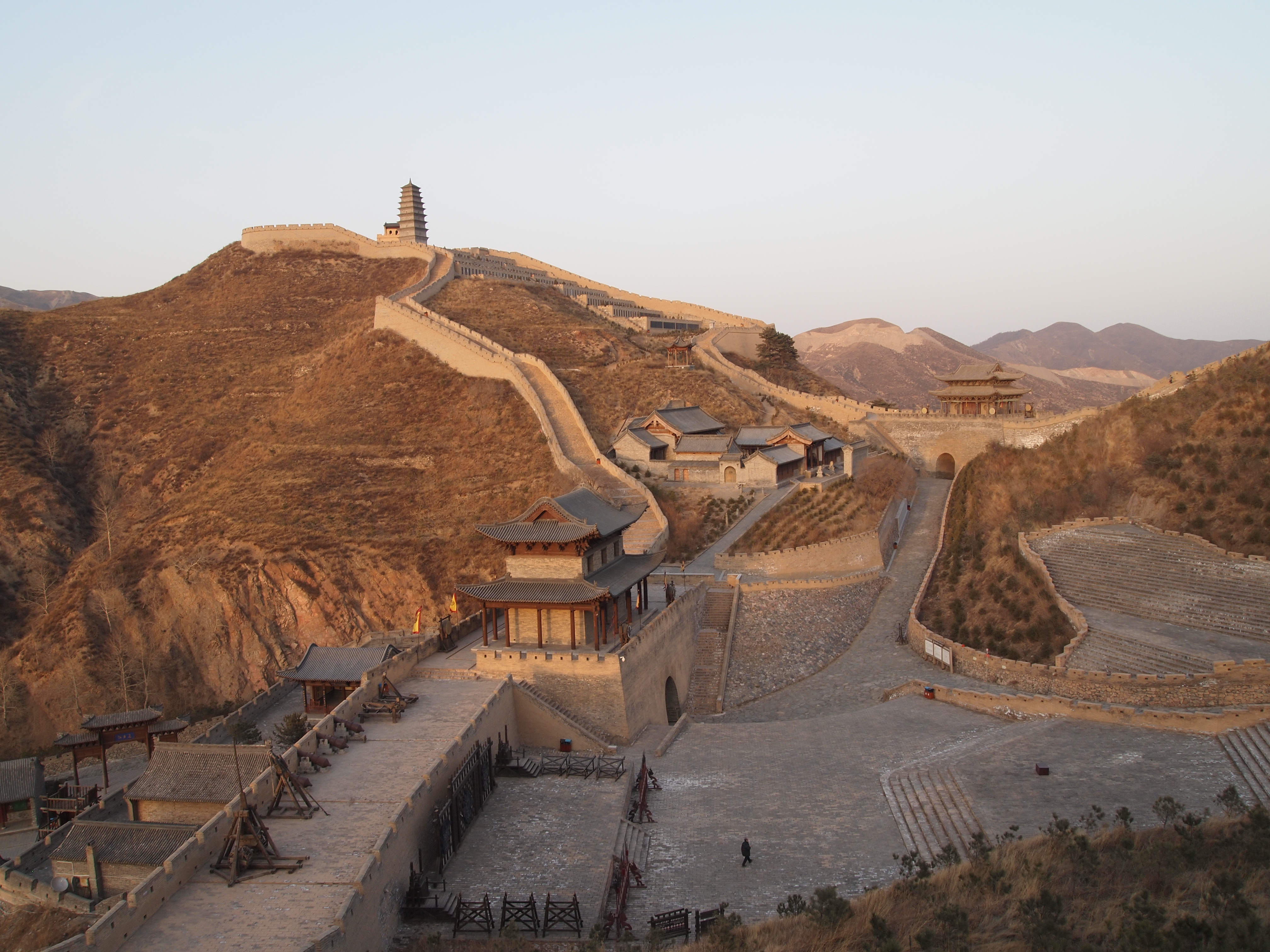
Yanmen Pass
Its name means Wild Goose Gate, after the migrating birds that thread through the narrow gap in the mountains each autumn. But the passage that geese navigate effortlessly was, for humans, one of the most contested corridors in Chinese history. Yanmen Pass, a fortified mountain choke point along the Great Wall in Dai County, Shanxi Province, controlled access between the agricultural valleys of central China and the vast grasslands of the Eurasian Steppe. Armies fought here under the Han dynasty, the Tang, the Song, the Ming -- and during World War II, when Chinese guerrillas ambushed Japanese supply columns in the same narrow defile that had funneled cavalry charges two thousand years before.
The Gate Between Worlds
Yanmen Pass sits at the boundary between two fundamentally different ways of life. To the south, the valleys of central Shanxi supported settled agriculture, cities, and the administrative apparatus of the Chinese state. To the north, the steppe extended into Mongolia, home to nomadic peoples whose mounted warriors could strike deep into Chinese territory and withdraw before any infantry response could organize. The pass was the lock on the door between these worlds, and whoever held it controlled the flow of trade, migration, and military force. It was formerly reckoned as the first of the Nine Passes under Heaven, a ranking that recognized its strategic importance above all other fortified positions in the empire.
Frontier Markets and Frontier Violence
Yanmen was not only a military position. During the early Han dynasty, a Chu nobleman named Ban Yi fled north to the Loufan people near the pass, where his clan grew wealthy trading cattle and horses. Their success encouraged broader Chinese settlement of the frontier. But commerce coexisted uneasily with conflict. In the fall of 129 BC, 40,000 Han cavalrymen massacred Xiongnu traders at markets along the frontier, an act of calculated brutality that provoked fierce retaliation. Generals Li Guang and Gongsun Ao suffered heavy defeats near Yanmen and barely escaped execution, surviving only by paying enormous fines and accepting demotion to commoner status. The frontier around the pass was a zone where trade and violence alternated with bewildering speed.
Walls Built, Walls Abandoned, Walls Rebuilt
The fortifications visible at Yanmen today date primarily to the Ming dynasty, which reconstructed the pass as part of the Inner Great Wall in 1374. The preserved walls stretch about one kilometer and stand roughly six meters high, incorporating three fortified gatehouses: the western Dili Gate (Chosen Battleground), the central Yanmen Gate, and the eastern Tianxian Gate (Impregnable Fortress). Under the Mongolian Yuan dynasty, when the great khan controlled both sides of the wall, the fortifications fell into disrepair -- there was no enemy to keep out. The Ming rebuilt them and maintained them as part of a sophisticated defense network that included the Ningwu and Piantou passes. Today, it is one of the few stone sections of the Great Wall remaining in Shanxi, and the entire complex holds China's highest AAAAA tourist rating.
Ambush at the Ancient Gate
On October 18, 1937, during the Second Sino-Japanese War, the ancient pass hosted a modern battle. He Bingyan led the 716th Regiment of the Eighth Route Army in an ambush of Japanese forces at Yanmen Pass, part of the larger battles of Xinkou. The regiment claimed to have killed or wounded more than 300 Japanese troops and destroyed over 20 vehicles, at a cost of 112 casualties. Two days later, a skirmish during the night was followed by an assault on a second supply column the next day. The guerrilla campaign aimed to cut Japanese lines of supply and communication as they advanced toward the provincial capital Taiyuan. That a twentieth-century army fought at the same chokepoint that Han dynasty cavalry had contested two millennia earlier is not coincidence. Geography imposes its own logic, and Yanmen Pass remains what it has always been: the narrowest point between two worlds.
From the Air
Located at 39.19N, 112.87E in Dai County, Shanxi Province, along the Inner Great Wall. The pass sits in mountainous terrain between the Shanxi valleys and the northern steppe. Nearest airports are Xinzhou Wutaishan Airport (ZBXZ) to the southeast and Datong Yungang Airport (ZBDT) to the north. The Great Wall fortifications are visible along the ridgeline. Approach with care in mountainous terrain; best viewed at 4,000-6,000 feet AGL.