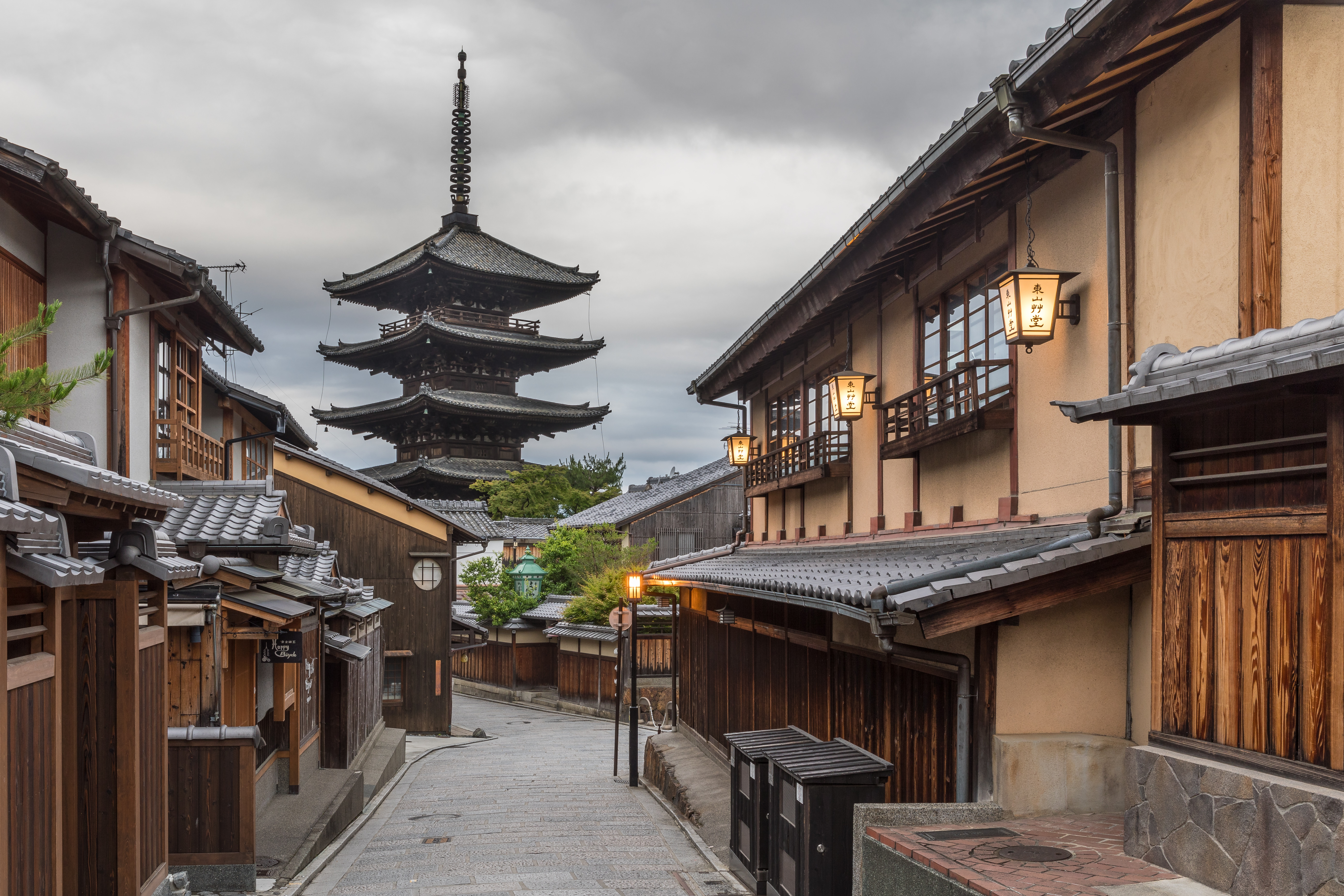
Yasaka Pagoda
Walk south down the stone-paved slope of Sannenzaka in Kyoto's Higashiyama district, and the view arranges itself into the photograph that has come to define this city: traditional wooden machiya lining a narrow lane, their dark timber frames converging on a single focal point where a five-story pagoda rises above the tile rooftops. The Yasaka Pagoda stands 46 meters tall, the last surviving structure of the Hokan-ji temple complex. Everything else -- the main hall, the gates, the monks' quarters -- has been claimed by fire or time. But the pagoda endures, built around a massive central wooden pillar that runs the full height of the structure, a spine of timber holding five tiers of gracefully curving eaves steady against whatever the centuries throw at it.
A Foundation Older Than the City Itself
Kyoto became Japan's imperial capital in 794, but the Yasaka Pagoda was already old by then. Archaeological excavations by the Kyoto City Archaeological Research Institute have dated the temple's foundation to the seventh century, though the exact year remains disputed. One tradition credits Prince Shotoku, the semi-legendary regent who championed Buddhism across Japan. Another pins it to 678 CE, during the reign of Emperor Tenmu. What the sources agree on is the founder's origin: the temple was established by a clan descended from the Korean kingdom of Goguryeo, immigrants who brought their Buddhist faith across the sea and planted it here on the eastern hills of what would become Japan's most refined city. The pagoda they built was among the earliest Buddhist structures in the Kyoto basin, predating the city's founding by more than a century.
Caught Between Gods
For centuries, the Yasaka Pagoda sat at the center of a tug-of-war between two of Kyoto's most powerful religious institutions. To the north stood the Gion Shrine, the great Shinto complex now known as Yasaka Shrine. To the southeast loomed Kiyomizu-dera, the celebrated Buddhist temple perched on its wooden platform above the treeline. Both claimed authority over the pagoda, and the dispute grew violent. In May 1179, the conflict reached its destructive peak when the pagoda was deliberately burned to the ground. It rose again in 1191, rebuilt with funding from Minamoto no Yoritomo, the founder of Japan's first shogunate and one of the most powerful military figures of his era. The pagoda burned again in 1291, and again in 1436. The Onin War brought devastation to the surrounding temple buildings a generation later, though the pagoda itself endured. In 1240, the head priest of the nearby Zen temple Kennin-ji had formally affiliated the pagoda with Zen Buddhism, a designation that holds to this day.
The Structure That Survived
The pagoda standing today dates to 1440, rebuilt under the patronage of Ashikaga Yoshinori, the sixth Ashikaga shogun. Nearly six centuries later, not a single nail holds the structure together in the traditional sense; the interlocking wooden joinery absorbs seismic energy that would shatter rigid construction. Inside, visitors who pay the 400-yen entrance fee can climb to the second floor, where four statues of the Gochi Nyorai -- the Five Wisdom Buddhas -- sit arranged around the central pillar on an elevated platform called the Shumidan Dais. The engineering of that central column is the pagoda's quiet genius: it acts as a pendulum during earthquakes, swaying independently of the surrounding floors and counterbalancing the building's motion. This principle, refined over centuries of Japanese pagoda construction, proved so effective that modern engineers studied it when designing Tokyo Skytree.
An Icon in Frame
The Yasaka Pagoda has become the most recognizable architectural silhouette in Kyoto, a city that does not lack for iconic structures. The view from Sannenzaka and Ninenzaka, the preserved historic lanes that slope upward through the Higashiyama district toward Kiyomizu-dera, frames the pagoda against a backdrop of forested hills in a composition so perfect it seems staged. The pagoda was designated an Important Cultural Property of Japan, and the surrounding Higashiyama district is one of the most carefully preserved historic neighborhoods in the country. Yet the pagoda remains more than a postcard. It is a working Buddhist site, its interior open to the public, its five stories a physical record of the engineering, artistry, and spiritual conviction that have defined this hillside for fourteen centuries.
From the Air
Located at 34.999N, 135.779E in Kyoto's Higashiyama district. The five-story pagoda is visible from altitude as a distinctive tower rising above the low-rise traditional neighborhood on the eastern hillside of Kyoto. Look for it between the larger complexes of Kiyomizu-dera to the southeast and Yasaka Shrine to the north, along the slope descending toward Gion. Nearest airports: Osaka Itami (RJOO) approximately 25nm southwest, Kansai International (RJBB) approximately 45nm south. Kyoto sits in a basin surrounded by mountains on three sides, which can create turbulence and restricted visibility in certain conditions.